Category: Articles

  • THE SMILING GENERAL

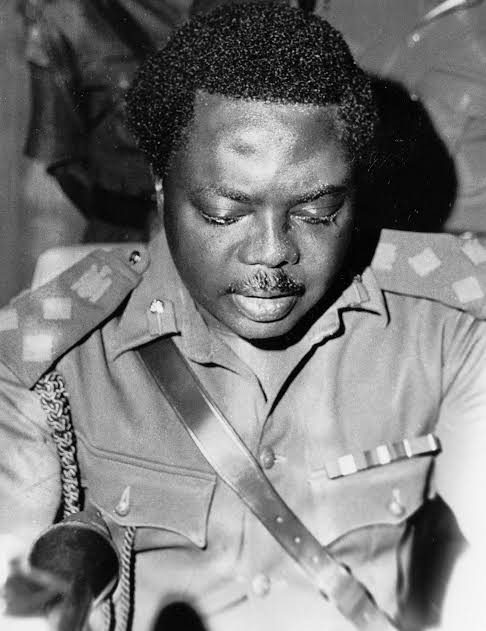
    If you grew up in Nigerian, the name Babangida (or IBB for short) doesn’t just sound like a person. It sounds like an era, a mood, a long political sentence with commas in strange places. While some call him IBB, some call him Maradona and some call him the Evil Genius. And the more you read about him, the more you realise that Babangida is not a simple story. He is layers, he is charm and calculation. He is history with a permanent half-smile.

    Let me tell it the way I understand it.

    He was born on August 17, 1941, in Minna, in present-day Niger State. [1] Northern Nigeria, dusty roads, conservative, muslim upbringing, structured environment. While his father, Muhammad Babangida, worked in the Native Authority system,[2] his mother, Aisha, grounded the home. Discipline was not optional, it was the major currency in his home.
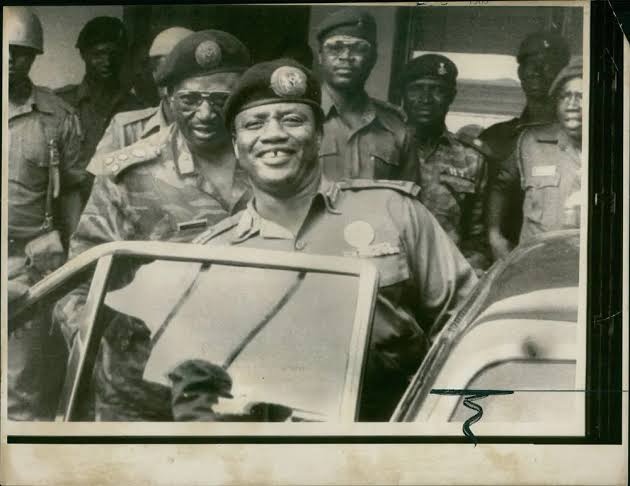
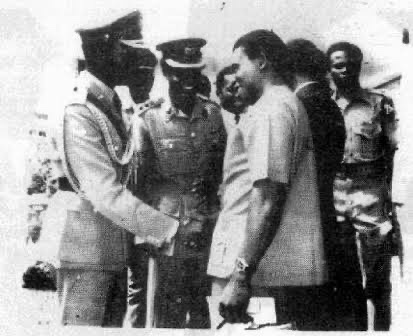
    (A picture of General Ibrahim Badamasi Babangida in Lagos on 1st September, 1985 leaving a session of the newly established Armed Forces Ruling Council (AFRC) days after he led a military coup that removed General Muhammadu Buhari from power)
    Source: Gettyimages

    Growing up in the late colonial era Nigeria meant you were born into transition. The British were still around, but independence was humming in the distance. Babangida’s early education took place in Bida and later in Kaduna.[3] Even as a boy, accounts suggest he wasn’t loud or flamboyant. He was observant.

    The quiet ones are always observing.

    Always calculating. At 21, in 1962, he joined the Nigerian Military Training College (NMTC) in Kaduna.[4] That decision changed not just his life, but Nigeria’s trajectory. The military, at that time, was one of the few national institutions cutting across ethnic and regional lines. It was disciplined, modern, and upwardly mobile. For ambitious young men, it was a launchpad.

    And Babangida? He thrived.
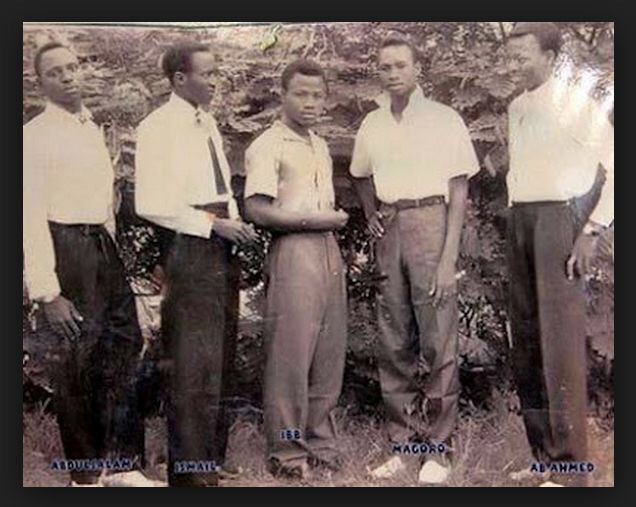
    Babangida (centre) and fellow Cadet officers at the NMTC (Later NDA) C. 1963
    Source: Nairaland

    Then came the coups in 1966 when Nigeria cracked open. The coup of January had been hijacked by Major General Johnson Aguiyi-Ironsi, the GOC of the Army who the coup plotters had failed to neutralise.[5] In July the same year, he was overthrown in a bloody revenge coup in which Lt. Babangida played a major role as a junior officer.

    The counter coup, also known as operation ‘Araba’, was a clear manifestation of suspicion that had engulfed the Army. The Nigerian military was no longer just an institution but a battlefield of ideology and ethnicity.

    When the Nigerian Civil War erupted in 1967, Babangida fought on the federal side. He was wounded in action.[6] Being shot in war at a young age changes you. It humbles you, it hardens you but it also convinces you that power is about survival and tact. It was during his recovery that he married Maria Okogwu who would later be known as Mariam.
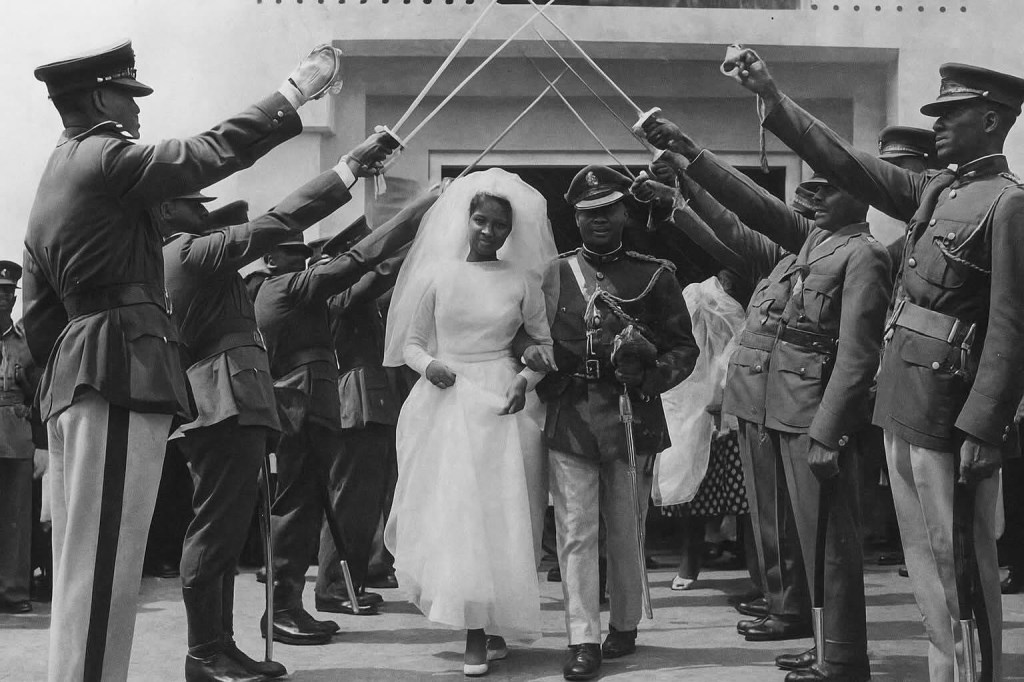
    This photograph captures Major Ibrahim Badamasi Babangida, then a Nigerian Army officer, alongside his bride, Maryam Babangida (née Maria Okogwu), on their wedding day, held on 6 September 1969 in Kaduna, while he was recovering from a battlefield injury.
    Source: Adeyinka Makinde

    During the war and after, he built alliances and strong friendships, most notably with officers like Sani Abacha.[7]

    In Nigerian military politics, loyalty is everything. Babangida understood that power in uniform went beyond rank. To be successful, one needed to have strong networks.

    As an officer, he had access to various elite training abroad most notably in India and The United Kingdom.[8] These advanced military education sharpened him and exposed him to global systems which influenced his orientation towards soldiering. In essence, he wasn’t just a local soldier, he was globally aware.

    By the 1970s and early 1980s, Babangida was climbing steadily through the ranks. Nigeria had entered its cycle of coups and counter-coups, military governments replaced civilian ones, corruption allegations were common. Economic mismanagement had followed the oil boom.

    In 1983, Muhammadu Buhari seized power in a coup that overthrew President Shehu Shagari.[9] Babangida supported Buhari initially. He became Chief of Army Staff.[10] But here’s the twist, Babangida believed Buhari’s regime was too rigid, too harsh, and too inflexible.

    And Babangida was not rigid, he was fluid and believed in realpolitik. It didn’t help matters that Buhari appointed Gen Tunde Idiagbon (Babangida’s junior) as Chief of Staff, Supreme HQ.

    In August 1985, Babangida led a bloodless coup against Buhari. He announced the takeover with smooth confidence. Nigeria had a new leader, just like that.[11]

    Babangida is famous for his smile that disarmed people. While other generals looked stern and intimidating, he looked approachable and charming. He would lean in slightly while speaking, listen carefully, then make a decision that nobody predicted. That’s why they called him the Maradona. The Argentine footballer Diego Maradona was known for dribbling past opponents effortlessly.[12] Babangida dribbled politically. One moment he promised a transition to civilian rule, next moment, timelines shifted. Policies reversed, aliances recalibrated. He was strategic ambiguity in human form.

    When he took power in 1985, Nigeria’s economy was struggling. Oil prices had dropped, debt was rising and inflation was biting. Babangida introduced the Structural Adjustment Programme (SAP) in 1986 under guidance from the International Monetary Fund and World Bank.[13] SAP meant currency devaluation, removal of subsidies, trade liberalisation and privatisation.

    In theory? Reform.

    In reality? Pain.

    The naira fell and prices rose. Many Nigerians struggled, critics argue that SAP widened inequality. Supporters say he inherited a broken system and had to take tough decisions. Here’s what fascinates me, Babangida didn’t see himself as reckless. He saw himself as modernising. He believed Nigeria needed economic restructuring to survive in a global system.

    Whether that belief was idealistic or convenient is still debated.

    Babangida promised to return Nigeria to civilian rule. But instead of allowing organic party formation, he created two political parties himself. The Social Democratic Party (SDP) and the National Republican Convention (NRC).[14] He once described them as “a little to the left” and “a little to the right.”

    Imagine a military ruler designing democracy like a software update.

    He banned politicians, unbanned them, postponed elections and shifted transition dates. It was like watching someone play chess alone and still managing to surprise himself.

    But then came June 12, 1993. The presidential election was widely regarded as Nigeria’s freest and fairest. Businessman Moshood Abiola[15] appeared to win. And then Babangida annulled it.[16] That single decision became the defining moment of his legacy.

    Why did he annul it? Some argue military pressure, some say fear of instability, ohers say he wanted to maintain control. He claimed there were irregularities and threats to national security. But Nigerians were furious, protests erupted and international pressure mounted. His political genius suddenly looked like political miscalculation.

    By August 27 1993, Babangida “stepped aside” and handed over to an interim national government.[17] That phrase became iconic. Not resigned, not overthrown, stepped aside. It was classic IBB language.

    Behind the politics was his marriage to Maryam Babangida. She was elegant, educated and charismatic. She redefined the role of First Lady in Nigeria. Her “Better Life for Rural Women” programme elevated women’s issues nationally.[18] They were seen as a power couple, almost glamorous compared to previous military regimes. They had four children.
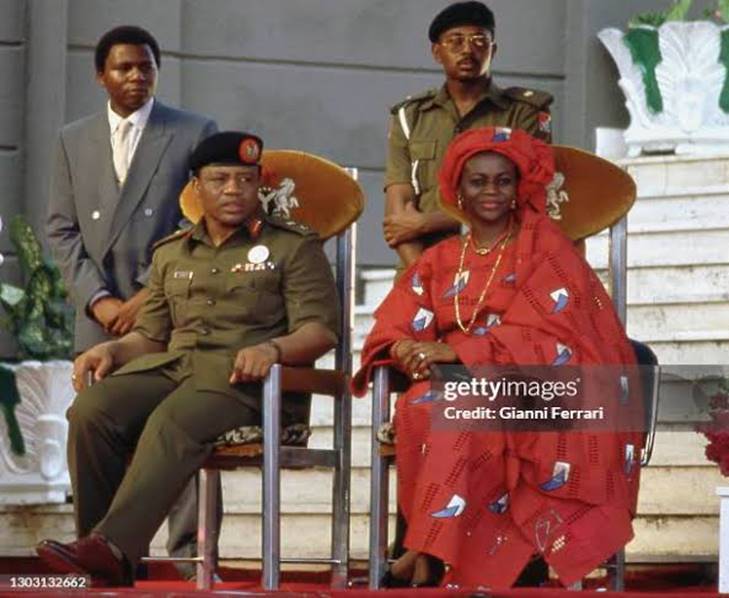
    (A picture of General Babangida and his wife, Maryam Babangida)
    Source: Gettyimages

    Those who interacted with Babangida socially often describe him as relaxed, humorous, and surprisingly informal. He enjoyed storytelling, he enjoyed being in control of the narrative.

    Maybe that’s why he has remained influential long after leaving office.

    Unlike some former rulers, Babangida didn’t fade away, he became a political kingmaker. Politicians visited Minna frequently,[19] his hilltop mansion became a pilgrimage site for aspirants. He never fully exited the stage, he just changed seats. Over the years, he expressed regret[20] about June 12, acknowledging it as a difficult decision. He however never apologised for annulling it. In later reflections, he suggested he was constrained by forces within the military.

    Whether that is accountability or reframing depends on who you ask.

    What Shaped Him? If I had to psychoanalyse him from the outside, I’d say this, growing up in colonial transition taught him that power structures shift. Surviving war taught him that control equals survival. Military training taught him hierarchy and strategy, exposure abroad taught him global realism. Nigeria’s volatility taught him that rigidity breaks regimes. So he chose flexibility, sometimes too much of it.

    He believed in controlled democracy, managed transitions, incremental reform and balance and distrusted chaos. But here’s the irony: in trying to control chaos, he often created more of it.

    Babangida is not easily categorised. He modernised parts of Nigeria’s banking sector, expanded the press environment in some periods, created new states, empowered technocrats. Yet his regime faced allegations of corruption, press intimidation and political manipulation. And the unresolved trauma of June 12. He is a paradox – reformist and disruptor, strategist and gambler in nature. And maybe that’s why he remains one of Nigeria’s most analysed leaders.

    When you think about Babangida, you do not see a cartoon villain or flawless hero. You see a man shaped by instability, convinced that only he understood how to hold the country together. He believed in diplomacy within the military. In balancing factions, in playing the long game. He was less about loud ideology and more about quiet maneuvering. His legacy depends on who’s telling the story.

    For some Nigerians, he represents lost democratic opportunity. For others, he represents complex reform during economic crisis. For historians, he represents the peak of military political engineering. But for me? He represents something deeper: the danger of believing you are the only one who knows how the chessboard should look.

    Ibrahim Babangida lived power like a strategist, not a preacher. He smiled through storms, he stepped aside instead of falling, he left questions hanging instead of answers. And maybe that’s the most Babangida thing of all.

    He didn’t just govern Nigeria.

    He dribbled it.


    [1] Max Siollun, Oil, Politics and Violence; Nigeria’s Military Coup Culture [1966-1976] [Algora Publishing, 2009].

    [2] Karl Maier, This House Has Fallen; Nigeria in Crisis [Penguin, 2000].

    [3] John Paden, Ahmadu Bello, Sardauna of Sokoto [Heinemann, 1986]

    [4] Nigeria Defense Academy historical records.

    [5] Siollun, Oil, Politics and Violence.

    [6] Nowa Omoigui, ‘‘The Nigerian Civil War and Military Leadership,’’ archived military studies papers.

    [7] Siollun, Soldiers of Fortune; Nigerian Politics from Buhari to Babangida [1983-1993] [Hurst, 2013]

    [8] Nigerian military training archives.

    [9] Siollun, Soldiers of Fortune.

    [10] Ibid.

    [11] Ibid.

    [12] Contemporary Nigerian Media accounts, 1985-1993.

    [13] International Monetary Fund country reports on Nigeria, 1986-1989.

    [14] Diamond, Larry, Class, Ethnicity and Democracy in Nigeria [Syracuse University Press, 1988].

    [15] Transition Monitoring Group reprts, 1993.

    [16] Siollun, Soldiers of Fortune.

    [17] Ibid.

    [18] Amina Mama, ‘’Feminism or Femocracy’’ Africa Development [1995].

    [19] Maier, This House Has Fallen.

    [20] Ibrahim Babangida, later public interviews and reflections on June 12.

  • Did Gowon’s Wahala Start in Kampala?

    It is shortly after 08:00 hours in Kampala, two hours ahead of Lagos.

    The OAU session for the day has already begun. The hall is settled. Amadou-Mahtar M’Bow, then Director-General of UNESCO, is addressing the conference. Idi Amin is chairing the session. He has just delivered his keynote address when news reaches him that something had happened in Nigeria. The information is sketchy but credible. It has been reported by Reuters.

    Yakubu Gowon, who had probably heard rumours of the news arrives late. As he takes his place, Amin signals to him. Gowon is called to the high table. Amin shows him a folded piece of paper. The message is brief. A coup has been announced in Nigeria. Gowon reads it without visible reaction. He returns to his seat. For a period, he says nothing. Then he beckons to Usman Faruk, the Military Governor of the North Western State, who is part of the Nigerian delegation. When Faruk leans in, Gowon speaks quietly, in Hausa:


     Abin da mu ke jin tsoro, ya faru a gida. (What we feared has happened at home).


    General Gowon (Left) and Usman Faruk, then Military Governor of the North-Western State (The first police officer to become military governor in Nigeria)
    Source: Historic Images

    The session continues.

    By the time the note reached Gowon, the coup was already several hours old. It had been meticulously executed with surgical precision. Lagos had already heard the first radio broadcast, which bore no language of treason, nor talk of ideology.

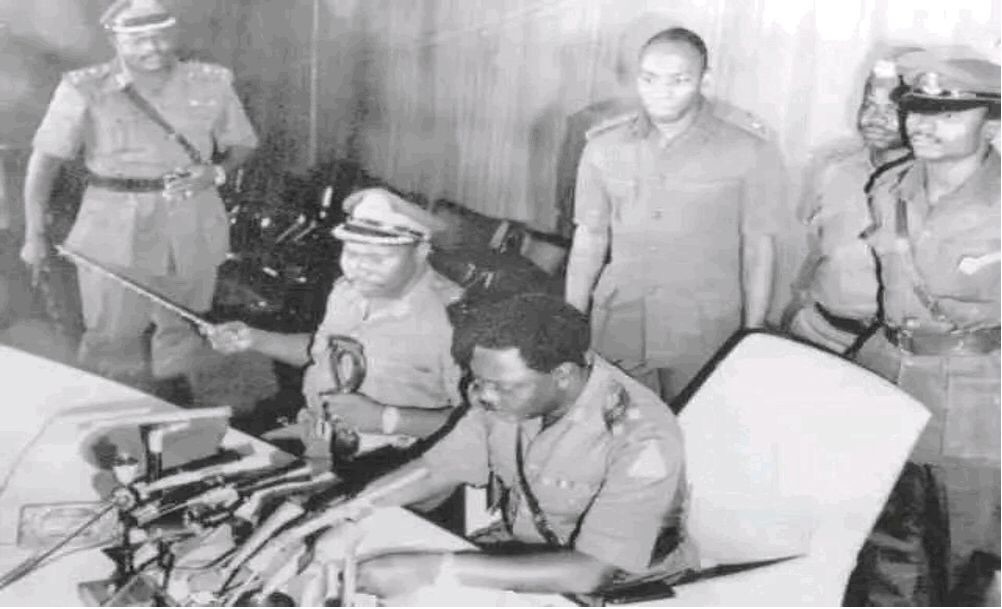
    The photograph captures Brigadier Murtala Muhammed delivering his first national address after the bloodless coup of July 29, 1975, which ousted General Yakubu Gowon from power.
    Speaking as Nigeria’s new Head of State, Murtala sat behind the microphone with a firm, commanding presence. At his right was Brigadier Olusegun Obasanjo, the newly appointed Chief of Staff, Supreme Headquarters. On the far left stood Brigadier Iliya Bisalla, Commissioner for Defence, while just behind them were Lt-Colonel Tunde Idiagbon and Lieutenant Akintunde Akinsehinwa, Murtala’s loyal aide-de-camp. Source: TVCNews.ng

    “Fellow Nigerians. “Events of the past few years have indicated that despite our great human and material resources, the Government has not been able to fulfil the legitimate expectations of our people. Nigeria has been left to drift. This situation, if not arrested, would inevitably have resulted in chaos and even bloodshed. “In the endeavour to build a strong, united and virile nation, Nigerians have shed much blood. The thought of further bloodshed, for whatever reasons must, I am sure, be revolting to our people. The Armed Forces, having examined the situation, came to the conclusion that certain changes were inevitable…


    The accusation was framed as an administrative failure – the usual corruption, indecision, and the stalled transition to civilian rule. This wasn’t a rebellion in the dramatic sense but a precise surgical strike. The subtle genius of all this was the way silence itself became a weapon against Gowon, just like it had been used against the whole country during the counter-coup of July 1966. Remember that for three days (July 29-31, 1966), the whereabouts of General Ironsi was unknown. Brigadier Ogundipe had sent Lt. Col Gowon to negotiate with the coup plotters, only for him to come back as Head of State. Well, you’re already piecing the picture, right?

    This time, every single person who might have defended Gowon, every loyalist, had either been neutralised, co-opted, or simply frozen by caution. It wasn’t out of confusion or fear, but simply a reasonable political calculation. One thing was clear, Gowon had already run out of goodwill from his major constituency (the Army). Reading Murtala Muhammed’s speech from Kampala, he would have known immediately that the country he thought he still controlled was gone.

    That calm, firm tone in the broadcast was a demonstration of decisiveness by a rebel who had facilitated the rise of Gowon in the first place. And when you step back and think about Gowon himself, it tells you a lot. Here was a man who had survived a civil war, navigated the fractious politics of a newly independent Nigeria, and held the country together through almost impossible circumstances.

    Ironically, he was not confronted by street chaos or mobs, but by the quiet efficiency of men he had once commanded. At this moment, he realised, almost philosophically, that power can slip away in silence. Betrayal isn’t always loud. Sometimes, it’s just the quiet click of a plan executed without error.

    While addressing a press conference in Kampala, he quoted Shakespeare’s As You Like It to reflect on his exit from power, saying,

    “All the world is a stage and all the men and women merely players. They have their exits and their entrances”.

    It was clear that he had learned a great lesson. While quoting Shakespeare, he must have realised that loyalty and charisma have limits, even history has its limits. The military, that very institution that had made him Head of State, had grown pragmatic, restless, and disillusioned. Gowon had held power but in that OAU hall in Kampala, he saw clearly how fragile that power really was.


    But when did his trouble really start?

    To answer that properly, we need to go back to how Gowon entered the military and how he came to power in the first place.

    Yakubu Gowon joined the Nigerian Army in 1954. He was part of the generation of officers who entered the army just before independence. At that time, the military was one of the few national institutions that offered upward mobility across regional lines. It was structured, disciplined, and still heavily influenced by British training. He trained at Sandhurst and later attended staff courses in the UK. That training shaped his outlook. Gowon was not ideological, he was institutional. He believed in hierarchy, order, and procedure. He was not known as a radical officer. If anything, he was seen as steady and professional.

    L-R: Cadet Madiebo, Cadet Gowon, Cadet Addo (Ghana), Cadet Ejoor.
    In February 1956, the Queen visited Nigeria. On her return to Britain, a guard honour comprised of West African officer cadets studying at the Prestigious Royal Military Academy, Sandhurst, were assembled to recieve the Queen and her family (husband prince Philip and their two kids, Prince Charles and Princess Ann)
    Source: Nairaland

    By January 1966, when the first military coup in Nigeria happened, he had just returned from a course in the UK. The coup, led by Major Ifeajuna and Nzeogwu, had seen to the death of many senior political leaders and several northern officers. In the midst of this chaos, Major General Ironsi took power. The country became tense, especially in the North, where the coup was viewed through an ethnic lens.

    Maj. Gen. Ironsi, the new Head of State, appointed Gowon as the first Chief of Army Staff, one of the youngest officers to hold the position. This was significant because it showed he was trusted, but it also showed something else: he was acceptable across factions in a military that was already developing internal suspicions.


    L-R: Gen. Gowon and Gen Ironsi
    Source: Ethnic African Stories

    The counter-coup in July 1966, however, changed everything again. Ironsi was killed. The military hierarchy was shattered. Many of the most senior officers were either dead or politically compromised. What remained was a fractured officer corps looking for someone who could hold the centre. Gowon was not the most senior or the most forceful. But he was the most acceptable.

    Brigadier Babafemi Ogundipe, who was next in line after Ironsi, attempted to assume command. On paper, succession should have been straightforward; however, the reality was murky. The northern officers who had executed the counter-coup were not prepared to take orders from him. Rank, in that moment, became just an accessory. Authority had shifted to those who controlled the guns.

    Ogundipe’s position became untenable almost immediately. He needed someone the mutineers would accept. Gowon fit that requirement. He was northern, but had not been associated with the January coup. He was also senior enough to be credible, yet not so senior as to threaten the officers who had just taken decisive action. Moreover, he was professional and, importantly, seen as cautious.

    Brigadier Babafemi Ogundipe
    Source: Wikipedia

    So, Brigadier Ogundipe sent Lt. Col. Gowon to speak to the coup plotters. That decision proved decisive.

    On 1 August 1966, to the bewilderment of Ogundipe, Lieutenant Colonel Yakubu Gowon was announced as Head of State. That was the real beginning of his long-term dilemma. His elevation was not the result of a structured constitutional transfer, but a settlement (a compromise inside a divided military). He emerged as a leader because he was the point at which competing interests temporarily converged. That gave him the office, it did not automatically give him deep-rooted loyalty. From the first day, his authority rested on a balance. In fact, when General Muritala’s memo was rejected by Gowon in 1972, he was quoted by Shehu Shagari, the then Finance Minister to have said:

    “Don’t mind him!” “We shall soon change him. We put him there and we can remove him anytime!”[1]

    A colourised picture of Muritala Muhammed
    Source: The Cable

    In essence, Gowon’s authority, from the very beginning, was conditional. He was Head of State, yes. But he was also the product of a negotiation inside a wounded institution. The July 1966 counter-coup had not restored order in a clean, constitutional sense. It had merely shifted the balance of force. Those who carried out the mutiny did not want to govern directly. They wanted someone who could stabilise the situation without threatening them. Gowon became that bridge.

    But, you know, bridges are meant to connect interests. They are rarely sovereign in their own right. That early dependence shaped his style in office. He governed carefully and avoided humiliating powerful officers. He always consulted widely, which made him move slowly where others might have moved decisively. In 1966, that caution was an asset. Nigeria was on edge. The regions were suspicious of one another. The army itself was fractured along ethnic and generational lines. A forceful or ideological leader might have accelerated disintegration.

    Then came Aburi in January 1967. The meeting between Gowon and Ojukwu in Ghana has been interpreted in many ways, but one thing is clear: it exposed the tension between military collegiality and political sovereignty. At Aburi, the atmosphere was informal, almost fraternal. Agreements were reached verbally. But once back in Lagos, federal civil servants and advisers warned that implementing Aburi as understood by Ojukwu would hollow out the centre. Gowon initially hesitated but eventually modified the interpretation through Decree No. 8. That hesitation mattered. To Ojukwu, it confirmed the distrust that had built up from the assassination of General Ironsi.

    By May 1967, Gowon made the boldest move of his career. Sensing Ojukwu’s move to secede, he broke Nigeria into twelve states. On the surface, it was a wartime calculation. It weakened the Eastern Region’s bargaining power and undercut Ojukwu’s leverage. But structurally, it did something deeper to the nation. It altered the federal architecture in ways Nigeria is still negotiating today. State creation became both a tool of integration and a permanent feature of political competition.


    Then the war began.

    From 1967 to 1970, the conflict bought Gowon something invaluable: time. Wartime narrows public focus. During wartime, survival takes precedence over reform as the need for stabilisation often overshadows scrutiny. In that environment, leadership is judged by endurance and cohesion, not administrative efficiency. During those years, Gowon was not managing oil wealth or civilian impatience. He was prosecuting a war to keep the country intact. That objective simplified politics. Loyalty was closely tied to national survival. Dissent could be framed as sabotage.

    Victory in 1970 elevated him further. The war consolidated his authority and expanded his legitimacy. Ironically, oil revenues increased almost immediately, Nigeria’s international profile rose due to its economic and military strength.

    However, once peace returned, expectations resurfaced. The same structure that had centralised authority during conflict now had to justify itself in peacetime. And peacetime is less forgiving. It demands timelines, reforms, and visible direction.

    So, in many ways, the war strengthened Gowon. But it also postponed the day of reckoning. When that reckoning came in the early 1970s, through various debates about corruption, governance, and especially the transition to civilian rule, it was sharper because it had been deferred.

    It was within this context his overthrow happened.


    [1] Omoigui, N. (n.d.). Military rebellion of July 29, 1975: The coup against Gowon – Part 6. Dawodu. Retrieved February 11, 2026, from https://www.dawodu.com/articles/military-rebellion-of-july-29-1975-the-coup-against-gowon-part-6-635

  • The Rebel Soldier who Became a National Symbol

    The Rebel Soldier who Became a National Symbol

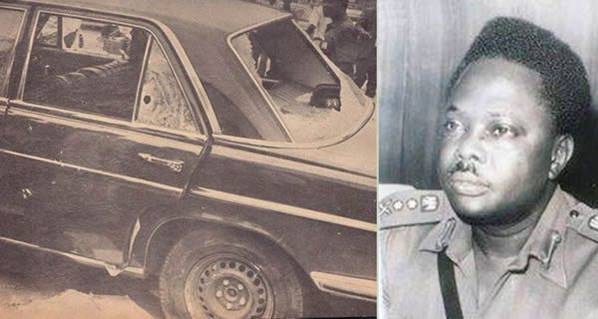
    On 13 February 1976 (a day to Valentine’s Day 50 years ago), General Murtala Ramat Mohammed was ambushed and killed in Lagos on his way to work by troops loyal to Lieutenant Colonel Buka Suka Dimka. He was on his way to Dodan Barracks with no serious security, asides the service pistol his ADC bore. Along Federal Secretariat Road, his vehicle was blocked. Shots were fired at close range. Within minutes, the Head of State was dead and left on the highway to the full view of bystanders.

    A picture of General Muritala’s official vehicle moments after he was assassinated C. February 1976.
    Source: Nairaland

    Fifty years later (in 2026), the interpretation of that event remains divided. Some argue that Murtala’s death was almost predictable. That a man who participated in coups, commanded troops in a civil war, and removed a sitting Head of State could not realistically expect a quiet political retirement. Others insist that he had become a necessary reformer and that his assassination interrupted what might have been a structural turning point in Nigeria’s political development.

    There is also a third claim, more speculative but persistent: that Murtala governed with the urgency of someone who knew he might not last. He moved quickly because he understood the volatility of the institution that produced him.

    But before we draw conclusions, we need to ask a more grounded question: How did he get there?

    Before 1976

    Murtala did not emerge suddenly as Head of State the previous year. By the time Gowon was overthrown, he had already been inside the core of Nigerian military politics for nearly a decade. Like Gowon, he belonged to the early generation of post-colonial officers. Born in Kano in 1938, Murtala attended Barewa College in Zaria, a school that produced a generation of northern political and military elites. Like Yakubu Gowon too, he trained at the Royal Military Academy, Sandhurst. On paper, he was a product of the British military tradition of discipline, hierarchy, and loyalty to the chain of command.

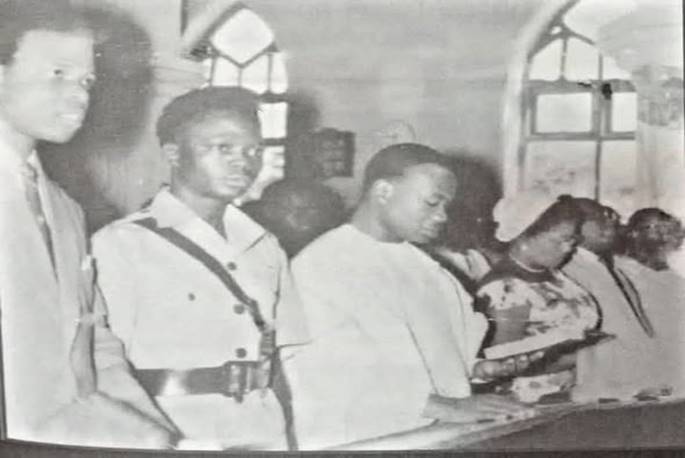
    This rare image captures Lieutenant Murtala Ramat Mohammed in 1962, pictured in military uniform while attending a church service as a young Nigerian Army officer. At the time, he was serving as Aide-de-Camp (ADC) to Dr. Moses Adekoyejo Majekodunmi, the Administrator of the Western Region during Nigeria’s political crisis of the early 1960s.
    Source: Folaranmi Ajayi (Facebook, 2026)

    But there is an important distinction. While Gowon absorbed institutional caution, Murtala absorbed structure, but not restraint. By the mid-1960s, he had developed a reputation for bluntness, impatience, and emotional intensity. Even early colleagues noticed that he only respected discipline when it aligned with his judgment. When it did not, he was prepared to challenge it. The pattern was already forming.

    His First Instance of Open Rebellion

    Murtala’s first clear break with military hierarchy came in July 1966. After the January coup brought General Johnson Aguiyi-Ironsi to power, tensions inside the army intensified. Many northern officers believed the political balance had shifted dangerously, and General Ironsi did little to assuage those fears. His promulgation of the Unification Decree, which replaced the federal system with a unitary structure, deepened that suspicion.

    At this point, Murtala was no longer a passive bystander, he was one of the officers who coordinated the counter-coup from Lagos. He took control of strategic points, including the airport, and maintained communication with other northern officers. In a sense, he was not merely executing orders handed down from above but was part of the circle shaping events as they unfolded. The July counter-coup was a calculated intervention by officers who believed the balance within the federation had been altered beyond comfort.

    It is also important to note that, at that stage, the objective was not simply regime change. Among many northern officers, the idea of Araba (secession of the North) was openly entertained. Murtala was associated with that current of thinking. In other words, his first major political act inside the Nigerian state was tied to a movement that contemplated breaking the state itself. Its an irony today that he is often viewed as a nationalist; people even go further to justify his ‘fellow Nigerians’ phrase as a pointer to his nationalist traits.

    Well, as we would see in the next article, Nigeria ultimately remained united, largely because political negotiation overrode separatist impulses. But July 1966 established something that would follow Murtala throughout his career. When he believed a structure was flawed or dangerous, his instinct was not patience. It was decisive correction, even if that correction risked fragmentation. He did not treat the Nigerian state as untouchable. If he believed it was failing or biased, he was prepared to dismantle or restructure it by force. That was his first open rebellion within the system he had sworn to serve.

    The Civil War: Courage and Disobedience

    When the civil war began in 1967, Murtala was appointed commander of the Nigerian Army’s 2nd Division, responsible for operations in the Midwestern and eastern theatres. His performance during this phase mixed tactical success with persistent friction with the high command. What stands out most in his wartime record was not only bravery, but a pattern of acting independently of orders from Army Headquarters and Supreme Headquarters.

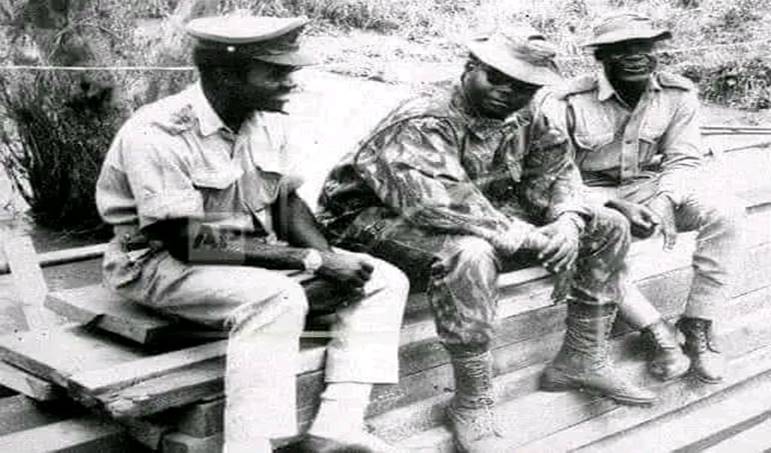
    A picture of General Murtala Muhammad with two other soldiers in Benin after capturing the city during the Biafra War.
    Source: Associated Press

    The most discussed example is the push toward Onitsha.

    After retreating Biafran forces destroyed the key bridge over the River Niger, Army Headquarters in Lagos advised a cautious, unopposed crossing at Idah, followed by an overland advance  (a plan viewed as less risky and more coordinated with neighbouring formations).

    In his usual character, Murtala rejected that option. He favoured a direct river assault from Asaba, believing the momentum was with federal troops. Supreme Headquarters, his brigade commanders, and even the commander of the neighbouring 1st Division, Colonel Mohammed Shuwa, advised against it; despite this, Murtala persisted. He ordered the river crossing despite explicit strategic recommendations to the contrary.

    Twice, the frontal assault was repulsed by the Biafran soldiers with significant casualties and loss of equipment. Even after those setbacks, he tried a third assault before eventually agreeing to Army Headquarters’ original plan and capturing the town. The failure of his earlier attempts cost lives and morale.

    This episode reveals two consistent traits in his wartime command:

    • He valued initiative and decisiveness over procedural coordination.
    • He was willing to act against directives from his superiors if he judged them too cautious.

    Ideally, as some military observers have pointed out, such independence should likely have led to a court-martial in less chaotic conditions. However, in the Nigerian civil war’s fluid environment, it did not.

    These decisions were, however, not isolated, they reflected a larger pattern within the 2nd Division under his command, where he adopted rapid movement, aggressive engagement, and often unilateral decision-making that prioritised tempo over hierarchical compliance. That combination won him recognition for bold leadership and respect from many subordinates. It also created unease among senior officers who saw traditional military discipline eroding under the pressure of his personality and approach.

    The 1975 Coup

    By 1975, Murtala was no longer a divisional commander at war. He was Federal Commissioner for Communications in a government that had been in power for nearly a decade. But the impatience that marked him in 1966 and during the civil war had not softened. The post-war years were marked by oil revenue expansion and reconstruction. They were also marked by delay due to bureaucracy in government procedures. The promised transition to civilian rule, initially projected for 1976, was postponed. Administrative reforms were discussed repeatedly but implemented slowly. Don’t forget that by 1974, there had been two major milestones: The wage and Salary increases headed by Jerome Udoji, and a National Conference on Manpower Utilisation and Development. On one of such occasions where Gowon rejected his memo, he angrily remarked to Shehu Shagari,

    “Don’t mind him!” “We shall soon change him. We put him there and we can remove him anytime!”[1]

    Within sections of the officer corps, especially among those who had fought the war, frustration began to build. To them, the post-war state appeared slow, procedural and overly cautious. Murtala stood at the opposite end of that temperament. He was direct where others were consultative. He preferred resolution to deliberation.

    When the July 29, 1975 coup was executed while Gowon was abroad, Murtala was not an accidental beneficiary. He was the senior officer around whom dissatisfaction had quietly gathered.  Whether or not he drafted the plan himself is less important than the fact that he accepted its outcome without hesitation. Once again, he aligned himself with intervention as a corrective instrument.

    His months in office reflected the same instinct. State governors were removed. Senior officers were compulsorily retired. Thousands of civil servants were dismissed. A new federal capital was announced. Foreign policy shifted decisively. The tempo was unmistakable. Supporters described this as clarity and discipline restored. Critics saw recklessness and institutional shock. But even in government, Murtala behaved as he had in 1966 and during the war: when he believed a structure was defective, he moved to reset it.

    Then came 13 February 1976.

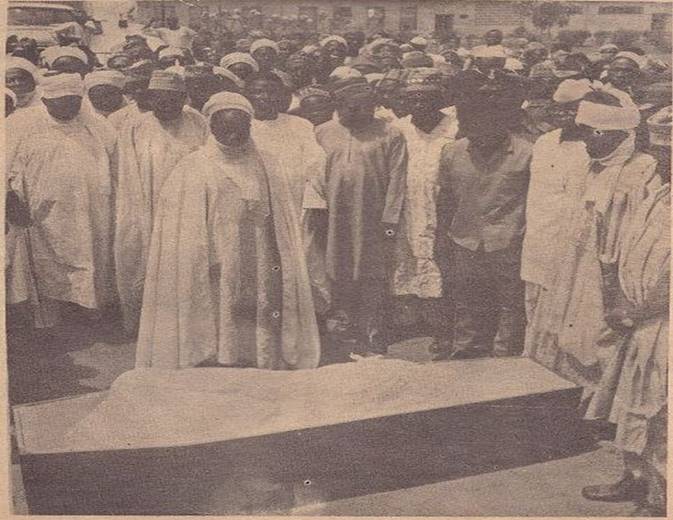
    General Murtala Mohammed’s Burial And Corpse, 1976.
    Source: Nairaland

    The irony is difficult to ignore. A man who had seized the airport in 1966 now has that same airport named after him.

    The first Nigerian Head of State to appear on a naira note is a man whose career repeatedly challenged the very hierarchies he once swore to uphold. Monuments, institutions and public memory have fixed him in national symbolism.

    It is here that Dimka’s failed coup assumes a historical weight beyond its immediate violence. Assassination froze Murtala at a particular moment as an energetic, reformist, and uncompromising leader. Death removed the possibility of decline, error, or prolonged controversy. It converted a divisive figure into a fallen one.

    In life, he was a rebel inside the system. In death, he became a symbol of it.

    That transformation may be the most consequential outcome of 13 February 1976.

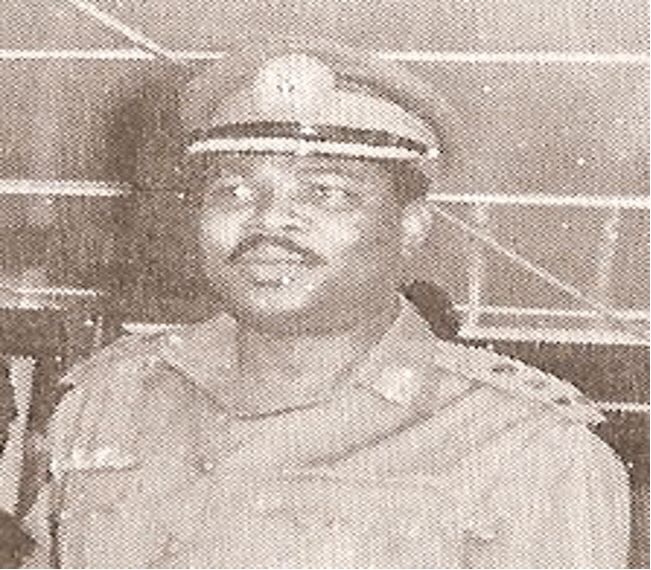
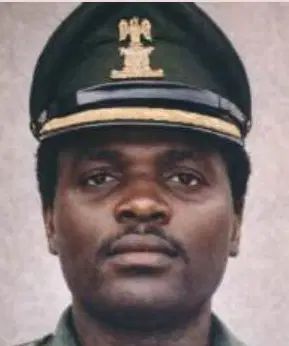
    A portrait of Lt. Col. Buka Suka Dimka. Source:Vanguard News

    [1] Omoigui, N. (n.d.). Military rebellion of July 29, 1975: The coup against Gowon – Part 6. Dawodu. Retrieved February 11, 2026, from https://www.dawodu.com/articles/military-rebellion-of-july-29-1975-the-coup-against-gowon-part-6-635

  • THE PROMISES WE KEEP HEARING 2

    THE PROMISES WE KEEP HEARING 2

    EPISODE TWO: WHEN THE PROMISES BROKE

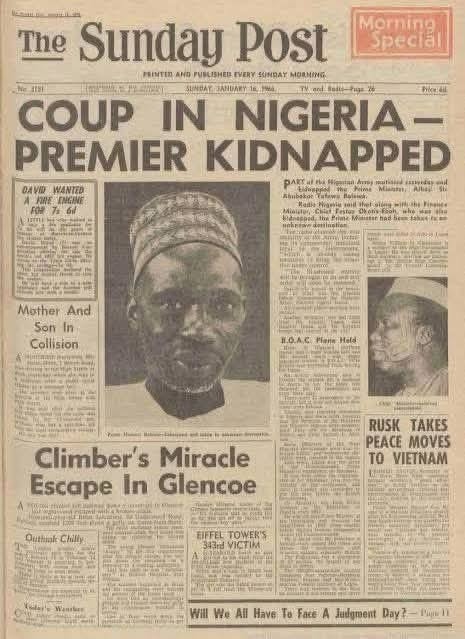
    On the morning of January 15, 1966, Nigerians woke up to a country they no longer recognised. Before dawn, soldiers had moved through Kaduna, Lagos, Ibadan, and Enugu with stealth and precision. By the end of the day, quite a number of politicians were either missing or killed, senior officers in the military were ambushed, and government authority had been effectively shattered. For many citizens, the first confirmation came not from officials in Lagos, but from Radio Kaduna. The voice that came through did not sound like a reassurance but a verdict.

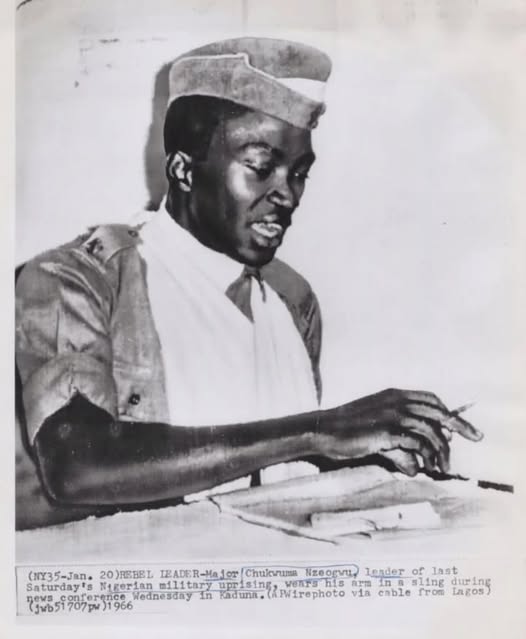
    Major Chukwuma Kaduna Nzeogwu’s broadcast was sharp, moralistic, and unlike anything Nigerians had heard from their leaders. Gone were the polished lines of Independence Day speeches. He spoke of “political profiteers… swindlers… men who seek bribes and demand ten percent.” His speech was not simply a justification for the coup; it was a public indictment of the First Republic. And for many Nigerians, it captured something they already felt but had not articulated: the promises of independence had begun to collapse long before the soldiers arrived.

    Major Chukwuma Nzeogwu, addressing a press conference in Kaduna, Nigeria. His arm was in a sling due to injuries he sustained during the military coup he had led just hours earlier on January 15, 1966

    To understand why the 1966 coup resonated so widely, you have to look at the slow breakdown that preceded it.

    The early optimism of independence did not survive the crises of the early 1960s. By 1962, politics had become a battlefield. The Action Group crisis in the Western Region (a dispute between Awolowo and his deputy, Akintola) grew into a full political fracture. What started as ideological disagreement escalated into violent street clashes, burnings, and targeted attacks. The period later known as Operation Wetie or “Wild Wild West” symbolised how far the democratic project had drifted. State institutions struggled to contain the violence. Public trust evaporated due to perceived biases and partisanship.

    At the national level, tensions grew worse. The 1962 census collapsed into controversy. The 1963 recount did not settle the matter; it further deepened suspicion. The 1964 federal elections were discredited by boycotts and intimidation. And the 1965 Western Regional elections triggered violence so intense that many Nigerians openly questioned whether democracy had a future.

    This was the environment in which political speeches began to lose their power. Leaders still invoked unity, brotherhood, and discipline, but the gap between rhetoric and reality widened daily. Citizens heard the speeches, but they no longer believed them.

    Do you see a similarity today?

    Why Nzeogwu’s Broadcast Hit the Way It Did

    What made his message different was not the language itself but the way he used them. Themes like honesty and discipline had appeared in earlier speeches, but his rendition stood out. Where Azikiwe had used such words to appeal, Nzeogwu used them to condemn. He was not asking for national unity; he was asserting that the political class had betrayed it.

    For many Nigerians, especially in regions where the crises had been most severe, the broadcast felt like a brutal but familiar truth. In the North, early reactions included cautious approval. In the West, exhausted by political violence, some citizens expressed relief that someone had taken control. In the East, responses were more restrained, coloured by concerns about who had been targeted in the coup.

    But across regions, one sentiment was consistent: the politicians no longer controlled the national narrative. Someone else (uniformed, armed, confident) had stepped in to define the country’s direction.

    In actual sense, the coup did not erase political rhetoric, it simply changed its tone. In the days following the intervention, military leaders adopted the same themes that civilians had used the word ‘unity, discipline, national survival’ but the meaning shifted. These were no longer appeals rooted in persuasion but instructions backed by authority. The vocabulary remained familiar, but the centre of power had moved from the parliament to the Supreme Military Council.

    Aguiyi-Ironsi’s First Press Conference After the January 15, 1966 Coup

    This transformation matters because it marks the first major rupture in Nigeria’s rhetorical tradition. From 1960 to 1966, civilian leaders used language to build consensus, manage crises, and hold together a fragile federation. After the coup, the military used similar words, but as instruments of control.

    This episode reveals the point at which the promises of early independence finally broke under the weight of political crisis. By January 1966, the gap between what leaders said and what citizens experienced had become impossible to bridge. The rhetoric of unity and progress no longer reassured anyone. That vacuum created the space for Nzeogwu’s broadcast, and for the new political language that would dominate the years to come.

    In Episode Three, we will follow this shift into the era of counter-coups and the Civil War: a period when rhetoric about unity, survival, and sacrifice took on deeper, more urgent meanings and when political language began to reflect not just hope, but existential struggle.

    Thanks for reading. Let us know what you think in the comments.

  • The Promises We Keep Hearing 1

    The Promises We Keep Hearing 1

    EPISODE ONE: The First Promises

    In 1960, Nigeria became independent. The euphoria was real, but fragile. Three regions, each with distinct histories and political ambitions, were suddenly asked to govern themselves under a federal system. Unity was therefore not guaranteed; democracy was only an experiment. In this context, every speech from the national stage carried a weight far greater than ceremony. These speeches were instruments of reassurance. They served as appeals to cohesion and subtle warnings.

    By 1962, the first cracks appeared. The Action Group, dominant in the Western Region, fractured. Awolowo and Akintola clashed over leadership, party structure, and policy, turning the Western Region legislature into a battleground. The crisis quickly became national, raising doubts about the viability of democracy itself. Politicians across the country watched as trust between regions eroded, and ordinary citizens began questioning the promises of independence.

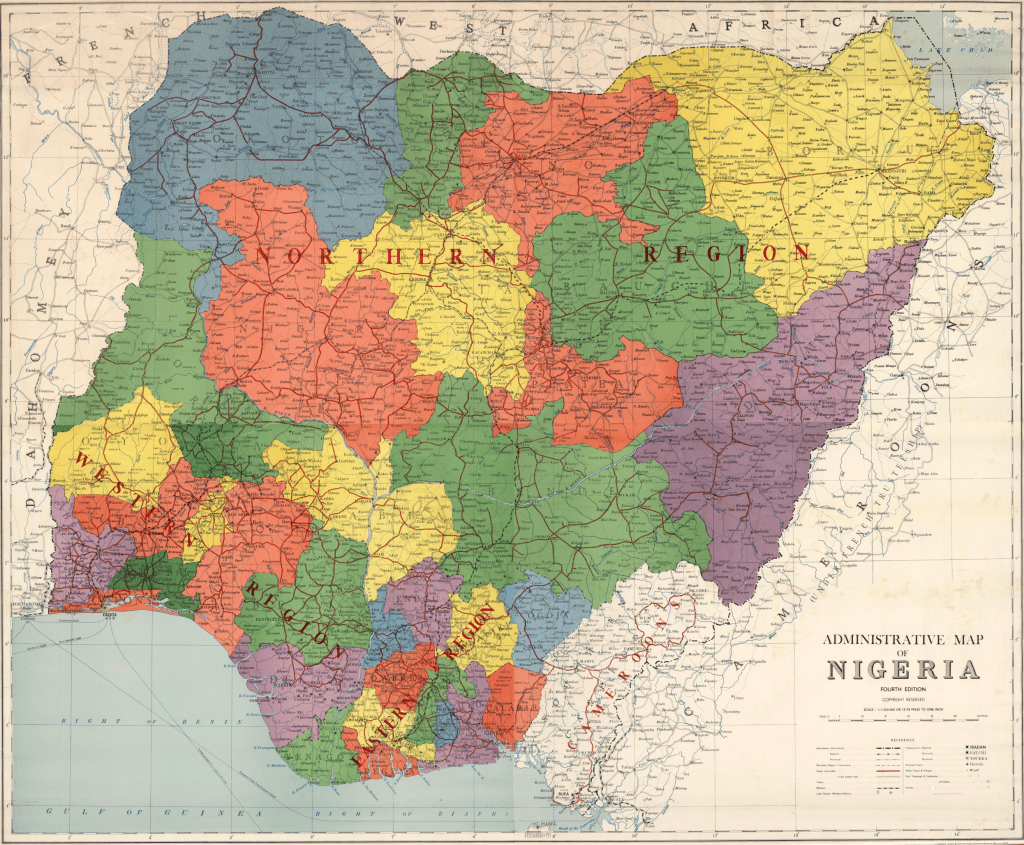
    Detailed map showing the regions and provinces of colonial Nigeria. Produced in 1924 and revised in 1960

    It was against this backdrop that Nnamdi Azikiwe addressed the nation:

    “Let us renew our faith in liberal democracy and strengthen our belief in the greatness of our country.” (1962 Independence Day Speech)

    Contrary to popular beliefs, these words were not just patriotic exhortation on a national day, but a deliberate attempt to restore confidence in a system already under stress. Azikiwe was not only speaking to the citizens, he seemed to also be addressing the emerging power of the military, a silent observer of civilian failures.

    Two years later, the tensions over identity and representation had intensified. The 1963 census had sparked allegations of manipulation, feeding regional suspicion and inflaming ethnic consciousness. Political rhetoric increasingly addressed not policy but cohesion. In his 1964 address, Azikiwe invoked a line from the national anthem:

    “Though tribe and tongue may differ, in brotherhood we stand. Let us give meaning to these words by living and working together.”

    These words were not symbolic; they were a response to a real threat – a nation on the verge of fragmenting along ethnic lines. Interestingly, decades later, the administration of President Bola Ahmed Tinubu reintroduced this old anthem officially. Senate President Godswill Akpabio argued at the time:

    “If we had kept to that anthem, we probably would not have banditry today in Nigeria because if you take your neighbour as your brother, you will not want to kill him.”

    But that is a digression for another day. Returning to the early 1960s: the federal elections of 1964 and the ensuing violence in the Western Region, later dubbed the “Wild Wild West” or “Wet tie” crisis, intensified the stakes. Political rhetoric became both shield and strategy. Leaders promised peace, discipline, and unity while the country witnessed arson, intimidation, and targeted attacks. The language of promise was a mechanism of control: to assure, to persuade, and to postpone the inevitable confrontation.

    By 1965, the military was observing these developments with increasing concern. Civilian authority appeared ineffective, and the prospect of intervention grew. The promises made by politicians, while aspirational, also underscored the fragility of the republic. Gowon’s 1966 Independence Day address illustrates the continuity of the message, even as the voice shifted from civilian to military:

    “We must rediscover honesty and sincerity. Let us dedicate ourselves to discipline, loyalty and service.”
    “Our nation must remain united. It is only in unity that our progress can be guaranteed.”

    The words remained familiar, unity, progress, discipline, but their delivery signaled a change in authority. Whereas early promises sought to inspire, military rhetoric sought to command. Yet the underlying narrative of hope persisted, as though the nation’s imagination required a constant reminder that a better Nigeria was always within reach.

    Looking back, the first promises of independent Nigeria reveal two enduring truths. The first is that rhetoric is inseparable from the context in which it is delivered. Every speech, every line of persuasion was a response to political crises, social anxieties, and regional tensions.
    Second, the themes of unity, progress, and renewal established in the 1960s have endured. They continue to resonate because they address the same hopes, fears, and expectations of Nigerians today.

    Episode One closes here, not with resolution but with foreshadowing. The promises of 1960–1966 laid the groundwork for the challenges that would erupt in 1966, as the nation confronted civil war, further coups and the first tests of the rhetoric’s durability. Understanding these first promises is essential to tracing how political language shapes not only expectations but the trajectory of the nation itself.

  • The Promises We Keep Hearing

    The Promises We Keep Hearing

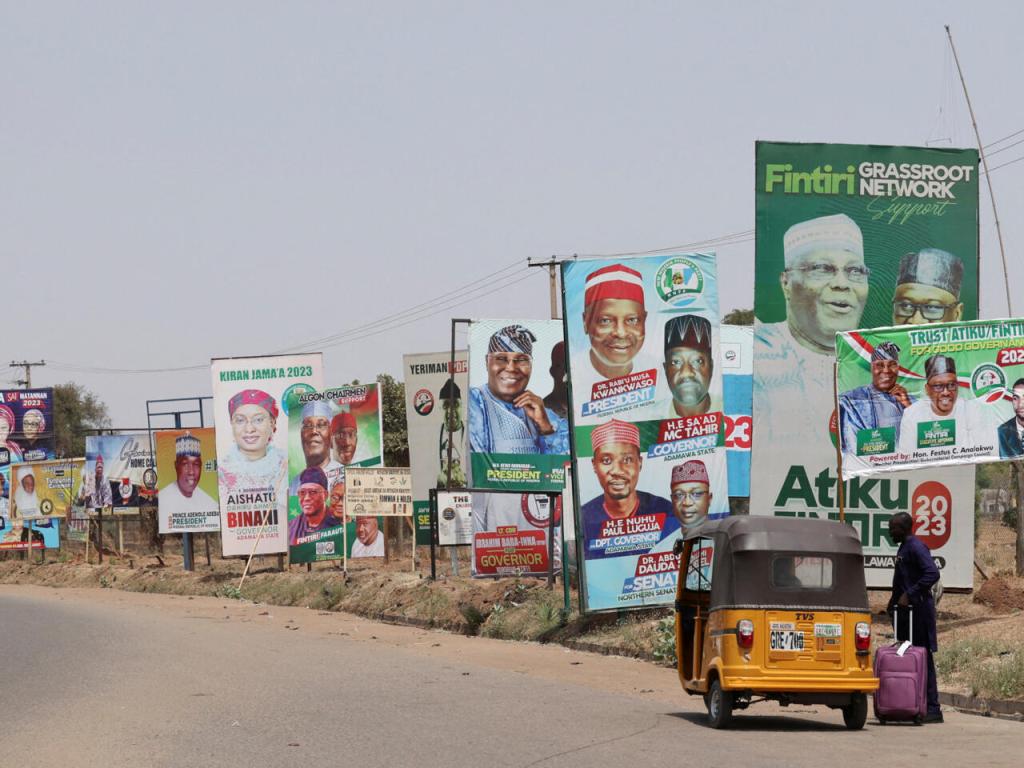
    Every election season in Nigeria feels like a revival. You hear new slogans, see new faces but the same promises of hope. In 2014 up till 2015, a new political coalition promised “Change”, then by 2019 they moved to the “Next Level.” Today, we listen patiently to the promise of “Renewed Hope.” These promises may sound fresh but are quite familiar; they are all echoes of promises we’ve heard before.

    In recent months, while reading through old Nigerian newspapers, one thing became clear: these promises are not new. From independence till now, every government has spoken the same language of transformation. They often promote the belief that a new dawn is just one administration away. These repeated declarations are not just political statements; they have become part of our national rhythm.

    This recurring pattern of rhetoric is what inspired this series — The Promises We Keep Hearing. It’s an attempt to look back at how political speech has shaped Nigeria’s identity and imagination. By tracing the evolution of the words of our leaders, we observe their tone and ideals. We also note their contradictions. This analysis helps us understand how language itself became one of the most powerful tools of governance in Nigeria.

    During the colonial era, Nationalist leaders delivered anti-colonial speeches. Today, most politicians make populist appeals to mobilise people, legitimise actions and, manipulate public opinion.

    The early nationalist movements of the 20th century show how language carried the moral weight of freedom. Early nationalist leaders understood the power of well-crafted speeches. Macaulay, often regarded as the father of Nigerian Nationalism, was renown for his fiery essays in The Lagos Daily News. Azikiwe’s speeches were often effective because they married intellect and hope, painting Nigeria as a proud, united nation (you really need to listen to his speeches).

    Awolowo’s tone, on the other hand, was often pragmatic and policy-driven, reflecting the discipline of a planner (See ‘Awo’, his memoir for more of this). Ahmadu Bello’s speeches often appealed to cultural preservation and dignity, linking tradition with progress. No wonder he was highly regarded by majority of the Northern Nigerian populace.

    The 1960s were full of optimism, but also rivalry. Independence brought hope, however political language quickly became a contest of identities and power. Our politics became regionally based. By 1966, the military replaced politicians who had fought themselves with words and the same institutions that wuld supplant them.

    Their eloquence gave way for the language of command. Leaders like Aguiyi-Ironsi, Gowon, and Murtala Mohammed spoke not to persuade, but to instruct. Even so, words such as unity, discipline, and accountability became rallying cries for a nation finding its footing.

    With the return to democracy in 1999 came a new vocabulary: unity, reform, rebirth. Obasanjo spoke with authority, Yar’Adua with humility, Jonathan with empathy. Today, slogans dominate social media: Change. Next Level. Renewed Hope. But the power of words hasn’t faded. Leaders still know that how they speak matters.

    Nigeria’s political rhetoric is also a story of how we imagine ourselves. The words of leaders shape what we believe is possible. This series starts by tracing those words – their origins, their intent, and their impact. Understanding the promises we keep hearing might just help us understand the country we’re becoming.

  • The Sleeping Man

    The Sleeping Man

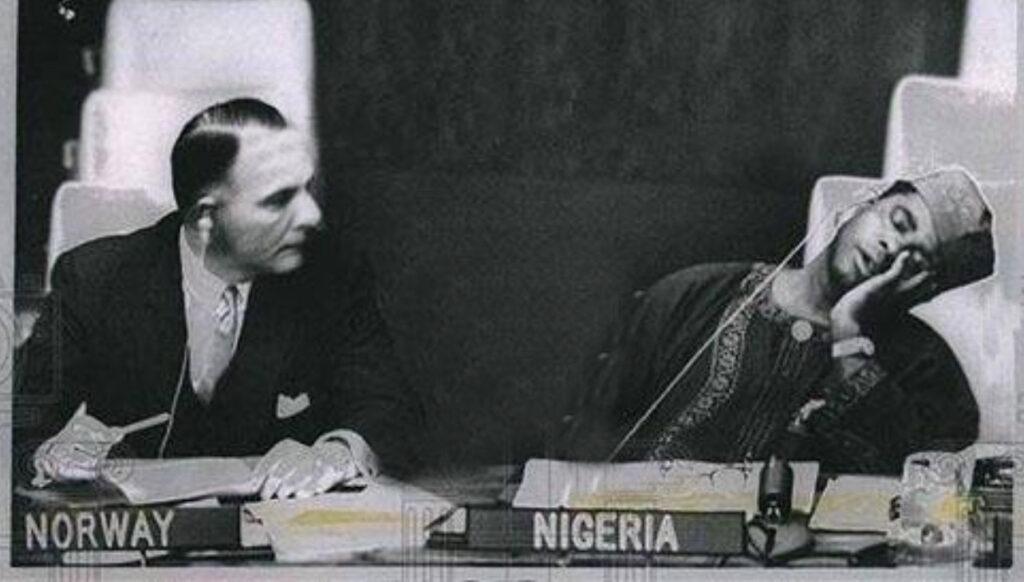
    There’s a picture that stayed with me since secondary school – Jaja Wachukwu sitting at the United Nations, eyes closed as if he was fast asleep. My classmates and I used to joke about it, wondering how a man could doze off in such an important meeting. For years, we believed that story. We never really asked questions. We never verified.

    That’s the scary part. Not that we were wrong, but that no one corrected us. We didn’t have a history teacher then, so that photograph became just another meme in our young minds. Only later did I find out that “the sleeping man” wasn’t asleep at all.

    He was protesting.

    Meet Jaja Wachuku, Nigeria’s first United Nations Ambassador. In 1960, his news rotated around the world for “sleeping” at a United Nations meeting.

    In 1960, Jaja Wachukwu, Nigeria’s first ambassador to the United Nations, was denied the right to speak after a condescending remark was made toward him. So he sat back, closed his eyes, and folded his arms, not in rest, but in silent defiance. That simple act of quiet dignity spoke louder than any speech could.

    It’s fascinating how one image can hold two completely different stories: one born of ignorance, and another of courage.

    Years later, when I learned the truth, it made me think about how many “sleeping men” we’ve misjudged in history, people whose actions we didn’t understand because no one told us the full story. It reminded me of the importance of teaching history, of looking twice before we conclude.

    Maybe that’s what storytelling does, it wakes us up.

  • Egungun Be Careful, Na Express You Dey Go

    Egungun Be Careful, Na Express You Dey Go

    If you were scrolling social media in 2020, you probably couldn’t escape it

    Obesere’s classic Fuji track suddenly became a viral sound, just like the Atassa trend. It was used everywhere as memes, sound effects on TikTok videos, and Instagram reels. In fact, people were singing it, joking about it, or using it to describe their own “na express” moments.

    But behind the catchy beat and funny clips, the song actually carries a serious message rooted in Yoruba tradition.

    What the Song Really Means

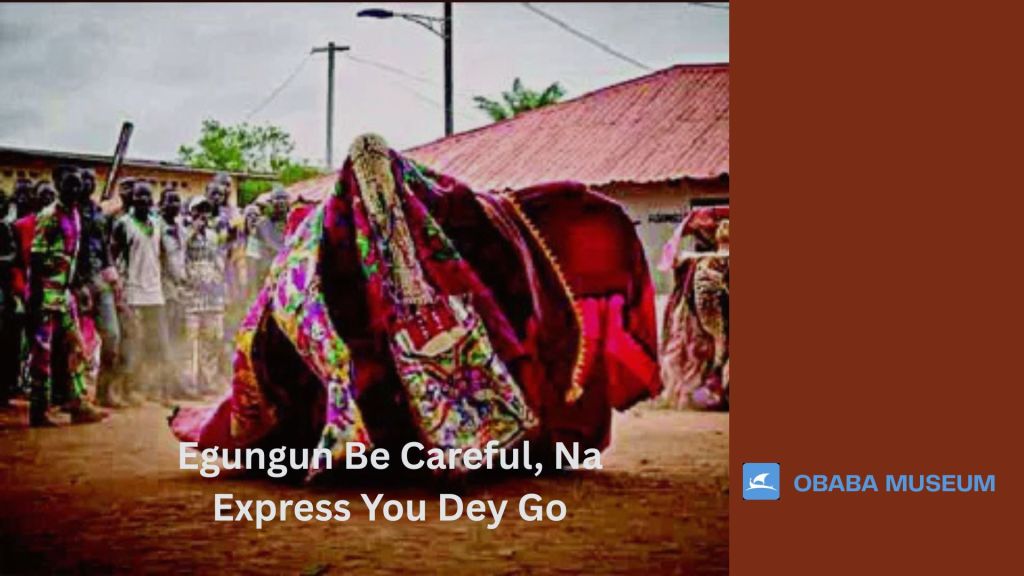
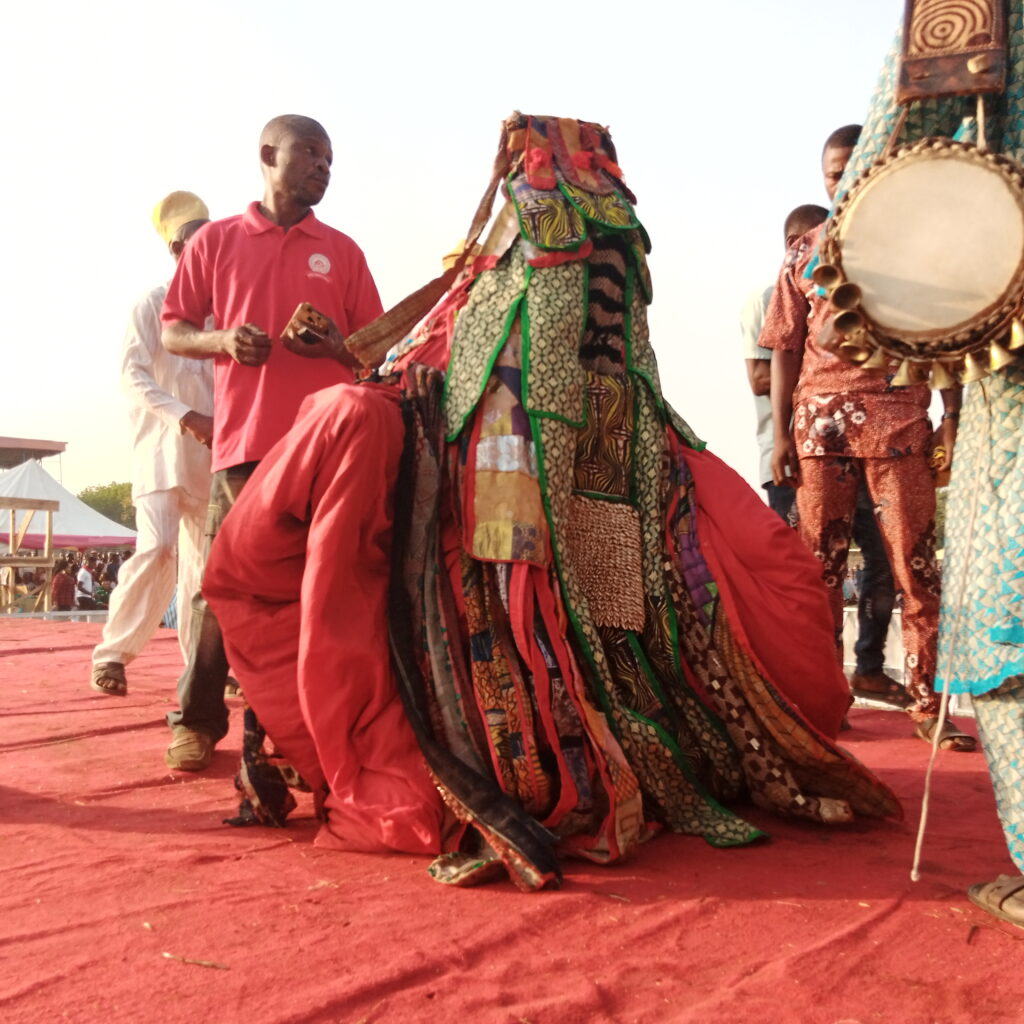
    In Yoruba culture, Egungun isn’t just a masquerade but a representation of the ancestors. When an Egungun appears, people make way (you wouldn’t want to be flogged by one). It’s regarded as sacred, spiritual, and respected. But Obesere flipped it. He used the image to talk about pride, carelessness and overconfidence that make people forget themselves.

    “Na express you dey go” — that part means you’re moving too fast, straight into trouble. It’s like saying, slow down before life humbles you.

    An Egungun masquerade with its handlers behind

    Obesere later explained that the song was really about being cautious, especially in relationships – don’t act on impulse or ego. Even the mighty can fall if they don’t watch their steps.

    When Obesere dropped Egungun Be Careful in the early 2000s, it was a solid Fuji jam. But in 2020, out of nowhere, it came back. The internet picked it up, and boom — it was trending everywhere.

    Obesere himself was shocked. “This is beyond my imagination,” he told Vanguard Allure. “Even when I dropped the album years back, it was well accepted. But this? It’s God’s doing.”

    He didn’t waste time though. He teamed up with Zlatan Ibile to do a remix”

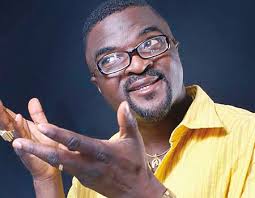
    Obesere

    Why did it trend again?

    Here’s what I think, the reason Egungun Be Careful went viral wasn’t just because of the beat. It’s because it felt like life advice we could all laugh at. Nigerians are good at that. We turn pain and wisdom into jokes. I remember a lot of people used the sound to describe breakups, bad investments, failed stunts, anything that looked like a mistake waiting to happen. One viral version even added a line that wasn’t in the original:

    “E don happen, I don tell am, motor don jam am, him family don carry am.”

    It was dramatic, exaggerated, but that’s the point. It carried the same Yoruba lesson. Don’t let pride lead you into trouble.

    What started as a streetwise Fuji warning became a proverb for a new generation.
    The beat may have evolved, but the wisdom still hits the same.

  • What the Ṣẹ̀kẹ̀rẹ̀ says

    What the Ṣẹ̀kẹ̀rẹ̀ says

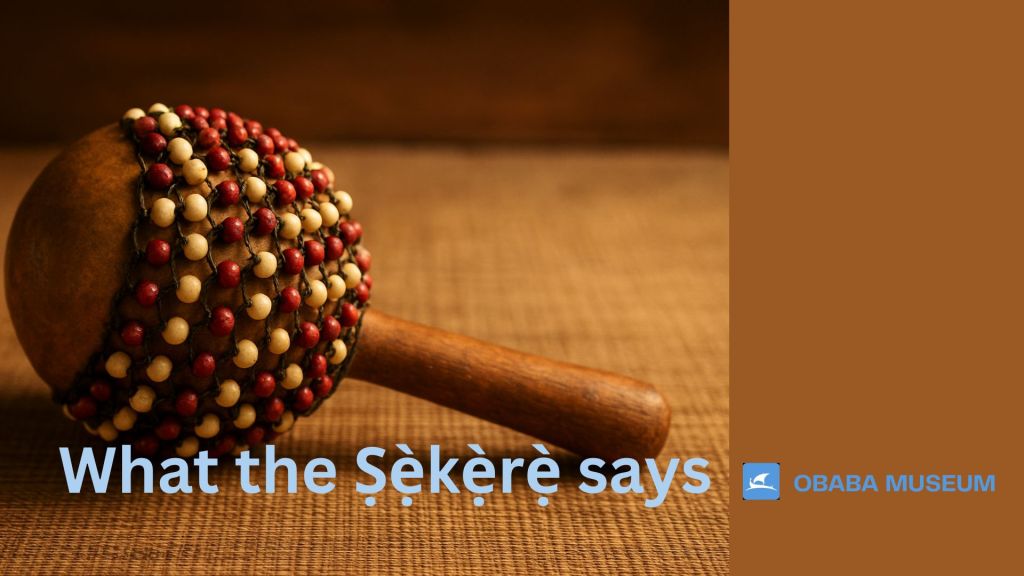
    Across much of West Africa, the ṣẹ̀kẹ̀rẹ̀ is more than a musical instrument, it is a symbol of joy, community, and rhythm. Made from a dried gourd covered with beads or cowries, it’s one of those instruments that almost everyone recognises by sound. When you hear it, you know something good is happening.
    Among the Yoruba people, the ṣẹ̀kẹ̀rẹ̀ is a staple in traditional music and ceremonies. It is rarely played in moments of sadness, such as funerals and definitely not during mourning, because it’s seen as a bringer of joy. Its rhythm is tied to celebration, thanksgiving, and togetherness. You’ll find it at weddings, naming ceremonies, festivals, and even in religious worship.
    And this isn’t only in Yorubaland. Across Africa, there are instruments that look and sound like the sekere – in Ghana, it’s called axatse; in Senegal, chekere; and in some parts of East Africa, there are similar shakers made from gourds and seeds. However, they all share the same purpose: to keep rhythm and to keep people connected. The ṣẹ̀kẹ̀rẹ̀’s sound travels easily, crossing languages, borders, and emotions.

    For me, the sound of the sekere brings back the village. I remember those mornings when my dad would take me along on his trips home. He was a generous man; everyone knew him for that. And most mornings started with music. You’d just hear the sound of the sekere from outside, women singing and laughing as they came around. In Igboland, they call them Umuada; in Yagbaland (where I hail from), the women would belong to an Egbe Obinrin (women’s group or club). But they often came as a group, celebrating, greeting, and, honestly, trying to make my dad “drop something.”
    The sound filled the compound, warm, cheerful, and alive. It wasn’t just about the beats; it carried meaning. It said, ‘we’re here, life is good, let’s share it together’.
    When I asked a friend what the sekere means to him, he said something that really stayed with me:


    “The Yoruba have a saying that the sekere doesn’t go to a place of sadness, not to funerals or war. It’s an instrument of joy, peace, and celebration. The sekere brings melody and smiles to people’s faces. It’s often used at naming ceremonies and marriages, and even to encourage generosity. It lays the foundation for other instruments that rhythm that every other sound builds on. Without the sekere, the music feels incomplete.” – Adekunle


    And that’s true. The sekere carries more than sound; it carries memory. It reminds us of what it means to live in rhythm with others, to share joy, to celebrate generosity, and to keep our traditions alive. For me, that sound will always mean home, community, laughter, and mornings when life felt simple and connected.

  • When Elephants Fight Again: ASUU, CONUA, and the Forgotten Victims

    When Elephants Fight Again: ASUU, CONUA, and the Forgotten Victims

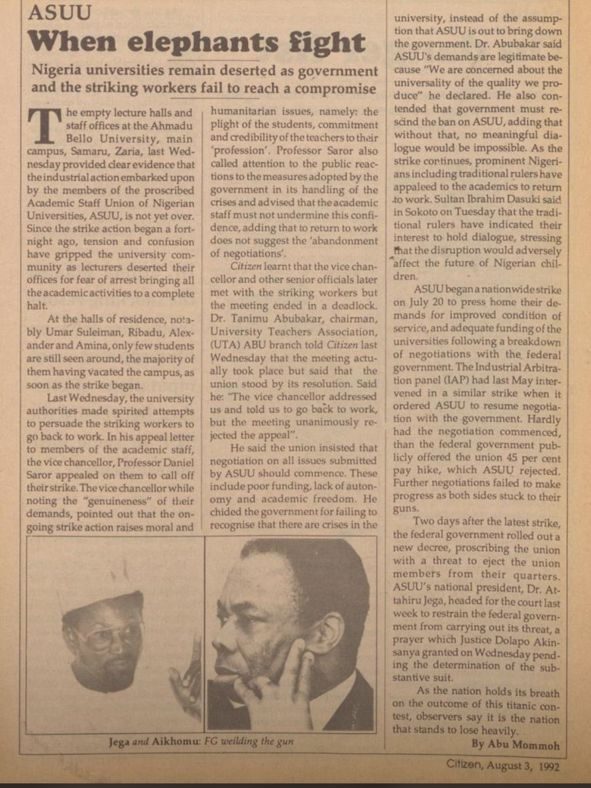
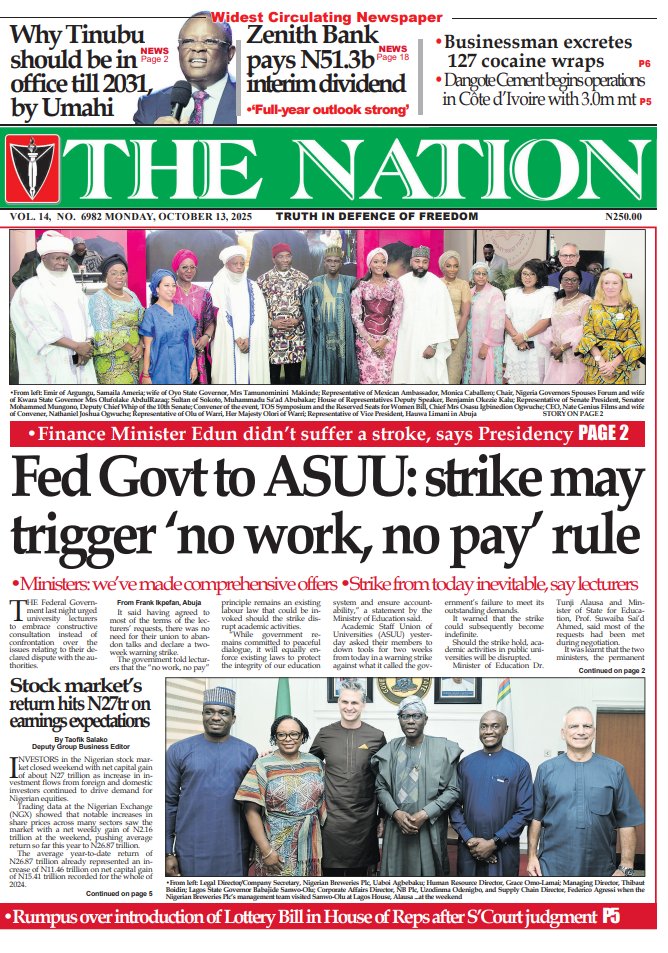
    In August 1992, The Citizen newspaper carried a bold headline, “When Elephants Fight.” It captured the standoff between the Academic Staff Union of Universities (ASUU) and the Federal Government of Nigeria. More than three decades later (2025) the same script is being replayed. Only now, a third elephant has entered the field: the Congress of University Academics (CONUA).

    Since its founding in 1978, ASUU has been at the centre of university activism in Nigeria. Its first strike in 1988 set the tone for a long tradition of confrontation between academics and the state. The goals have always been clear: fair pay, academic freedom, and improved university funding. The strategy, however, has remained unchanged (indefinite strikes that bring the entire system to a halt).

    The 1992 crisis, which once dominated national headlines, reflected the same story we see today: a government reluctant to fulfil agreements and a union unwilling to change its approach. What is most painful, however, is that the true victims have always been the same; students whose academic lives are suspended in uncertainty.

    Today, CONUA presents itself as a reformist alternative, distancing its members from ASUU’s constant strikes. It seems to speak the language of “dialogue” and “continuity” rather than confrontation. Whether this marks a genuine transformation or political posturing remains to be seen. Still, its rise reveals growing frustration within the academic community itself.

    Forty years on, ASUU’s relevance is now questioned more than ever. Can a union remain the conscience of the university system if its methods continually harm those it claims to protect? The story of 1992 and 2025 may be separated by time, but the pattern is painfully similar.

    As long as the elephants continue to fight, the grass (the students, their parents, and Nigeria’s fragile education system) will always bear the scars.

  • How a Single Word Took Over TikTok

    How a Single Word Took Over TikTok

    If you have been scrolling through TikTok lately, you’ve probably heard it. Sometimes it is shouted with dramatic flair, sometimes it is whispered like a secret, sometimes it drops right at the climax of a joke. Nobody explains it. Nobody even pauses to ask what it means. But somehow, everyone gets it. I guess that is what makes for a good inside joke.

    Like so many internet catchphrases before it, Atassa has become a sound for all occasions. It slips into reaction videos, skits, and music edits. You can think of it as a kind of verbal seasoning sprinkled wherever you need extra spice. But here is the thing, if I ask you where it started, you fit no sabi o.

    And that is because Atassa is not alone. It joins a long tradition of viral words that the internet grabbed, reshaped, and turned into inside jokes. Think back to Twitter’s “Bomboclat” wave or the bizarre Sco Pa Tu Mana era. Did I see you nod? If you did, you be ancestor o. I am just kidding sha.

    But jokes apart, how do random words go from obscure origins to global entertainment? And what happens when their meanings get lost along the way? That is a question worth pondering. Perhaps you could share your thoughts.

    On TikTok, Atassa now works almost like a sound effect.

    Someone stumbles in a skit. Atassa!

    A punchline lands. Atassa!

    A dramatic reveal hits. Atassa!

    The good thing is that it is flexible, ambiguous, and rhythmic enough to fit any vibe.

    But where does it actually come from? That is where things get interesting.

    Some say it came from a dream. A creator from Sàbè in Benin claimed he woke up shouting Atassa and turned it into content. Others link it to the Fon language, where it can mean something as ordinary as basin. A few argue it is just a random chant.

    Origin story aside, once TikTok got its hands on it, the meaning did not matter anymore. Atassa has now become more of a feeling than a definition.

    Remember the Bomboclat Trend
    If Atassa is today’s viral darling, Bomboclat was yesterday’s Twitter obsession. Around 2019, timelines were suddenly flooded with it. The format was simple. Post a picture or clip with the caption “Bomboclat” and wait. Within minutes, replies rolled in with witty captions, sarcastic remarks, or hilarious re-interpretations of the image.

    The first viral use, according to reports, was a September 2019 tweet with two pictures from the cartoon CatDog. From there, it became Twitter’s shorthand for ‘caption this’

    But here is the twist. Bomboclat is not just a fun syllable. In Jamaican Patois, it is a loaded expletive with cultural depth. Some sources even trace it back to the literal meaning of ‘toilet paper’ or ‘menstrual cloth’. In essence it is used as a sharp insult and a release of frustration. On Twitter, though, it was stripped of all that and turned into a harmless meme.

    The critique here is obvious. When language travels online, especially across borders, it often gets flattened. What Jamaicans wield with emotional force became just another tool in Twitter’s joke arsenal.

    Don’t forget the ‘Sco Pa Tu Mana’ Era?

    There was also Sco Pa Tu Mana, the nonsense word that ruled Twitter in 2019 before it got overthrown by ‘Bomboclat’. It came from a Ghanaian track by Kawoula Biov featuring Patapaa who was known for his chaotic, offbeat style (remember One Corner? Yeah na him sing am). On this particular track, he slipped Sco Pa Tu Mana into his verse not as a meaningful word but as filler.

    The internet, of course, could not resist. Soon, Twitter users worldwide were posting random phrases with the hashtag #Scopatumana. It became a kind of linguistic dare. A prompt for opinions, like saying ‘what do you think about this? Or ‘share your thoughts’. A photo of a food, a celebrity or even a random object could be captioned Sco Pa Tu Mana, and the replies would pile in.

    What made it work was not meaning but rhythm and vibe. Like Atassa, it was catchy. And just like Bomboclat, it thrived on call and response. It did not need a dictionary definition to spark joy.

    Now, if you put Atassa, Bomboclat, and Sco Pa Tu Mana side by side, you would notice a common pattern. They are all short, punchy, and flexible. They are the perfect ingredients for memes and endless remixing. They also thrive on call and response culture. One person posts it and others quickly respond, pile on, or reframe it in their own style. Most importantly, they flatten cultural depth. Bomboclat became detached from its Jamaican roots and turned into a global joke. Sco Pa Tu Mana, lifted from a Ghanaian rap verse, left its local setting and evolved into meme-speak. And Atassa, whether dream-born or rooted in Beninese language, is no longer about its origin. E don turn content.

    That is the paradox of internet language. On one hand, words can unite us across borders. On the other hand, they raise uncomfortable questions. Are we celebrating cultural expressions or stripping them of meaning? And once the internet takes a word, who really owns it?

    Atassa might have been born in a dream, a Benin household, or a football stadium. Bomboclat might have been a Jamaican curse. Sco Pa Tu Mana might have been nonsense. But once they hit the internet, they became something else entirely (memes that meant everything and nothing at the same time).

    And that is the beauty and the tragedy of internet language. A word can carry centuries of cultural weight or absolutely no meaning at all. Either way, the internet will remix it until it is unrecognizable.

    So the next time you hear someone yell Atassa on TikTok, remember this. You are not just laughing at a sound. You are watching language itself go through the blender of the internet, and somehow it still comes out catchy.

  • The Strategy of Total War

    The Strategy of Total War


    I recently took a Global History course, and one of the major concepts that stood out for me was the idea of total war. When I first encountered the term in Von Clausewitz’s On War, I was struck by its depth, the idea of a nation pouring out all available resources in its pursuit of victory. It made me wonder: how often do we, in our own lives, pour everything we have into achieving a goal?


    Total war refers to a form of warfare where a nation mobilizes all its resources—economic, industrial, social, and political—towards the war effort. In such conflicts, the distinction between combatants and civilians often blurs, as civilian infrastructure, industries, and populations become direct targets to weaken the enemy’s ability to sustain the fight.


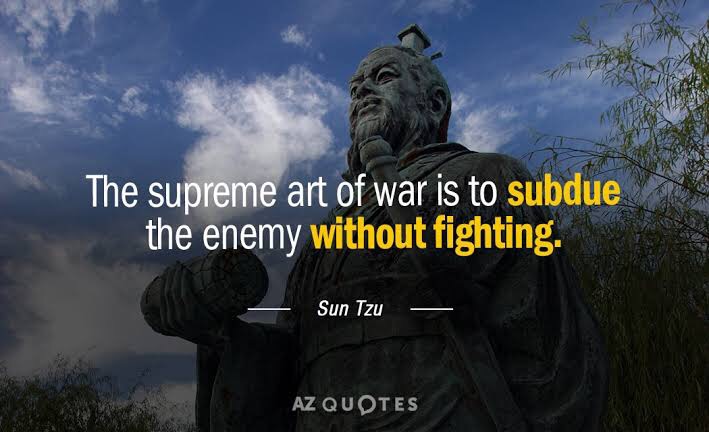
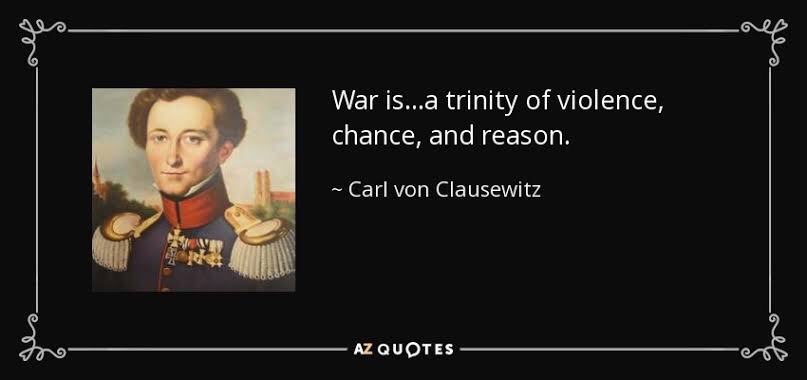
    While Sun Tzu’s The Art of War teaches that the supreme goal is to conquer the enemy without fighting, Clausewitz counters with a starkly different perspective. For him, war is a duel on an expansive scale, one where the goal isn’t just victory but the utter destruction of the enemy’s capacity to fight.
    Therefore, the objective of total war isn’t just to defeat the enemy but to destroy their capacity to fight altogether. It’s a strategy that demands total commitment to success. But, beyond active combat, do we consciously employ this tactic in our own lives? Reflecting on how the concept has shaped history, I wondered if total war can teach us something personal and profound about achieving success.


    The concept of total war can be traced back to Clausewitz, the 19th-century Prussian military theorist who emphasised using every available resource to achieve complete victory. While he didn’t coin the term, his ideas laid its foundation. He saw war not as an isolated event but as an extension of politics by other means, requiring nations to mobilise fully and relentlessly. The two World Wars showcased total war in its purest form, with entire economies and populations mobilised for the fight.

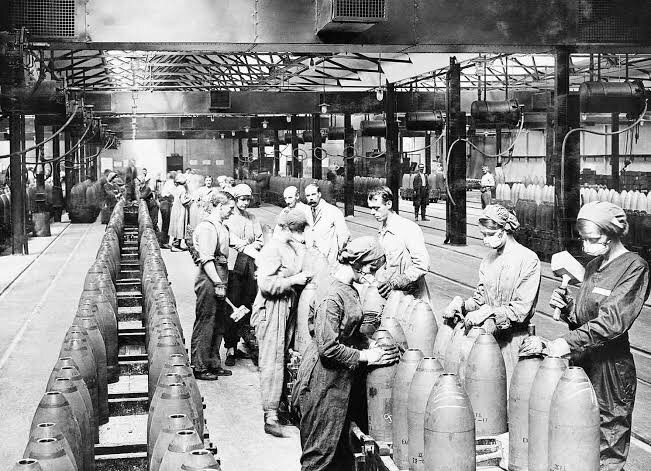
    Women working the factories during World War 2

    Women stepped into factories leaving enough men of fighting age for active combat, civilians endured rationing, and whole cities became targets of strategic bombing. Even before these global conflicts, the Napoleonic Wars in Europe had set the stage. Napoleon Bonaparte blended nationalism and military innovation, rallying entire nations behind his campaigns. Similarly, during the U.S. Civil War, Union General Sherman’s scorched-earth tactics targeted not just soldiers but the entire war-making infrastructure of the South.


    Another vivid example could be found in Nigeria’s federal military government, which employed a form of total war during the Civil War (1967–1970). Through an economic blockade, the government aimed to isolate Biafra, targeting its supply chains and crippling its war economy. This blockade not only curtailed the secessionists’ ability to sustain the conflict but also had a profound impact on civilian life. Necessities such as food, medicine, and infrastructure became scarce, leading to widespread suffering and famine. While the strategy contributed to ending the war, it highlighted the devastating human cost of total war tactics. Through an economic blockade, the government targeted Biafra’s ability to sustain its fight, cutting off supplies and resources. This strategy ultimately ended the secession attempt but at a heavy humanitarian cost.


    These moments didn’t just change the nature of war; they reshaped societies, leaving profound and lasting impacts. For instance, women stepped into roles traditionally held by men, taking over factory jobs and contributing directly to war efforts, which spurred post-war feminist movements. Meanwhile, in colonised nations, the sacrifices made during wartime fueled demands for independence, as populations began questioning the legitimacy of colonial rule. These changes weren’t just fleeting adjustments but seismic shifts that transformed the social and political fabric of the world.
    The essence of total war is however not confined to military strategy alone, it’s a mindset that has reshaped fields like business, sports, and social movements. Steve Jobs, for example, approached Apple’s products with a total war mentality, pouring every bit of focus and energy into their perfection. He was able to come up with innovations that set it apart from other smartphone brands. The same all-in approach applies to sports legends like Serena Williams and Michael Jordan, whose unwavering commitment turned them into icons.
    Even in everyday life, the principles of total war can be seen in the home. Parents juggling work, personal goals, and family responsibilities often employ a form of “total war” by aligning every aspect of their lives towards providing for their families – from working multiple jobs while still making time to help with homework and attending school events.
    What if you applied the principles of total war to your personal goals? Imagine mobilizing all your resources (time, energy and focus) towards a single mission what would be the results?

    Do you think it applies to you? Let’s hear your thoughts in the comments.

  • Retrospective Fallacy: The Trap of History

    Retrospective Fallacy: The Trap of History

    History has a way of turning us into hindsight experts—people who seem to know all the answers when looking back but forget the complexities of the moment. We usually tend to judge historical events and decisions with the clarity of hindsight, forgetting how unclear and uncertain things were at the time for those individuals, this term is called Retrospective Fallacy. This is similar to what we do to football players on the pitch forgetting that as onlookers we have a better view of the whole field than the players who are limited in sight.

    For instance, imagine trying to make decisions in 1966 Nigeria amidst the political chaos and ethnic tensions—it wasn’t as straightforward as it might seem now.

    In Nigeria, this attitude is prevalent, conversations about the military coups of 1966 and leadership failures often turn into “if only” scenarios. “If only the Balewa government had continued, the Civil War wouldn’t have happened.” Or, “If only our leaders weren’t so shortsighted, Nigeria would be Dubai by now.” Sounds familiar, doesn’t it?

    First, let’s tackle the elephant in the room: the 1966 coups.

    Many Nigerians see them as the original sin, the moment everything fell apart. Many argue that if the civilian government had been left alone, the Civil war would not have happened and perhaps, Nigeria would have become the greatest nation in the world. 

    But is this really true?

    By the time Major Nzeogwu and his colleauges staged the first coup in January 1966, Nigeria was already dancing kukere on the edge of a political cliff. Here’s why:

    There were Ethnic and Regional Rivalries, Nigeria’s politics was like a bad soap opera, with the NPC, AG, and NCNC playing the lead roles.

    Plot twists? Plenty. Trust? Zero. 

    It did not help matters that all the major political parties were based on regional and ethnic loyalty. NPC for the North, AG for the West and NCNC for the East.

    Election Drama was another episode of the soap opera. The 1964 and 1965 elections were straight out of Nollywood—rigging, violence, and thuggery galore. The Western Nigeria elections, in particular, were characterized by ballot box stuffing, burning of opponent ballot boxes, and unfair counting of votes. The incident degenerated into what became known as ‘Wet tie’ (meaning burn him/her in Yoruba), a situation where political opponents and properties were set ablaze after being soaked with petrol.

    To add salt to injury there were great economic inequalities. Resources weren’t just unevenly distributed; they were hoarded like jollof rice at Nigerian weddings. Politics was characterized by nepotism and favoritism; you needed to have ‘long legs’ to share the national cake. 

    The Balewa government wasn’t exactly riding on a wave of public love as some may want to believe. Between the chaos in the Western Region and the brewing dissatisfaction up north, the country was a ticking time bomb. So, when the coup came, it wasn’t so much a shocking plot twist as it was the next episode in an already messy series. Rumours have it that while the Junior officers (Nzeowgwu and the rest) were plnning a coup, the generals had also been scheming. The junior officers just happened to strike first.

    But what if the first coup hadn’t happened? What if Balewa had continued? Would Nigeria have avoided the Civil War?

    Maybe. Maybe not.

    Jenga game

    The truth is, Nigeria in 1966 was like a shaky Jenga tower. Pull one block—coup or no coup—and the whole thing was bound to come crashing down. The structural issues—ethnic divisions, poor governance, economic disparities—were too deeply rooted to disappear overnight. Without major reforms, even the most angelic leader (if such a thing exists) would have struggled to keep the peace.

    If there’s one thing Nigerians excel at, it’s finger-pointing. Leaders from Balewa to Buhari have been blamed for everything from economic woes to why NEPA took the light while favourite TV show, Super Story, was being shown. This is not to say that the leaders did the best to stabilize the nation but let’s break it down:

    Yakubu Gowon is often criticized for post-war policies in Nigeria and for making Nigeria an oil-dependent economy. But give the guy a break—he was trying to stitch a broken country back together. The nation may have degenerated into a Civil War during his regime but don’t forget, the seeds of discord had been sown even before independence. 

    Alhaji Shehu Shagari, Nigeria’s second civilian leader was also demonised for an economic meltdown in the Second Republic. But oil prices had tanked globally, and the country was already neck-deep in debt. It’s no surprise that those who overthrew him further destroyed the economy.

    Sani Abacha… Okay, okay you don catch me, lol. But even his excesses point to systemic flaws that long predated his regime. He had been a participant and beneficiary of all successful coups in Nigeria and simply benefitted by aligning himself with the power brokers.

    Blaming leaders is easy. Understanding the systems they operated within? That’s harder but much more enlightening.

    The summary of my story is that history isn’t black and white, the retrospective fallacy is everywhere, even outside Nigeria. 

    Think about World War I, people slam the Treaty of Versailles for being too harsh, but back then, the Allies had voters demanding Germany pay for the war. Or is it British Prime Minister, Neville Chamberlain’s appeasement policy before World War II—easy to mock now, but in the 1930s, avoiding another global war seemed like a pretty great idea.

    Nigeria’s 1966 coups are no different. Sure, they were pivotal, but they didn’t happen in a vacuum. They resulted from years of unresolved tensions, poor governance, and mistrust. Blaming them (or any leader) for all our problems is like blaming a broken chair on the last person who sat on it, ignoring the termites that had been eating away at it for years.

    History isn’t just about what happened; it’s about why it happened—and what we can learn. So, instead of playing the blame game or indulging in “what if” fantasies, let’s focus on the real lessons:

    1. Context is King: Understand the challenges and pressures people faced at the time.

    2. Simplistic Narratives Are Misleading: Life is messy, and so is history.

    3. Learn, Don’t Lament: Use the past to inform the future, not to wallow in regret.

    So, the next time someone says, “If only this or that didn’t happen,” remind them of the termites. And then, maybe, steer the conversation toward what we can do differently today. After all, history isn’t just there to be judged; it’s there to teach.

  • The January Myth

    The January Myth

    There is a common joke in Nigeria that January seems to last forever. In fact, most Nigerians joke about January being the longest and toughest month of the year. While the month does indeed have 31 days, the perception of its “length” often has little to do with the calendar. Many people enter January after the festivities of December, a month characterised by high spending on celebrations, travel, and gifts. The financial strain becomes evident for most as the new year begins, leading to the illusion that January drags on longer than usual. Add to this the wait for salaries—which often feel delayed due to early December payouts—and it’s easy to see why the month gets its reputation as being “longer.”

    Photo Credits: littleleague.org

    Another widespread belief is that January is a month of universal financial drought. While it’s true that many people feel the pinch after December’s expenses, this isn’t a universal truth. Smart financial planning can make January no different from any other month. Still, the myth persists, perhaps as a way to justify frugality or avoid financial commitments during the month. It’s worth noting that this perception is not unique to Nigeria but resonates in many cultures around the world where December festivities are equally extravagant.

    The name January has fascinating roots in Roman mythology. It is derived from Janus, the Roman god of beginnings, transitions, and endings. Janus is often depicted with two faces—one looking forward into the future and the other backwards into the past. This symbolism makes January a month of reflection and resolution, as people take stock of the previous year while setting goals and intentions for the one ahead. Its position as the first month of the Gregorian calendar makes it a symbol of new beginnings. It is a time for fresh starts, planning, and envisioning the year ahead.

    In Nigeria, this month is often marked by a renewed sense of purpose, with many embarking on personal development goals, fitness routines, and financial resolutions. Churches and religious organizations also hold prayer and fasting sessions to dedicate the year ahead, highlighting the spiritual importance of the month. We usually have a lot of New Year resolutions, and this is the point at which the zeal to achieve the resolutions is highest. Moreover, January serves as a reminder of the cyclical nature of time. Just as Janus looks both ways, so too does the month encourage us to learn from the past while embracing the opportunities the future holds.

    Credits: Youversion


    However. the January Myth (its perceived length and financial strain) is more psychological than factual. By planning ahead and managing expectations, the “longest month” can be reframed as a productive and meaningful period. Rather than dreading January, it can be embraced as a chance to set the tone for the rest of the year. After all, the way we perceive time often has more to do with mindset than reality.

    What do you think? Let’s hear your January story.

  • The Heartbeat of Igbo Apprenticeship: A Time-Honored Tradition


    Watching Afamefuna recently stirred up my thoughts on the Igbo apprenticeship system. After chatting with a friend from the East, I felt compelled to write about it.

    The Igbo people, famously associated with business and enterprise, have nurtured this system through the centuries, with its significance surging right after the Civil War in 1970.

    Credits: @filmoneng (Instagram)


    For the Igbo apprentice, it’s not just about learning a trade, his experience is a cultural journey filled with resilience, community spirit, and the drive for independence.
    Basically, the Igbo apprenticeship system is a form of vocational training where young individuals, typically males, are placed under the mentorship of established artisans or business owners to learn a specific trade or craft. This apprenticeship can last anywhere from a few years to a decade, during which the apprentice gains hands-on experience, technical skills, and valuable insights into the chosen profession.


    Imagine Chibuzor, a young boy from Onitsha who, instead of heading off to a university, moves to his uncle’s shop in the bustling Alaba Market in Lagos to learn trade. Over the next five years, Chibuzor will learn everything about running a business, from bargaining with suppliers to handling stubborn customers.

    Credits: Onedotphoto

    Every morning, he’s there to sweep the shop, stock the shelves, and shadow his uncle. This is the essence of the Igbo apprenticeship system. Its comprehensive approach to education and economic empowerment is what makes it unique. Unlike formal education systems that often prioritise theoretical knowledge, this system emphasises practical skills and real-world experience.


    In this system, the relationship between the oga (master) and the nwa boy (apprentice) goes beyond a simple job. Chibuzor learns not only the trade but also the art of igba mbo—hard work. He watches his uncle negotiate with customers and manages the daily hustle, and, over time, he becomes familiar with the highs and lows of the business. This is hands-on learning at its finest, and it teaches more than any classroom ever could. Apprentices not only learn the technical aspects of their trade but also absorb invaluable lessons in entrepreneurship, financial management, and social responsibility from their masters.

    One of the unique aspects of this system is its principle of mutual exchange. Chibuzor works long hours, often late into the evening, but he knows it’s for a purpose. In exchange for his service, his uncle will eventually “settle” him—essentially providing him with the capital to start his own shop. This isn’t just business; it’s a cycle of empowerment, where today’s apprentice becomes tomorrow’s oga.

    And when Chibuzor finally returns to Onitsha to open his own shop, he brings with him the economic ripple effect of his success, creating jobs for his community and investing back into the local economy.


    What’s remarkable is how this system has adapted over time. Once upon a time, apprentices focused on traditional trades like palm wine tapping, blacksmithing or carpentry. Today, young men and women are learning everything from computer repairs to stock trading, all through this same mentorship model.

    Even in the fast-paced world of tech, the Igbo apprenticeship system is alive and well, bridging the gap between tradition and innovation.

    But it’s not always smooth sailing. There are tales of apprentices who, after years of service, feel betrayed by their masters. In some cases, as the settlement day approaches, the master might accuse the apprentice of theft or other wrongdoings, sometimes to avoid the cost of setting them up. For some, it’s a heartbreaking end to years of loyalty. Despite the possibility of such a story of betrayal, there are countless more of success, where apprentices go on to thrive and even become mentors themselves.

    The Igbo apprenticeship system is a beautiful reminder of how community, hard work, and shared success can lift entire families and towns. In a world where education often means paper certificates, this tradition champions real-world learning and celebrates the journey from nwa boy to oga.


    So, to all the Chibuzors out there, tirelessly grinding away in shops and stalls across Nigeria, your journey matters. You’re not just learning a trade—you’re keeping a legacy alive. Let’s celebrate this tradition and all it stands for.

    What are your thoughts? Do you know someone who has gone through the Igbo apprenticeship system? I’d love to hear your stories!

  • THE STORY BEHIND THE USE OF BRAILLE              

    As a curious child, I always found myself poundering over the seemingly impossible feats achieved by those who were visually impaired. How do blind people navigate the world? How do they read?

    These questions ignited a flame of curiosity within me. In the end, my curiosity about blind persons, especially how they read, led me on a transformative journey of discovery, opening my eyes to the beauty of the Braille.

    It all started one lazy summer afternoon when I stumbled upon a documentary showcasing the remarkable abilities of the blind. Intrigued, I watched intently as individuals effortlessly deciphered raised dots on paper into a world of words and ideas. This revelation left me in awe, sparking a desire to understand the intricacies of this tactile language. Simply determined to learn more, I delved into a research uncovering the history and significance of Braille and I am grateful for the opportunity to have a glimpse into the power of adaptation and innovation.

    A Braille machine

    Braille is a tactile system of touch Reading and writing for blind persons in which dots and patterns represent the letters of the alphabet and are felt by the fingertips. It can be either read or written on hard paper or by using renewable braille displays that connect to computers and smartphone devices.
    Brailles are also produced by special machines with six keys, one for each dot in the braille cell.

    Louis Braille (Credits: Britainnica)


    Braille, which is originally known as “night Reading” is named after it’s creator, Louis Braille. Louis Braille who was blind as the age of three, later invented the braille writing system in 1824 at the age of 15. Thereafter, in 1829 Louis Braille published his first Braille book with the idea of using dots as the basis of a tactile alphabet for the blind at that time.
    Later on, this system of writing by Louis Braille gradually came to be accepted throughout the world as the fundamental form of written communication made to enable blind persons to read.

    The use of braille is a significant milestone in the history of empowering individuals with visual impairment. He developed this with the idea of raised dots arranged in specific patterns to represent letters, numbers and punctuation marks, allowing blind people to read and write.
    Braille reformed education and accessibility for the blind, enabling them to assess textbooks and other information independently.

    Today, Braille, being a compilation of code for 133 languages from around the globe, is a vital tool for communication and literacy within the blind community contributing greatly to their inclusion and participation in the society.

  • BRICS: A Potential for Global Change

    BRICS: A Potential for Global Change

    The emergence of the BRICS ( Brazil, Russia, India, China, and South Africa) bloc has marked a significant shift in the global economic and political landscape. This coalition, representing diverse regions and cultures, has become a formidable force challenging the traditional dominance of Western powers. 

    The acronym BRIC was coined by economist jim O’Neil to classify the top 4 countries which he believed had the ability to challenge the G7 coalition in terms of global economic, political and militaristic dominance, in the foreseeable future.

    BRIC formally came into existence in 2009, recognizing the shared economic interests and concerns of its member nations. While individually these countries have unique historical backgrounds, the alliance is rooted in a common aspiration for a more balanced and inclusive global order.

    South africa, under the leadership of former President Jacob Zuma, expressed interests in joining the BRIC coalition in 2009 , because their interests were similar to those outlined by BRIC.

    They later made this move in 2010. Hence,BRIC became BRICS with the addition of south africa.

    The rise of BRICS reflects a desire to break away from historical imbalances and create a multipolar world where diverse voices are heard.

    Also, the US Federal Reserve has raised interest rates in recent years. As a result of this, developing countries have widely suffered from paying higher interests on their dollar debt and are battling the exchange rate impact from a strong dollar. The interest to borrow in local currencies or other currencies is strongly motivated by economic considerations, and this has made many countries consider aligning themselves with BRICS

    Together, the BRICS coalition has a nominal G.D.P of $26.03trillion, which is a bout 23.12% of the world GDP.

    BRICS hopes to challenge the dominance of the G7 bloc through three major pathways: 

    1. Political and security collaboration: BRICS Ministers of Foreign Affairs and International Relations also usually meet twice a year – once for a standalone meeting and again on the margins of the UN General Assembly. BRICS national security advisers meet to coordinate a BRICS approach to peace and security matters.[1]

    2. Financial and Economic Collaboration:The New Development Bank (NDB) was established in 2015 with a AAA and AA+ credit rating to play a catalytic role in providing financial support to emerging markets and developing countries for infrastructure gap, sustainable development and equity in power-sharing.[2]

    3. Cultural and People to people Collaboration:BRICS cooperation provides tangible benefits for its member countries through research and innovation, energy, health and education. More than 100 multilateral BRICS research projects have been funded under the BRICS Framework Programme. The BRICS partnership involves a strong commitment to joint ownership and shared responsibility, the real and open sharing of experience, expertise and resources; and a determination to contribute BRICS respective, comparative scientific and technological strengths for the advancement of the global good.[3]


    While the BRICS coalition has taken steps to achieve some of their goals through effective collaborations, there are still some challenges that they are yet to surmount.

    Some of these challenges are:

    selection of common currency for international trading within the BLOC: 

    There have been many white paper proposals on the creation of a new common currency for trading. Some countries also proposed the use of their currency as a local currency for trading amongst each other. Many countries are against the use of other countries’ currency as a common legal tender because “he who pays the piper, calls the tune”.


    Volatile changes in economic interests amongst BRICS+ Countries:

    There are speculations that most countries are using BRICS as a means to ‘get back’ at the United States. If relationships between these countries and the United States improve, they might reconsider their positions in the BRIC alliance.


    Only the future can tell whether BRICS can successfully meet their objectives, which silently include: dedollarization of the world economy.


    REFERENCES:

    [1][2][3] BRICS (2023). BRICS and Africa: Partnership for Mutually Accelerated Growth,

    Sustainable Development and Inclusive Multilateralism. Retrieved from https://brics2023.gov.za/three-pillars-of-cooperation/#:~:text=Financial%20and%20Economic%20Cooperation,of%20food%20and%20energy%20insecurity

  • Crafting a Great Piece Through Everyday Language

    I was going through some entries for the first edition of our magazines and quite a number of them depicted vivid imageries. However, a particular essay stood out and I kept grinning while reading, I was just asking myself why I enjoyed reading it so much and here’s why.


    The simplicity made it so realistic and relatable. The writer was narrating a particular hiking adventure and it was sort of a gist-like writing so you could see emotions in the simple diction used.

    For me the greatest writings are those which convey messages, stories, lessons or facts in the simplest way possible. Think about it, your favourite teacher/lecturer in school was the one who could explain topics with stories or vivid day to day analogy.


    So when next you’re writing, keep it in mind that your goal isn’t to show off your grasp of vocabulary but to pass your message to as many audience as possible.

  • NGFA24

    NGFA24


    In this realm our voices intertwine
    A resilient spirit,fierce yet divine
    The hustles and bustles our daily reminder
    Thundering in our minds, no time to squander.

    In this prime we leave no stones unturned
    Busting our moves we leave zero latches unanchored
    No yielding ground, No compromise
    No hold backs yes we strife!
    Oh Poverty, the end of your demise.

    Let it ripple, this anthem true
    Triple the yarn in your favorite hue
    With laughter and joy or hardships blow
    This mantra, a steadfast flow
    Even when it comes with waves of tsunami
    Omo Iya mi no gree for anybody!!!


  • January 15: From Surrender to Salute

    January 15: From Surrender to Salute

    It’s Thursday, the 15th of January 1970, Philip Effiong, the acting Head of State of Biafra announces the unconditional surrender of Biafra, following Ojukwu’s ‘foreign peace trip’.
    We’re told that Colonel Olusegun Obasanjo, GOC 3 Marine Commando Division, had earlier on received the instruments of surrender from General Effiong the previous day at Amichi village in Anambra – a previous stronghold of Ojukwu.

    Gowon shake hands with Effiong


    At Dodan Barracks, the Nigerian head of State Major-General Yakubu Gowon shake hands with arrested senior Biafran officers that were presented to him by Colonel Olusegun Obasanjo. Obasanjo said the Biafran officers were reporting for “reassignment and redeployment”. Gowon greeted the leader of Biafra’s delegation Phillip Effiong with the words “how are you my friend?”
    Effiong then proceeds to deliver the surrender speech:

    Gen. Effiong delivers his speech declaring the surrender of Biafra


    I, Philip Effiong, do hereby declare: I give you not only my own personal assurances but also those of my fellow officers and colleagues and of the entire former Biafran people of our fullest cooperation and very sincere best wishes for the future.
    It is my sincere hope the lessons of the bitter struggle have been well learned by everybody and I would like therefore to take this opportunity to say that I, Maj. Gen. Philip Effiong, officer administering the government of the Republic of Biafra, now wish to make the following declaration:
    That we are firm, we are loyal Nigerian citizens and accept the authority of the federal military Government of Nigeria.
    That we accept the existing administrative and political structure of the Federation of Nigeria.
    That any future constitutional arrangement will be worked out by representatives of the people of Nigeria. That the Republic of Biafra hereby ceases to exist.


    Following this, Gowon delivers his ‘Speech to the Nation’ signalling the end of the Nigerian Civil War. He states that the ‘so-called rising sun of Biafra is set forever’ and that it would be ‘a great disservice for anyone to continue to use the word ‘Biafra’ to refer to any part of the East Central State of Nigeria’. He then calls on Nigerians to ‘build a new nation’.
    In the aftermath of the war, Nigeria faced the challenging task of healing wounds and reintegrating the former secessionist region of Biafra into the larger nation.

    The Federal Military Government declares that the Armed Forces Remembrance Day which was previously marked on the 11th day of November would now be marked on January 15 every year in honour of the many lives lost in the bitter civil war and coup of 1966.


    Every January 15, we remember our fallen heroes and the sacrifices of all serving members of the Armed Forces. The heart of the commemoration lies in the laying of wreaths, a sombre ritual conducted at the National Arcade in Abuja and war memorials nationwide. Dignitaries, officials, and military personnel gather, honouring the fallen by placing wreaths at cenotaphs. Statewide observances, religious services, and military parades amplify the day’s gravity.

    President Bola Ahmed Tinubu at the 2024 Armed Forces Remembrance Day


    The President of Nigeria typically addresses the nation on Armed Forces Remembrance Day, reflecting on the significance of the occasion, expressing gratitude to the armed forces, and reaffirming the commitment to national unity and security. The Nigerian Legion plays a pivotal role in the planning of the ceremony which often begins two months before the event.
    Every soldier prays for peace because, they bear the brunt of violence.
    God bless the Armed Forces of Nigeria!

  • Effects of Sound Loops in Advertising

    Effects of Sound Loops in Advertising


    Recently my brother and I discovered a meat stall in Ojoo market where a voice keeps saying “Chicken wa Turkey wa o”, meaning there is Chicken and Turkey in Yoruba language. This messed with our heads and got me thinking on the effectiveness of sound loop in advertising.


    We all know sound is a powerful tool in the realm of advertising, and one technique that has gained prominence is the use of sound loops. These repetitive and catchy auditory sequences have proven to be effective in capturing attention, creating brand recall, and influencing consumer behavior. In this article, we explore the effectiveness of sound loops in advertising and how they contribute to a brand’s success.


    Sound loops serve as attention magnets in the crowded space of advertising. The repetitive nature of these auditory elements can quickly capture the listener’s attention, cutting through the noise of competing messages. Whether it’s a jingle, a short melody, or a rhythmic beat, a well-crafted sound loop can leave a lasting impression on the audience. If you are a football fan you probably will remember the 2010 FIFA World Cup advert with Shakira’s “Waka Waka” song.

    Shakira’s famous ‘Waka waka’ music video


    It also has the ability to evoke emotions and stir memories. A carefully designed sound loop can tap into the emotional reservoir of consumers, fostering a connection between the brand and its audience. Whether it’s a sense of nostalgia, happiness, or excitement, the emotional impact of sound loops can linger long after the advertisement is over. The Gen Z may not remember the popular peak milk advert featuring Kanu Nwankwo (Papilo), a popular hit that graced Nigerian televisions for years.

    Peak milk’s famous ‘Papilo’ advert


    Another interesting fact is that Repetition is a fundamental principle in advertising, and sound loops serve as a reliable tool for reinforcing key messages. By integrating the brand’s tagline or a memorable slogan into a sound loop, advertisers ensure that the core message is not only heard but etched into the listener’s memory. Most businesses who understand the importance of repetition employ fancy catchphrases like MTN’s “everywhere you go”, AIT’s “Sharing The African Experience, GLO’s “Grandmasters of data” among many others.


    Finally, repetitive nature of sound loops encourages audience engagement. When consumers find themselves humming or mentally replaying a sound loop, it indicates a level of engagement that goes beyond passive viewing or listening. This heightened engagement can lead to increased brand loyalty and a higher likelihood of conversion. Who wants to be a millionaire is one show that has captures the attention of the audience.
    These are just some of the advantages of sound loops and it shows us that when wielded effectively, sound loops can orchestrate a sonic symphony that resonates with audiences, leaving a lasting imprint on the consumer psyche and contributing significantly to a brand’s success in the market.
    We would also like to hear about your experiences with sound loops.

  • A Leap onto 24

    A Leap onto 24

    It’s January 1, 2024. the start of another year. Incidentally this year starts on a Monday but its also a leap year. Well don’t expect me to explain why any of these may line up with any theory, I’m just fascinated by the peculiarity of the year. A leap year affords those born on February 29 to at least celebrate their actual birth days.

    No need to choose March 1 this year 😉


    Of course many people have also set up resolutions and plans for the year, my advice however is to set SMART goals. I’m not particularly a fan of new year resolutions I just make a daily commitment to personal development. I try not to beat myself hard if things do not go particularly as expected, but that’s by the way.


    The line up of events for this year are numerous. Virtually every football confederation has a tournament this year – AFCON, UEFA Euro, CONMEBOL COPA America, AFC Asian Cup, CONCACAF Champions Cup, etc. Lets not forget the Paris 2024 Summer Olympics which begins on the 26th of July.


    The United States would also be electing a new President on Tuesday, the 5th of November, of course the primaries for various political parties starts from the 15th of January to the 10th of September.


    All this story just to let you know how lucky you are to witness a special year. You sef deserve some accolades, do not settle for less, you just might surpass your expectations. You could consider picking up cool habits and dropping off unproductive ones.
    We know most people keep a to-do list but its also important to consider a ‘not-to-do list’.
    For me, writing/journaling is a habit that followed me from the previous year and I expect to improve on it.


    Just glancing through my journals and ‘Snaps’ makes me realise how much progress has been made in my personal development, the fact that certain prayer points suddenly transited to reality and I hardly noticed, I got to achieve a lot of goals I didn’t think were possible but I mean, I could track them because they were itemised.
    Buttom line, dey write o.

    Thanks for reading through. Welcome to 2024, we wish you a blessed and prosperous year ahead.

  • Evolution of the Nigerian Army: From Colonial Origins to Modern Divisions

    Evolution of the Nigerian Army: From Colonial Origins to Modern Divisions


    The history of the Nigerian military could be traced back to the 19th century when British colonial forces first established a local presence in what is now Nigeria. In 1863, Lieutenant Glover of the Royal Navy took a significant step by selecting 18 individuals from the northern part of the country and organizing them into a local force known as the Glover Hausas. The primary responsibilities of these men who had just been freed from slavery included mounting punitive expeditions in the Lagos hinterland and protecting British trade routes in the Lagos region.

    Sir John Hawley Glover

    The force was essentially a paramilitary group with a dual role, serving both police and military functions. Two years later, in 1865, this local force was officially recognized and transformed into the Hausa Constabulary. As the name suggests, it continued to perform both policing and military duties under the governance of the Lagos colonial government. Subsequently, as part of a broader reorganization, the force’s name was changed to the Lagos Constabulary.


    The formation of the West Africa Frontier Force (WAFF) in 1901 was a pivotal development, unifying various paramilitary units across British dependencies in West Africa. In Nigeria, this led to the emergence of two distinct regiments: the Northern Nigerian Regiment and the Southern Nigerian Regiment. The Southern Nigerian Regiment, under the leadership of Lieutenant C.H.P. Carter (1899-1901) and Colonel J. Wilcox (1900-1909), played a vital role in various expeditions during the annexation of Nigeria by Lord Lugard between 1901 and 1903. The amalgamation of Nigeria in 1914 necessitated the unification of the Northern and Southern Regiments, leading to the establishment of the Nigerian Regiments.

    Queen Elizabeth inspects men of the West African Frontier Force (WAFF) on her Commonwealth Tour to Nigeria in 1956


    The Northern Nigerian Regiments were reorganized into what became known as the 1st and 2nd Battalions of the Nigerian Regiment, while the Southern Nigerian Regiment transformed into the 3rd and 4th Battalions of the Nigerian Regiments (NR). This consolidation aimed to create a unified military force for the entire nation, which was now under British colonial rule. As one would note, the military structure and organization were evolving in response to the changing political landscape and the needs of the colonial administration. This reorganization was a reflection of the broader administrative changes taking place during the colonial period. Additionally, it’s worth mentioning that the Mounted Infantry of the Northern Regiments underwent a transformation. After the Second World War, it transitioned into an ordinary Infantry Battalion, adapting to new roles and responsibilities.
    Furthermore, a field artillery unit existed within the Northern Regiment, indicating the diversification of military capabilities and the ongoing efforts to modernize and adapt the Nigerian Regiments to meet various operational needs. These developments showcased the growing complexity and sophistication of the Nigerian military during the early to mid-20th century. The amalgamation and unification of regiments laid the foundation for a more integrated and nationally focused military force, setting the stage for further changes and evolution in the years to come.
    In 1956, a pivotal moment came with the visit of the newly crowned Queen Elizabeth of Britain. This visit prompted the renaming of the Nigerian Regiment to the Queen’s Own Nigerian Regiments (QONR), a gesture symbolizing the regiment’s connection to the British monarchy. Simultaneously, the West Africa Frontier Force (WAFF) underwent a significant restructuring. Each regional military force within the British West African colonies gained independence, marking a shift toward self-governance. The QONR, as part of Nigeria, was no exception. This restructuring led to the birth of the Nigerian Military Force (NMF), signifying Nigeria’s increasing control over its military affairs. It was a notable step toward autonomy in military governance.


    On June 1st, 1958, another milestone was reached when the British Army Council in London relinquished control of the NMF to the Nigerian Government. This transfer of authority marked a significant stride toward Nigeria’s sovereignty over its armed forces. The year 1960 witnessed Nigeria’s attainment of independence from British colonial rule. In recognition of this historic achievement, the NMF was rebranded as the Royal Nigerian Army (RNA). This title acknowledged the British monarch’s continued ceremonial role as the head of state. However three years later, in 1963, Nigeria transitioned from a constitutional monarchy to a republic. Alongside this political shift, the RNA became the “Nigerian Army,” reflecting the nation’s republican status.

    Lt. Col Odumegwu Ojukwu (1st Indigenous Quarter Master General of the Nigerian Army)


    In this era of transformation, the Nigerian Army also made notable changes to its appearance. The traditional attire, rank structure, and instruments of the Royal West African Frontier Force (RWAFF) gave way to new ones. Most notably, the military adopted green khaki uniforms, emblematic of Nigeria’s commitment to forging its distinct identity on the global stage. These developments underscored the Nigerian military’s evolution from its colonial roots to an independent and nationally oriented force and this was presided by Lt. Col Odumegwu Ojukwu, the first indigenous Quarter-Master General of the Army. The changes in nomenclature, structure, and attire served as tangible markers of Nigeria’s growing sovereignty and the assertion of its unique identity in the world.


    To appreciate the evolution of the Nigerian Armed Forces one must compare its colonial capabilities right from its inception with less than a Platoon to about 8 Divisions today. In essence, the Nigerian Army’s organizational journey embodies the nation’s transition from a colonial past to an independent and self-reliant future.
    In the next episode we shall explain the organization of the Army explaining the composition of a division which will provide further insight into the military’s structure and capabilities as it continues to evolve to meet the nation’s defense needs and security challenges.

  • Decoding the Nigerian Military

    Decoding the Nigerian Military


    I recently took a keen interest in military history and this led me to study the structure and organization of the military. I also did an etymology of some military words. Have you ever wondered where terms like ‘lieutenant’ and ‘colonel’ come from? Lieutenant is derived from two French words, ‘lieu’ (place) and ‘tenant’ (holding) while Colonel has its own interesting history.

    Understanding these word origins can add a layer of fascination to military knowledge.

    I also had a discussion with my friend who is a military cadet officer about the organisation of soldiers into sections, platoons, company, battalion, brigade and division. I really learnt a lot from his detailed explanation. So relax and grab a popcorn or biscuit as we begin this thriller.


    The Nigerian Army is one of the three wings of the Armed Forces. It is a highly structured and organized institution, with a strict hierarchical system that determines the roles and responsibilities of its members. From the entry-level recruit to the highest-ranking general, each rank within the Nigerian Army is not just a title but a reflection of the individual’s training, experience, and expertise. Every rank has some specified responsibility and a specific number of men attached to their command, even a lance corporal has men under him. This helps to ensure the smooth functioning of military operations. Understanding the military hierarchy is essential not only for those in the armed forces, but also for civilians who want to grasp the complexity and importance of this system.


    There are generally two categories of soldiers in the Nigerian Army – the commissioned officers and the non-commissioned officers. These categories come with distinct roles and career paths, each playing a crucial part in the military’s effectiveness.
    Commissioned Officers receive their commissioning directly from the President who is the Commander in Chief of the Armed Forces of Nigeria. They play pivotal roles in decision-making and leadership. Members of this class (in descending order) include: General, Lieutenant-General, Major-General, Brigadier-General, Colonels, Lieutenant-Colonels, Majors, Captains, Lieutenants and 2nd Lieutenants.


    Non-commissioned Officers constitute the majority of soldiers in the army. They are the major backbone of field operations in the military, responsible for executing orders and maintaining discipline. This group includes ranks (in descending order) like Warrant officers (1, 2 and 3), Staff Sergeants, Sergeants, Corporals, Lance Corporals and Privates.


    There are strict rules and traditions maintained in the army one of which is the prohibition of marriage between commissioned officers and non-commissioned officers. This can be allowed only when one of them decides to resign from the military. The reason for this is to maintain order and enforce discipline. Let’s look at a practicable explanation. If the marriage is allowed, the non-commissioned officer who married the commissioned officer may start disobeying his or her seniors. Another possible scenario is that some of the commissioned officers who are junior to either the husband or wife of the senior commissioned officer may not be discharging their duties because of familiarity and sentiments.

    Similarly, even among commissioned officers, there is a rule which states that you do not salute your junior, and therefore, once your junior colleague is promoted ahead of you, you must quit the job. Hence when new service chiefs are appointed a lot of Generals often retire.
    Beyond titles and ranks, the structured organization of the Nigerian military is fundamental to its efficiency and success. This hierarchical system ensures precise coordination during missions and operations, which is vital for maintaining order and achieving objectives, particularly in complex and high-stakes situations. This adherence to strict discipline and regimentation has placed the Nigerian military as one of the most formidable Armed Forces in Africa with its troops playing pivotal roles in significant events and conflicts, both domestically and internationally. The structure and ranks of the Nigerian military have evolved over time to adapt to changing circumstances and meet the nation’s defense needs.


    In the next episode, we would discuss the history of the Nigerian Army, its organization and terminologies, and how they have evolved over time. Do well to subscribe so you be the first to get notified about our latest articles.

  • The Man behind the Deadliest Military Invention

    The Man behind the Deadliest Military Invention


    When you search for the world’s deadliest weapon, you would expect to hear the name Oppenheimer or talks about the Atomic Bomb and its devastating consequence in Hiroshima and Nagasaki. However there are smaller weapons of war that has claimed more lives than all bombs ever produced.


    In the annals of military history, certain names have stood out as game-changers in warfare technology. These individuals have left an indelible mark on warfare through their groundbreaking inventions, one of such names is Mikhail Kalashnikov, the mastermind behind the AK-47 assault rifle.

    Mikhail Kalashnikov

    Hailing from the Soviet Union, Kalashnikov’s creation would go on to become one of the most widely used and recognized firearms in the world, reshaping modern warfare and cementing his place as one of the deadliest military inventors in history. He was born on November 10, 1919, in the small village of Kurya, Russia and grew up during a tumultuous period marked by revolutions and wars, these early experiences had a profound impact on his life. He exhibited an early fascination with mechanics and engineering, honing his skills through various odd jobs till his eventual enlistment into military service in 1938. Though he had no formal engineering education, Kalashnikov’s practical experience and determination proved instrumental in his path towards creating a weapon that would change the course of modern warfare during the cold war era.
    Inspired by the shortcomings of existing firearms during World War II, he sought to create a weapon that was not only durable and easy to maintain but also capable of functioning effectively in various combat conditions. His efforts to design a reliable and efficient assault rifle for the Soviet military culminated in the invention of the AK-47, short for ‘Avtomat Kalashnikova 1947’ (The Avtomat was one of the worlds first automatic rifle designed in Russia in 1915).

    A Prototype of the Fedorov Avtomat, the predecessor of the Avtomat Kalashnikov (AK) 47

    That same year Kalashnikov’s design was accepted into the Soviet army, marking the birth of a legend. The AK-47 was characterized by its simplicity, sturdiness, and adaptability. Its unique gas-operated mechanism, combined with its rugged construction, allowed it to function even in adverse environments, making it a preferred choice for soldiers and insurgents across the world.

    Mikhail Kalashnikov posing with an Ak-47

    The AK-47 and its subsequent variants quickly gained popularity across the globe, turning it into a symbol of resistance, revolution, and conflict. From Cold War battlegrounds to insurgent movements, the weapon’s ubiquity remains a testament to its effectiveness and reliability. However, its widespread availability has also contributed to its association with violence, criminal activities, and terrorism. Kalashnikov himself struggled with this duality. In later years, he expressed regret over the misuse of his invention, stating that he would have preferred to design something useful for agriculture. This internal conflict showcased the complexity of his legacy and the ethical questions surrounding military inventions (Oppenheimer had a similar regret over the Atomic Bomb)’.

    Jihadist using an AK-47


    Kalashnikov’s impact on modern warfare however extends far beyond the invention of a single weapon. His work revolutionized firearm design, inspiring subsequent generations of engineers and weapon manufacturers to develop innovative solutions. The AK-47’s enduring popularity has led to the creation of countless variations and imitations, highlighting its timeless design. Despite its military significance and the ethical debates surrounding it, the AK-47 remains an iconic symbol of innovation and adaptability in military engineering.
    As history continues to be shaped by technological advancements, Kalashnikov’s story remains a thought-provoking narrative that raises important questions about the role of inventors in shaping the world.

  • Museums vs. Cinemas in Nigeria – A Tale of Neglect

    Museums vs. Cinemas in Nigeria – A Tale of Neglect


    Some days ago I picked up a newspaper and I saw the headline, ‘Nigerians opt for cinemas ahead ageing museums’. Upon closer look at the contents of the article, I realised an underutilised sector of the economy – culture and tourism. Most of these museums are government owned, could that be the reason for the redundancy in the museums compared to the cinemas which are mostly privately owned? Lets explore!

    National War Museum, Umuahia


    Nigeria undoubtedly is a nation rich in history and diverse traditions, an abundant wealth of cultural treasures are housed within its museums. However, as cinemas draw in crowds seeking entertainment, many of these museums find themselves in states of disrepair and obscurity. Government-owned museums, once bastions of heritage, have struggled to maintain their relevance and appeal in the face of privately-owned cinemas that capture the public’s imagination. Perhaps, you just watched Nollywood’s latest release but haven’t seen Ojukwu’s Bunker or Murtala Muhammed’s Mercedes Benz. But fear not, this is not entirely our fault, quite a lot of factors contribute to this trend, some of which are highlighted in the subsequent paragraphs.

    A Cinema in Nigeria


    One major difference between both sectors is clearly reflected in investment and modernization. The cinema industry has thrived due to private ownership’s ability to secure funding for state-of-the-art facilities, modern technology, and engaging movie offerings. In contrast, many government-owned museums suffer from inadequate budgets, hindering their ability to modernize and attract visitors. To compound this most museums are often bound by bureaucracy and often struggle to adopt innovative strategies to captivate and engage visitors effectively whilst cinemas constantly study market trends and audience preferences and respond promptly. They continually update their offerings to cater to changing tastes. Their aggressive marketing and promotional efforts also contrast starkly with the limited visibility of government-owned museums. Cinemas leverage social media, partnerships, and interactive campaigns to create buzz and attract audiences, while museums remain largely invisible.
    Another obvious reason for the traffic in cinemas is the universal desire for entertainment and leisure. The cinema setting often appeals to younger demographics. The dark and cozy room with comfy chairs is often a good idea for a date with that your crush or spouse. Museums, although repositories of history and culture are often perceived as formal and educational, failing to capture the interest of a broader audience, don’t lie, most of your memories in the museum were alongside other students, course mates or team mates. Now that I said that you just thought about it. I think the ignorance of history in our school’s curriculum is a major contributing factor because my motivation for visiting most tourist attraction has come from history classes and personal research or discussion with colleagues. I guess I should invite mademoiselle for a timeout at Opa Oranmiyan, lol.

    Discovery museum, Abuja (Nigeria’s foremost digital museum)


    Now we’ve considered some of the reasons why Nigerians opt for the cinema, lets see what could be done to drive more traffic to our ageing museums. Personally, I think there should be better collaborations between government bodies and private entities to inject fresh capital, expertise, and modernization into museums. These partnerships can result in engaging exhibits, digital experiences, and effective marketing campaigns. Museums can revitalize their spaces through interactive displays, augmented reality, and immersive storytelling techniques. This evolution can bridge the gap between education and entertainment, attracting diverse visitors. Check https://discoverymuseum.ng/ to see what I mean. Museums can embrace the digital age with engaging online content, virtual tours, and social media campaigns. This can draw in tech-savvy audiences while generating anticipation for physical visits.

    Students from Apex Olive College visiting a museum


    Another important strategy is community engagement, museums need to actively engage with local communities, fostering a sense of ownership and pride. Inclusion of local artists, workshops, and community events can transform museums into lively cultural hubs. This should be bolstered by cooperating with the key stakeholders in the educational sector. By aligning with educational institutions, museums can seamlessly integrate their offerings into curricula, enticing students and ensuring visits are both entertaining and enriching.
    The disparity between Nigeria’s cinemas and museums underscores a broader challenge in the nation’s cultural and tourism sector. While government ownership has hindered museums’ evolution, a collective effort involving public and private stakeholders can breathe new life into these cultural repositories. By embracing innovation, engaging communities, and leveraging modern strategies, Nigeria’s museums can regain their rightful place as beacons of heritage, attracting visitors and preserving the nation’s rich cultural tapestry. You and I have a role to play in revitalizing our museums. Lets spread the word with the hast tag #revitalizeourmuseums. Thanks for reading.

  • Ibrahim Traore: The Resonance of Thomas Sankara

    Ibrahim Traore: The Resonance of Thomas Sankara


    In the wake of new tensions in West Africa, the Niger question seems to be a subject of discord among West African states. ECOWAS under the leadership of Nigeria’s President, Bola Ahmed Tinubu, has declared a military action on the new military government in Niger while other countries like Mali and Burkina Faso have declared support for the new Junta in Niger. Burkina Faso’s young leader seems to appeal to the vast majority of youths not just in his homeland but across the West African region. Many have likened him to the late Thomas Sankara, often referred to as “Africa’s Che Guevara.” At the age of 34, Traore is the youngest ruler in the world the same age Sankara assumed power. Nigeria’s Yakubu Gowon was also 31 years old when he became Head of State but our focus today is on Traore, the resonance of Sankara.

    Ibrahim Traoré


    Burkina Faso, a nation with a history deeply etched in the quest for progress and self-determination, has seen the resurgence of a familiar spirit in its leadership. The spirit of Thomas Sankara, a revolutionary icon, lives on through the ideals and principles embodied by President Ibrahim Traore. Sankara was known for his radical vision of a self-reliant and progressive Burkina Faso. He aimed to free the country from the shackles of neocolonialism, promoting national pride, self-sufficiency, and social justice. His administration implemented groundbreaking policies to empower marginalized groups, including women. He challenged traditional gender norms, appointed women to prominent positions, and promoted women’s rights. Sankara’s battle cry against corruption shook the foundations of Burkina Faso. He knew that for a nation to prosper, it needed leaders of integrity, free from the stain of greed. Hence Upper Volta as his country was then known became ‘Burkina Faso’ the land of Upright men. One of the major manifestoes shared by both leaders is the issue of self sufficiency in Africa. Both Sankara and Traore share a resolute commitment to empowering Burkina Faso’s citizens and Africa by extension. Sankara’s rallying cry for self-sufficiency and national pride finds a kindred spirit in Traore, who echoes these sentiments in his approach to governance.

    Thomas Sankara

    Both leaders envision a Burkina Faso where the people are not only beneficiaries but also active participants in the nation’s development. There is also a shared passion for social justice in the policies of both leaders. The echoes of Sankara’s drive to uplift marginalized communities and ensure equal opportunities are unmistakable in Traore’s initiatives. This alignment underscores their joint aspiration for a society built on fairness and inclusivity, where every citizen has a chance to thrive this is clearly reflected in their first stand against corruption.
    A major threat to French interest in her former colonies is Sankara’s vision of a united Africa, free from neocolonial influences, which finds renewed expression in Traore’s foreign policy. The thread of African unity runs through their leadership styles, as Traore seeks to strengthen regional ties and elevate Burkina Faso’s presence on the global stage. This shared commitment to African identity emphasizes their shared goal of unity and progress. This policy has been reflected in Burkina Faso’s support for the new military government in Niger Republic.
    As Burkina Faso stands at the crossroads of history, the spirit of Thomas Sankara finds a vibrant echo in the leadership of Ibrahim Traore. Their shared ideals for empowerment, social justice, anti-corruption efforts, and a united Africa paint a compelling portrait of leadership rooted in a vision for a better future. Traore’s embodiment of Sankara’s principles weaves a narrative of continuity and hope, where the past inspires the present, and the present shapes a promising tomorrow.

  • I sunk.

    I sunk.

    “Oops!” That was all I could say. If not that I’d decided to quit profanities then it would be more along the lines of “Shit, I’m fucked.” Nothing could have been worse, this is one of the worst days I’ve had in the history of worst days. Not like I have better days anyway and they don’t even meet the cut for good. They are just bleh!

    However, the attention isn’t on me, no it’s on the event of the day; should have been a special day. Well, it was a special day, only it’s one to remember and cringe, vex and wallow all over again in the embarrassment that came with the day.

    The embarrassment of the day was tripled just like the event not just because of what happened, but also because of where and to whom it happened. I would have loved if the whole world had witnessed it and that person was exempted. But unfortunately, I had the reverse and the person still smiled after it happened.

    I would love to give you all the details of the event, the person and where it happened, but doing that would let you know all about it and perhaps you might even know me or the other person. But I’ll give you various incomplete parts of the story and wait for the beautiful human brain to work out the possibilities of what I did or didn’t say. Some people might guess right great but you’ll never really know if you’re right or wrong, right? Which is beautiful for me as I have the satisfaction of sharing the event but also the closure of knowing you don’t know the full story or the participants (well except you’re a psychic or witch).

    Weird might seem like a cliche now but for lack of a better qualifying adjective and having been called that too often I would love to use it to qualify myself. But if I was asked sincerely, I would say I am worse than weird.

    A very beautiful morning, it’s worth to know. Bright sunny day, at least for now. The light will soon be dried out of the day. I woke up early, happy to see another day. Happier that I get the chance to probably get laid or just spend time with my crush.

    I doubt I’ll get laid though, I can’t commit that sin yet. But there could be romancing and other which can’t be prevented because I’m going to be in the same room with someone I have feelings for. Well, my feelings could go down the drain now.

    So back to my short lived happiness. I did every takes with joy that morning. The meetup was her place, she had more money and her place was more well furnished and in a better environment as compared to my self contained face-me-I-face you. She had a 12 by 13 apartment.

    ….

  • How a journalist became CBN Governor

    How a journalist became CBN Governor

    Its a cool Wednesday morning in the bustling city of Lagos, Nigeria. Amidst the turmoil and reorganisation characterised by military rule, a journalist currently the Editor and Managing Director of New Nigerian Newspaper sets off for a meeting with the Head of state where he’s expected to take up a new role in the newly constituted government. His analytical mind and passion for communication had already set him on a path of distinction. Unbeknownst to him, fate had grander plans in store.

    Gen. Murtala Mohammed

    The faint murmurs of speculation indicates that something significant is about to unfold. To the surprise of the whole nation, he is appointed as the Governor of Nigeria’s Central Bank. The appointment of a historian as the Governor of the Central Bank of Nigeria (CBN) seemed unconventional, almost enigmatic.

    There are rumours as to what really transpired.  Kole Omotosho, argues that Ciroma, was actually supposed to be appointed the managing director of Daily Times, while Aliko Mohammed, an accountant, was to be made CBN governor. At the swearing-in however, Muhammed mistakenly gave Ciroma the papers assigning him the governorship of CBN and Mohammed the papers as MD of Daily Times. After the ceremony, the attention of the head of state is drawn to the error, but he says “a general does not change his mind” and that the two should go and learn on the job. Ciroma would later recount the circumstances surrounding his appointment In an Interview with Daily Trust two years before his death.

    Alh. Aliko Mohammed

    With the mantle of power now upon his shoulders, Adamu Ciroma embarked on the daunting task of steering the economy. His every move is being scrutinized, his every decision weighed carefully. However the young governor handles his assignment with total commitment and diligence.

    Adamu Ciroma

    And so, dear comrades, as we glimpse into the past, we see that the tale of Adamu Ciroma, the historian who became the CBN Governor, was no mere coincidence. It was a story of foresight and destiny, of a man who, unbeknownst to himself, held the key to Nigeria’s economic future.

    Thanks for reading

  • The Politics of Agberos in Nigeria

    In Nigeria, two parallel worlds seemingly exist side by side – the world of informal transport, represented by the notorious “Agberos,” and the world of politics, characterized by its own complexities and dynamics. While seemingly unrelated at first glance, a closer examination reveals intriguing similarities in their modus operandi. In fact many Nigerians have been socialised into the necessity of an Agbero to political triumph. This piece of writing delves into the similarities of the informal transport and politics in Nigeria, shedding light on the shared elements that shape these two vital aspects of Nigerian society.

    A major similarity is that both sectors in Nigeria thrive on a system of patronage and clientelism. In informal transport, Agberos gain power and influence by controlling access to passenger terminals and routes, leveraging this control to extract fees and bribes from transport operators. Similarly, in politics, political figures often build support networks by providing benefits to loyal followers, leading to a web of obligations and dependencies that perpetuate their power. This dynamics is often regarded as godfatherism or the cabal – while the godfather exacts sole authority often shared with loyalists bounded by shared interests, the cabal is a group of oligarchs who zone powers and slots in all sectors of the society and economy. The dynamics of these cabals is often beyond the realm of public eyes.
    Another similarity is that both operate within a framework of informality and lack of regulation. In the transport sector, Agberos often function outside formal regulatory frameworks, bypassing licensing and safety standards. Similarly, politics in Nigeria has been marred by a lack of transparency and accountability, with many politicians evading scrutiny and operating with little oversight, leading to a perception of impunity which has continually questioned the potency of the Judiciary. As noticed in the 2023 election, Agberos play a vital role in electioneering. They are infamous for using violence and intimidation to maintain control over their territories both in the election and post election period. Nigerian politics has witnessed its fair share of thuggery and violence, with political rivals resorting to strong-arm tactics during elections or power struggles. This parallel underscores the unsettling overlap between the worlds of transport and politics in Nigeria.

    One can not separate the influence of economic Motivations from both spheres of influence. Agberos engage in informal transport due to limited economic opportunities, and the lucrative nature of the transport sector serves as an attraction. Similarly, politics can be a pathway to wealth and influence, with politicians often pursuing personal gains through corrupt practices and embezzlement. The worlds of informal transport and politics intersect at the nexus of power and corruption. Agberos exploit their positions to gain economic advantages, while politicians exploit their positions of authority to amass wealth and influence. This intersection highlights the pervasive nature of corruption in Nigerian society and how it impacts various aspects of life.

    The comparison between the modus operandi of informal transport and politics in Nigeria reveals a disconcerting overlap that speaks to larger systemic issues within the country. The presence of patronage, informality, violence, and corruption in both sectors underscores the need for comprehensive reforms to address these challenges. Addressing them would require a concerted effort by the Nigerian populace and civil societies. The question of the role of government depends on the individuals who occupy it and how they find their way top office. Ultimately, by recognizing and addressing the similarities between informal transport and politics one becomes more politically conscious.

  • The ‘Agbero’ Syndrome

    While commuting in many urban cities around Nigeria one is quick to notice a significant presence of informal transport operators, colloquially known as ‘Agberos’ – a term that originates from the Yoruba language. Agbero loosely translates to “someone who helps collect passengers”. It is a Yoruba word, and as such, is written as agbèrò; re-do-do, per the Yoruba tonic sol-fa. These are usually gangsters engaged in informal transportation services, often operating in the grey areas of the law. For majority of Nigeria’s population, the encounter with ‘Agberos’ is a daily one. As many of them come from economically disadvantaged backgrounds and are driven to this line of work due to limited job opportunities. Their presence in the transport sector provides them with an opportunity to earn a livelihood, albeit in an unregulated and often exploitative manner.

    If you take public transport in Lagos or Ibadan for instance, you will find them waiting at every bus stop along the way, crowding the bus as it pulls in to drop or pick passengers, hands outstretched for owo loading – money for loading. Never mind that they neither had any hand in the erection nor maintenance of the bus stop. Their insistence on getting certain monetary cuts from cab and bus driver often results in bitter altercations sometimes at the detriment of innocent commuters. Any driver that refuses to pay the tax risks having his conductor harrassed or a part of his bus (especially the windshield wipers) ripped off.

    For those of you who have witnessed this exchange of money, let me explain the full details of what’s happens. Generally drivers pay three types of ‘taxes’ to Agberos: “booking”, which is paid so they can start work at the motor parks every morning; “loading”, which is paid before each trip and is usually a sum equal to the fare of two passengers; and “tickets”, which are undefined charges paid once or twice a day depending on the parks they use.

    Addressing this issue requires a deeper understanding of the root causes of informal employment and the development of inclusive economic policies.

    The existence of the Agberos underscores a lack of effective governance and regulation in urban transport systems. Many states within the federation do not have government playing an active role in the road transport industry. Weak enforcement of existing laws and regulations coupled with inadequate Urban Mass Transit schemes, enables informal transport operators to continue their activities with little accountability.


    The Agbero Syndrome serves as a poignant reminder of the multifaceted challenges faced by urban centers in accommodating the needs of their growing populations. Sadly enough, majority of the urban population see the presence of an Agbero controlled transport system as a normal thing. Addressing this issue requires a holistic approach that involves stakeholders from the government, private sector, and civil society. By implementing comprehensive urban planning, strengthening regulatory frameworks, and creating viable economic opportunities, cities can gradually transition from the Agbero System towards a more sustainable and equitable urban transport industry.

    The next article examines the role of Agberos in politics. Kindly subscribe to get notified when we publish new articles.

  • A Story Of Nigeria’s Diversity

    It’s really been such an exhausting week and it hasn’t even began. There’s always the tendency to get stuck in the abyss of thoughts consistently pervading one’s mind especially when the teacher strikes a cord with one of those historical allusions.

    My Hausa friend!

    My friend from the North!

    Adaeze nudges me as if to say come back to class.

    James!

    Yes sir, I finally turn realising that I was the Hausa friend Mr. Kola was referring to. Most people in the Southwest seem to be so ignorant about the extent of Nigeria’s ethnic diversity; they seem to refer to every northerner as Hausa or everyone from the South-South and Southeastern part of Nigeria as Igbo. Well I know that most Nigerians are ignorant of ethnicities outside their geopolitical zones, I personally admire the rationale behind the NYSC Scheme. I think beyond mastering Mathematics and statistics Mr. Kola should learn history or simply become friends with Mr. Victor.

    The next day Mr. Victor decides to add a twist to history class, I wish all other teachers could take a cue from him; if all students were taught this way, I doubt there would be failure in school. ‘Good morning class, today’s topic is about The Precolonial History of Nigeria but I would be telling you a story’. The whole class is excited about the thought of storytelling in history class.

    Once upon a time, in the vast lands of Nigeria, a land as diverse as the colors of the rainbow, a group of scholars set out on a thrilling journey to uncover the hidden truths of their Nation. They were determined to shatter misconceptions and stereotypes that had clouded people’s minds for generations.

    Meet Amina, a bright and cheerful young woman from the northern region. Contrary to popular belief, not everyone in the North is Hausa. Amina herself belonged to the Fulani tribe, a nomadic group known for their breathtaking traditional attire and exceptional herding skills. With her warm smile and tales of her nomadic experiences, she captured her friends’ hearts, painting a vivid picture of life amidst the Sahel where the Fura stills the soul. There is also Chinedu, a vibrant man from the southeast. As they advance, Chinedu shares the intriguing stories of his people, the Igbo, known for their strong entrepreneurial spirit and rich cultural heritage. He proudly describes the southeast as a melting pot of various ethnic groups like the Igbo, Ibibio, and Efik, among others, each contributing to the region’s unique tapestry. Yewande, a charismatic woman from the southwestern region is an epitome of class and poise. Proudly Yoruba, she details the exploits of the Yoruba people particularly the long history of powerful kingdoms such as the Oyo empire not to neglect the exceptional craftsmanship of its artists and blacksmiths. She delighted her friends with tales of Yoruba mythology, showing that her ethnic group’s influence extended beyond Nigeria’s borders, reaching far into the Caribbean and South America due to the transatlantic slave trade.

    Advancing southward, they encountered Femi, a friendly and welcoming man from the Niger Delta region. Femi’s people, the Ijaw, were not only known for their fishing prowess but also for their unique blend of language and culture. Yes, you heard me right, Femi is Ijaw not Yoruba. He made sure his friends understood that the Niger Delta was not only a region of natural resources but also a land of diverse and distinct ethnicities some of which share close affinities with Yoruba nations such as the Ilajes.

    The friends’ journey didn’t stop there. They met and learned about more ethnic groups such as the Tiv, Idoma, Kanuri, Ibibio, and so many others. Each community having its own rich history, unique language, customs, and traditions that contributed to the vibrant tapestry of Nigeria’s cultural landscape.

    As the friends continued their expedition, they realized that the stereotypes they once held about Nigeria’s ethnic diversity were mere shadows in the light of reality. They had uncovered a nation with over 250 ethnic groups, each with its own distinct identity, languages, traditions, and contributing to the nation’s cultural heritage. Enlightened and humbled by their discoveries, the friends returned home with a newfound appreciation for their country’s diverse heritage. They vowed to share their experiences and educate others about the true extent of Nigeria’s ethnic diversity, breaking down barriers and fostering unity among all its people.

    And so, the story of Amina, Chinedu, Yewande, and Femi’s epic journey spread far and wide. It became a beacon of hope and understanding, inspiring people to embrace the richness of Nigeria’s diversity and celebrate the unique identities that together formed the vibrant nation they call home. For it is in acknowledging and cherishing this diversity that Nigeria’s true strength and unity lie, like a kaleidoscope of colors creating a breathtaking masterpiece.

    To be continued…

  • The Woman who dethroned the Alake

    Funmilayo Ransome-Kuti

    Funmilayo Ransome-Kuti was a prominent activist and women’s rights advocate during Nigeria’s colonial era. She fought passionately against colonial oppression and played a crucial role in Nigeria’s struggle for independence. Ransome-Kuti was also a vocal champion of women’s rights and social justice. She founded the Abeokuta Women’s Union, which empowered women to participate in politics and demand better living conditions.

    Funmilayo Ransome-Kuti was born on October 25, 1900, in Abeokuta, in what was then the British protectorate of Nigeria. Her father, Daniel Olumeyuwa Thomas, was a Yoruba farmer and an Anglican minister, while her mother, Lucretia Phyllis Omoyeni Adeosolu, was a skilled trader. These early influences shaped Funmilayo’s strong sense of social justice and concern for the welfare of her people.

    At the age of 11, Funmilayo was sent to the Abeokuta Grammar School, where she received a Western education that would later become instrumental in her activism. In 1919, she married Reverend Israel Oludotun Ransome-Kuti, who shared her passion for social change and supported her throughout her endeavors. Her activism began in the 1930s, during the height of British colonial rule in Nigeria. She became a vocal advocate for women’s rights and fought against various discriminatory practices and laws targeting Nigerian women. She founded the Abeokuta Ladies Club, which provided a platform for women to discuss issues affecting their lives and unite in the struggle for equality.

    She was also a founding member of the Nigerian Women’s Union (NWU) in 1949, which later evolved into the Federation of Nigerian Women’s Societies (FNWS). Through these organizations, Funmilayo campaigned against taxation policies that unfairly burdened women and fought for increased political representation for women at both the local and national levels.

    As Funmilayo’s influence grew, she expanded her activism beyond women’s rights. She became a prominent figure in the Nigerian independence movement, joining forces with other nationalists to advocate for self-rule and liberation from British colonial rule. One of her most notable moments came in 1947 during the Alake crisis. The Alake of Egbaland, Sir Ladapo Ademola II, was an influential traditional ruler who was perceived as collaborating with the British colonial authorities. In response to his actions, Funmilayo led a protest of Egba women to the Alake’s palace, demanding his abdication. This unprecedented action led to the Alake stepping down from his throne, symbolizing the power and determination of the Nigerian people in their fight for self-determination.

    Funmilayo Ransome-Kuti’s legacy extends far beyond her activism during the Alake crisis. She was a tireless fighter for human rights, democracy, and social justice, and her contributions significantly influenced Nigeria’s political landscape. Her relentless advocacy played a crucial role in the development of Nigeria’s nationalist movement and laid the groundwork for the eventual independence of the country in 1960.

    Unfortunately, her activism also made her a target of the colonial authorities and later, the Nigerian government. She was arrested and imprisoned several times for her activism and was even thrown out of a window during one particularly brutal crackdown on her son, Fela Anikulapo Kuti.
    Funmilayo Ransome-Kuti’s journey from an educated Nigerian woman to a prominent political activist and feminist icon is a testament to the power of determination and courage in the face of adversity. Her life’s work significantly advanced the cause of women’s rights in Nigeria and laid the foundation for a more inclusive and equitable society.

    Her unwavering dedication to social justice and the fight for independence earned her the revered title, “The Woman Who Dethroned the Alake.” Today, Funmilayo’s legacy continues to inspire activists and leaders, both in Nigeria and beyond, to strive for a better world where equality and justice prevail for all.

    Her courage and determination continue to inspire women in Nigeria to raise their voices and fight for their rights.

  • The Female Trailblazers

    Nigeria, has been home to numerous remarkable women who have shattered societal norms and barriers to pave the way for future generations. These female trailblazers have excelled in various fields and endeavours, leaving a lasting impact on their communities and inspiring countless individuals to reach for greatness.

    This article, highlights some of the most notable Nigerian women who have made significant contributions in their respective fields, breaking through gender barriers and leaving a legacy that continues to inspire and empower others. Let’s take a look at their profiles.

    Dr. Ngozi Okonjo-Iweala

    Dr. Ngozi Okonjo-Iweala is a globally renowned economist and development expert. No doubt she’s one of the first names you hear in the lips of Nigerian feminists. She served as Nigeria’s Finance Minister and later as the Managing Director of the World Bank. In 2021, Dr. Okonjo-Iweala made history by becoming the first woman and the first African to be appointed as the Director-General of the World Trade Organization (WTO). Her groundbreaking achievement not only highlights her exceptional leadership but also serves as an inspiration for women in Nigeria and beyond, encouraging them to pursue careers in international organizations and diplomacy.

    Chimamanda Ngozi Adichie

    Chimamanda Ngozi Adichie is a prolific author and feminist advocate whose literary works have received global acclaim. Her novels, such as “Purple Hibiscus,” “Half of a Yellow Sun,” and “Americanah,” explore themes of identity, culture, and feminism. Through her writing and public speaking engagements, Adichie has been an influential voice in challenging stereotypes and advocating for gender equality. Her impact has extended far beyond Nigeria’s borders, and she remains a powerful figure in the fight for women’s rights and social justice.

    Dr. Stella Adadevoh

    Dr. Stella Adadevoh was a Nigerian physician who made immense contributions to public health. Her quick thinking and medical expertise played a pivotal role in preventing the spread of the deadly Ebola virus in Nigeria in 2014. Despite facing immense pressure, she took a stand to isolate and treat the first Ebola patient in the country, ultimately sacrificing her life to protect others. Dr. Adadevoh’s dedication and selflessness have left an indelible mark on Nigeria’s healthcare system and serve as a reminder of the importance of putting public welfare above personal safety.

    Nike Davies-Okundaye

    Nike Davies-Okundaye, also known as “Mama Nike,” is a renowned textile artist and entrepreneur. She is a custodian of Nigeria’s traditional art forms, particularly the intricate art of Adire textile dyeing. Through her art centers and workshops, Mama Nike has not only preserved traditional Nigerian art but has also empowered countless women by providing them with training and economic opportunities. Her efforts have contributed to the cultural heritage of Nigeria and empowered women to become self-reliant and financially independent.

    These are just few of the female trailblazers in Nigeria who have defied stereotypes, overcome challenges, and made significant strides in their respective fields. From economics and literature to healthcare, activism, and the arts, these women have proven that gender should never be a barrier to success and influence. Their remarkable achievements continue to inspire and pave the way for future generations of Nigerian women to dream big and reach for the stars. As we celebrate these exceptional individuals, let us also acknowledge the countless other unsung heroines who contribute to Nigeria’s progress every day. Together, they form an indomitable force that is shaping the nation’s future with resilience and determination.

  • The Memorial of Memories: Preserving the Past for the Future

    The concept of memorials dates far back to antiquity (pauses). I just realise I sound like Prof. Noble always dropping bombastic phrases perhaps to attract admiration from his audience. Well what I simply meant to say is that keeping memorials is innate to humans. From ancient civilizations till today, the act of memorializing has served as a timeless testament to our collective consciousness and the enduring legacy of significant events, individuals, and moments that shape our identities. Humans have consistently sought ways to connect with their ancestral past, seeking solace and wisdom in the lives of those who came before us. Memorials, whether grand monuments or humble family markers, serve as tangible conduits to access the past. Standing tall against the relentless currents of time, these monuments tell tales of bravery, love, loss, and the human spirit.

    Lets consider the ancient pyramids of Egypt which stand as awe-inspiring edifices dedicated to pharaohs, preserving their memory for millennia. The Sphinx and Pyramid of Giza are classical examples which have served as archaeological sources for historical reconstruction. The inscriptions on weathered stones at historical sites like Petra, Machu Picchu, and Stonehenge offer glimpses into the lives of ancient civilizations and the cultures that shaped them. From the Great Wall of China to the Acropolis of Athens, memorials have borne witness to the rise and fall of empires, encapsulating both triumphs and tribulations.

    Beyond individual memorials, we find ourselves drawn to collective memorials that bind us together as a community, nation, or even as a species. These memorials are often rooted in shared experiences of joy or sorrow, forming a powerful bond among those who visit them. The common folktales featuring animal actor such as the bird, turtles and lion stand as intangible memorials documenting shared values, beliefs, norms and mores.

    But memorials are not solely dedicated to mourning or remembrance. Festive celebrations, such as Independence Day commemorations or religious festivals, serve as joyful memorials to mark significant events in the collective narrative of a society. As societies evolve, so too does the art of memorialization. In contemporary times, the internet and digital technologies have opened up new avenues for creating and experiencing memorials. Online memorial websites allow us to immortalize the memories of loved ones, enabling us to connect with their stories across vast distances and generations with pictures and videos permanently documented in cloud storages. The act of memorializing is not confined to historical events alone; it extends to our individual lives as well. We capture our cherished memories in photographs, journals, and personal artifacts, preserving a piece of ourselves for future generations. In doing so, we become creators of our own memorials, leaving behind a legacy of love, joy, and wisdom for those who come after us.

    In paying homage to the memorial of memories, we celebrate the very essence of what it means to be human: our ability to remember, to learn, and to pass on the stories that define us. So let us embrace the gift of memorialization, for in doing so, we ensure that the voices of our ancestors resound through the ages, echoing their wisdom and shaping our path into the future.

  • Otto Von Bismarck, the Architect of the Alliance System

    Towards the last quarter of the 19th century Europe had found itself embroiled in series of alliances creating a favourable background for the World wars which later emerged. In the annals of history, few figures have left a more profound impact on the world stage than Otto Von Bismarck, the Iron Chancellor. Often credited as the mastermind behind the unification of Germany, his astute diplomatic maneuvers extended far beyond the borders of his homeland. As the Chancellor of the German Empire from 1871 to 1890, Bismarck skillfully constructed a web of alliances, forever altering the geopolitical landscape of Europe. Enough could not be said to account for the life and legacy of this enigmatic statesman, especially his role as the architect of the alliance system and the partitioning of Africa in the famous Berlin Conference of 1884/1885.

    Otto Von Bismarck’s early political career was marked by his unwavering vision to unify the numerous German states into one powerful nation. After his appointed as the Prime Minister of Prussia in 1862, he embarked on a bold and calculated course to achieve this objective. Utilizing what he called “Realpolitik,” a pragmatic approach to diplomacy, Bismarck skillfully manipulated events to eliminate potential obstacles to German unification. One of his famous speeches stands out as an explanation to this concept. At the Prussian Diet on 30th September 1862, Bismarck amongst other things said ‘Not by parliamentary speeches and majority votes are the great questions of  the day determined – that was the mistake of 1848 and 1849 – but by iron and blood.’ He was alluding to the necessary requirement to achieve the unification of Germany, at the time a collection of small states governed by small-minded Kings and princes.

    The first major step in Bismarck’s grand plan was the Austro-Prussian War of 1866. In a carefully orchestrated conflict, he smartly maneuvered Austria, the dominant German state, into a war, ensuring the support of key German states in the process. Prussia’s victory over Austria led to the dissolution of the German Confederation and the formation of the North German Confederation, a critical milestone on the path to German unification. This left him with one powerful enemy – France.

    Bismarck’s most audacious move came with the Franco-Prussian War of 1870-1871. Through a series of skillful diplomatic maneuvers, he provoked France into declaring war on Prussia. This carefully calculated move helped to rally the southern German states around Prussia and paved the way for the final unification of Germany under the leadership of King Wilhelm I of Prussia, who was crowned Emperor of Germany on January 18, 1871, at the Palace of Versailles. Having achieved the unification of Germany, Bismarck was well aware that maintaining its new-found status as a major European power required adept diplomacy. To prevent potential encirclement by hostile neighbors and safeguard Germany’s territorial gains, Bismarck set about crafting a complex web of alliances with Germany’s national interest as the critical motivation.

    The first of these alliances was the Three Emperors’ League, formed in 1873. It united Germany, Austria-Hungary (they were not separate countries then), and Russia in a mutual defense pact, aiming to prevent conflict in Eastern Europe. Though short-lived, this alliance marked Bismarck’s initial steps in maintaining a delicate balance of power. In fact it would be impossible to explain the theory of balance of power without making reference to this instance. Recognizing the threat posed by a Franco-Russian alliance, Bismarck negotiated the Dual Alliance with Austria-Hungary in 1879. This pact assured mutual assistance in the event of an attack by Russia or any aggression by a third party supporting Russia. In 1882, the Dual Alliance expanded to include Italy, becoming the Triple Alliance. This alliance aimed to isolate France and keep potential rivals at bay. The Triple Alliance played a crucial role in maintaining peace in Europe for nearly three decades.

    To counterbalance the Triple Alliance and ensure friendly relations with Russia, Bismarck negotiated the Reinsurance Treaty with Russia in 1887. This secret agreement promised neutrality in case of war between Germany and Russia’s respective allies.

    From November 15 1884 to February 26 European Nations gather at Berlin to share African territories among themselves. Bismarck played a significant role in this pivotal event that reshaped the map of Africa and had far-reaching consequences for the continent’s future. By the late 19th century, European powers were increasingly interested in Africa’s vast resources and potential for economic exploitation. In the scramble for African territories, various European nations had begun to establish colonies, often leading to tensions and conflicts over territorial claims. To address these issues and avoid potential conflicts among European powers, Bismarck called for an international conference to discuss and regulate the colonization of Africa.

    Bismarck maintained a neutral stance during the conference, portraying Germany as an impartial mediator rather than a colonizer. This allowed him to project a favorable image of Germany and establish diplomatic goodwill with other European powers. Through the conference, Bismarck sought international recognition for Germany’s status as a unified nation and a major player in European politics. The conference offered an opportunity for Germany to assert itself on the world stage, even in regions where it did not have any significant colonial presence.

    Otto Von Bismarck’s astute statesmanship and diplomatic prowess forever changed the course of European history. As the architect of the alliance system, he skillfully navigated the complexities of international relations, ensuring Germany’s position as a major power and keeping the peace on the continent for a significant period. Though his alliances proved fragile in the hands of his successors, Bismarck’s legacy endures, illustrating the enduring influence of a true master of statecraft.

    Thanks for reading through. Kindly share your views about this article in the comments and don’t forget to share the link.

  • The 2023 Presidential Elections and the Third Force

    A major feature of democratic systems is periodic change of government through election. In populated countries like Nigeria, elections are nothing short of excitement. The heightened atmosphere of anticipation and anxiety among the masses, regarding their attitude during the pre and post electoral process is always Captivating.

    Many will agree that the country witnessed a major BREAKTHROUGH in it’s political history especially in the area of party system. For the very first time in the history of the country, the stereotypical practice of a de facto 2 Party system has been demystified. Hitherto, the political atmosphere used to be characterised by the predominance of two major parties dominating the political scene despite the provision for a multi party system in the Electoral Act.

    The contest of previous presidential elections was usually dominated by two leading parties, which gave the illusion of a de facto two party system. But this year’s presidential election proved its uniqueness in various ways. For one the leading parties are three in number, the APC (All Progressive Congress), PDP (Peoples Democratic Party) and LP (Labour Party).

    Another interesting fact is that neither of these leading political parties presented any Ex-military officer, this is the first time in Nigeria’s post military era that we witnessed a contest amongst civilians with no prior military background.

    What are other interesting facts you found about this year’s election, let’s hear them in the comments.

  • A Change of Guard: May 29

    Change, it has always been what every Nigerian expects from those in authority. Not sure if they got the information right about the whole change thing, because they actually gave change, but definitely not the change Nigerians wanted and desperately needed for themselves.

    They wait for four years and sometimes eight years only to be torn to shreds when another expected success happens to be an unexpected failure. The record of setbacks in Nigeria seems to supersede that of the success achieved. Change is needed in Nigeria, and it is needed urgently. Well another change has began, another hope, another success we wish wouldn’t turn out to be a failure. Another change, but this time they are specific in their request, they want good and positive change, one that grants a better life for Nigerians, change that gives opportunity to the young stars; you know the ones that are said to be the “future of tomorrow”. The ones that have planned their life out only to be delayed by extra years in the university, and the adults/parents that work hard so they would be able take care of their family but gain little or nothing for their hard work. The first class, second or even third class graduate that has no choice but to try a trade with the hopes of keeping body and soul together, due to the unavailability of jobs or perhaps because the jobs are given to those undeserving of it.
    No one is sure how things would go for Nigerians as this new era begins, the possibility that things would actually get bad at first is visible, the possibility that the fuel price would go up is also there but there is also the possibility that there would be good change, one that might give Nigerians the chance to enjoy their mother land. But Nigerians also have a lot to do so as to achieve this change, it is not all about those in authority – last time I checked, the government is not only those in power, it is the people. The lowliest of Nigerians are also the government, so why not work to increase the value of Nigeria?
    Change is expected again but everyone should brace themselves up for the best as well as the worst. As must as change is needed, one must also help in making the change effective, change cannot happen if the citizens are not ready for it. No matter what this new era does to effect change if everyone is not ready to put their selfish interests aside, it would take ages to effect the expected change.


    When last did you follow the rule of keeping your environment clean?
    When last did stand right when you heard the National Anthem?
    When last did you obey the traffic rules?
    When last did you not only think about yourself but about the effect of your actions on your fellow NIGERIAN?

    Change begins with you!

  • NYSC at 50: A trip down memory lane


    It’s October 1, 1972 a beautiful Sunday morning, of course it’s also independence day in Nigeria and over two years since the end of the Civil war which sought to disintegrate the nation. The wounds from the 30 months war are still fresh and mutual suspicion abounds amongst the various ethnicities despite the Head of states famous declaration – ‘No Victor, no vanquished’. Gowon however goes a step further to launch the three Rs – Reconciliation, Rehabilitation and Reconstruction. Adebayo Adedeji, an economist and academic who had already become full-fledged Professor at the age of 36 years, had already been appointed as Nigeria’s Federal Commissioner for Economic Development & Reconstruction last year. One major recommendation he makes to the Federal Military Government is the launching of a mandatory service to the nation modelled on the American Peace Corps with the sole aim of fostering national integration. Today this recommendation features in the Head of State’s Independence Day speech as he announces that as part of the initiatives of the three Rs, a mandatory one year service for graduates would be introduced.
    Fast forward to Monday, the 4th June 1973, General Yakubu Gowon addresses the management of the National Youth Service Corps which had been introduced the previous month by Decree No 24 of May 22, 1973.

    “It has been generally accepted that if Nigeria is to make rapid progress on all fronts internally, and if she is to make her mark on the continent of Africa, and indeed, in the community of Nations, then her youths must be fully mobilised and be prepared to offer, willingly and without asking for rewards in return, their best in the service of their nation at all times. I wish to assure you, Mr. Chairman and Members of the Directorate of the National Youth Service Corps, of the full support and co-operation of all the Governments in the Federation in all your undertakings. Yours is not an easy assignment and the whole world will watch to see what you make of this bold and challenging venture. God willing you will not fail. I wish you the very best of luck, success and God’s blessings. Thank you.”
    Col. Ahmadu Ali immediately assumes responsibility as the first Director-General of the Scheme and is tasked with the responsibility of going around the higher institutions to calm the protesting students. The announcement of the new scheme had been accompanied by widespread protests by parents and wards. The next month, Monday the 2nd of July, the first set of Corp members comprising 2,364 graduates drawn from the existing universities (University of Ibadan, University of Ife, now Obafemi Awolowo University, University of Nigeria, Ahmadu Bello University, and University of Lagos).
    Fifty years later the scheme mobilizes an average of 350,000 eligible Prospective Corp Members every year thereby making it the biggest youth mobilization agency in Africa. It has been a template for other African youth schemes such as the Gambia National Youth Service Scheme (GNYSS) launched on Friday, the 26th January 1996 with the assistance of Directorate members from the NYSC. Fifty years later, despite numerous criticism against the scheme, it has remained one of the greatest tool for unification and National integration among Nigerian Youths.

  • Why does the military shout commands?

    Parade Attention!

    Salute!

    These are some of the few words of command most members of the civilian population resonate with. We sometimes wonder why the life of the Force is characterised by loud jamborees. There are of course many obvious reasons why the life of a soldier has to be regimented but today we would be discussing why soldiers shout the words of command, especially during parades.
    The use of shouted military commands can be traced back to ancient times. It was particularly prevalent in armies before the widespread use of radios and other modern communication technologies. In order to ensure that the instructions were clearly heard and understood simultaneously by the soldier, especially in noisy and chaotic environments such as during combat or training exercises superior officers usually shouted commands. This made it easier for soldiers to hear and respond quickly. Ancient civilizations such as the Greeks and Romans established a formidable armed force which has remained a model for most military formations today in terms of discipline and regimentation, thus, most of the traditions remain in the military culture. In formations such as the phalanx, where soldiers fought shoulder to shoulder, commanders needed to shout orders to be heard over the noise of battle and ensure coordination, of course with the advancement in technology and historical experience many military exercises prioritise stealth in certain operations hence, not all commands are shouted. There are situations where quieter or more discreet communication methods, such as hand signals or radio transmissions, are employed to maintain stealth or operational security.
    While advancements in communication technology, such as radios, have significantly changed military command and control methods, shouting commands is still employed in various situations. It continues to be used in training exercises, close-quarters combat scenarios, and situations where rapid and direct communication is required.
    It’s worth noting that modern militaries have also developed other methods of communication, such as hand signals, radios, and encrypted digital systems, to complement or replace shouted commands, depending on the operational needs and circumstances. These additional communication tools provide more flexibility, security, and efficiency in relaying instructions, but shouting commands retains its significance in certain military contexts especially in most of ceremonial parades.


    Thanks for reading through, lets know what you think in the comments.

  • Stress in English Language

    Stress is a concept we’re all familiar with, when a strain or unnecessary pressure mounts up we say we are stressed the definition however varies from person to person or even circumstances.

    In linguistics stress could mean the relative emphasis that may be given to certain syllables in a word, or to certain words in a phrase or sentence. In English, stressed syllables are louder than non-stressed syllables. Also, they are longer and have a higher pitch.
    Stress is indicated with a stress Mark (‘) or stroke (|)before the stress syllable eg. /’vision/.

    Tips for identifying stress in words

    1. Generally affixes are not stressed.
    2. For words ending with suffixes like “ion, ily, ic, ial, ian” the stress is usually on the penultimate syllable.
    3. In polysyllabic words ending with the suffixes “ate, cal, al, fy, cy, ty, phy, gy” the stress is usually on the antepenultimate
    4. Words with suffixes “ment” retain the same stress as the root word.
    5. Polysyllabic words with the suffixes “sion, ist, ize, able, tor, ry” are usually stressed on the ante penultimate
    6. Weak vowels (schwa sounds) are not stressed at all e.g aGAIN
    9. In words that you can not quickly spot any prefix or suffix or u have more than one root words, stress placement may be difficult
    10. Words that are mono syllabic in nature are naturally stressed
    11. The teen in number words are often stressed e.g sevenTEEN
    12. In a two syllable words the syllable that has a dipthong or long vowel sound usually carries the stress e.g deBATE /ei/

    Thanks for reading through, let’s know what you think about this in the comments.

  • International Workers Day

    On May 1st every year, people in many nations of the world celebrate the fruits of hard-working men and women across the globe. It is also a time to celebrate the struggles the working class has endured to achieve its rights and freedoms – working conditions, such as working eight hours a day, fair wages and gender equality in the workplace. International Workers’ Day is historically associated with communist ideology, that is, the fight against capitalism. In the Soviet Union, this anniversary was one of the most important public celebrations of the year, when communist governments held grand military and civilian parades to demonstrate the strength of the ruling class.

    Also known as Labor Day or May Day, the celebration falls on May 1 and is a holiday in more than 80 countries. It is to honor the contributions of workers, promote their rights and celebrate the labor movement.

    While May Day was also a holiday to mark the arrival of spring in the Northern Hemisphere, it became associated with union activism in the late 19th century. Protests and strikes took place around the world on this day, sometimes leading to brutal clashes with the police. The day even became more significant when the Catholic Church established the feast of Saint Joseph the Worker on May 1st, 1955.

    While much of the world observes International Workers’ Day on May 1st, the United States celebrates International Workers’ Day on the first Monday in September. It was declared a national holiday in 1894, following the many decades of workers’ rights movements in the United States that led to the holiday becoming an official federal holiday. This movement is promoted by labor unions and their members, especially in the industrial sectors of the economy such as manufacturing, mining, textiles and construction workers.
    Thanks for reading through. Let’s know what you think.

  • Collocation

    A collocation is a predictable combination of words. In other words collations are two or more words that often go together. This combination sound natural to a native english speaker
    E.g A fast train ✔️
    A quick train❌
    We study collocation because we want our english to be natural.
    How to learn collocation
    1. You must be aware of collocation and try to recognise them when you see or here them.
    2. When you learn a new word write down other words that collocates with it.
    3. Read as much as possible, Reading is an excellent way to boost your vocabulary.
    4. Revise what you have read or learn regularly.
    Types of collocations
    1. Adverb + Adjective
    E.g. Utterly stupid
    Invading that country was an utterly stupid thing to do.
    E.g. Richly decorated
    I entered a richly decorated house.
    E.g. Fully aware
    Are you fully aware of the principal’s death.

    2. Adjective + Noun
    E.g. Excruciating pain

    She has an excruciating pain.

    3. Noun + Noun
    E.g. Cease fire agreement
    The cease fire agreement came into effect by 12:00pm.
    E.g. Round of applause
    Give him a round of applause.
    We were forced to give Johnson a round of applause.
    E.g. Bars of soap
    She gave two bars of soap.

    4. Noun + Noun
    E.g. Lion roar and Dog barking
    The lion started to roar when it’s heard the dog barking.

    5. Verb + Noun
    E.g. Committing murder
    The prisoner was hanged for committing murder.
    E.g. Make my bed
    Before leaving the house I always make my bed.

    6. Verb + An expression + Preposition
    E.g. Run out of money
    We had to trek home because we had run out of money.
    Shola run out of money after spending recklessly.
    E.g. Burst into tears
    She burst into tears, when her fiancee called of the wedding.

    7. Verb + Adverb
    E.g. Whisper something
    She whisper’s something into qudus’s ear.


    Exercise
    Complete the Collocation
    1. I was running late, so I only had time for a _________ shower.
    (a. Short, b. Quick, c. Fast)
    2. I was so tired when I got home, that I had to order for a _________ from the restaurant.
    (a. Quick food, b. Fast food, c. Rapid food)
    3. The __________ will be a three hour written examination.
    (a. Final test, b. Last test, c. Total test, d. Complete test)
    4. ________ name on the attendance list.
    (a. Put your, b. Write your, c. Drop your, d. Hit your)
    5. Yaro failed his exams, because he did not __________ it
    (a. Rehearse for, b. Revise for, c. Study for, d. Prepare for)

    Answers to Exercise
    1. B
    2. B
    3. A
    4. A
    5. C

    Exercise 2
    Choose the most appropriate interpretation for each sentences

    1. I would be in deep waters if I don’t pass my examination. This means that I would be?
    (a. Drowned, b. Surprised, c. In a dilemma, d. In trouble)
    2. My mates gave me the cold shoulder because I voted against our on-going strike, this means that they?
    (a. Poured cold water on me, b. Attacked me, c. Were unfriendly towards me, d. Removed me from school)
    3. I heard James insulting his mother, which was out of character, this means that it was?
    (a. What he always did, b. Due to annoyance, c. Not typical of him, d. An unfriendly behavior)
    4. Tolani has been throwing her weight about since she completed university, this means that tolani has?
    (a. Become very fat, b. Turned restless, c. Been found everywhere, d. Been behaving arrogantly)
    5. After weeks of exciting training, Bruce Lee suddenly got cold feet on the day of the competition, this means that he? (a. Had a swollen foot, b. Decided not to play, c. Became nervous, d. Fell ill)

    Answers to Exercise 2
    1. D
    2. C
    3. C
    4. D
    5. C

  • Game Of Thrones

    We’d thought they loved us.
    We’d thought they’d care for us.
    We’d thought they’d see us.
    See us as their creator,
    for we create that iron throne
    with our tears, sweats and blood.

    Tyrannical they rule!
    They’d thought we’d blend with it.
    They’d thought we were indifferent about it.
    They’d thought we’d forget about it.
    They’d thought they’d pull the wool over our eyes.
    For them, it’s fun ruling us,
    For them it’s a game of chess.
    A game of thrones.
    For we are pawns in the game.
    And pawns are ladders to the throne.

    They’ve hurt us.
    They’ve hurt our children.
    They’ve hurt the womb of the nation.
    They’ve betrayed our unalloyed trust.

    And they shall pay,  how?
    We will remind them, that
    They may be politicians,
    But they are like diapers to us.
    Meant to be changed so often
    Changed for a defined reason.
    With passionate hatred of mind,
    We struck them with our pen.
    For our pen was mightier than their sword.
    For we will bury their career with our pen.
    And show them the power of the masses.

    Mencius Kingly way ” The ruler is the boat, the people is the water”

  • BLACK AND SHINE


    Black but still very shinny.
    Though you have been laughed at;
    Your adorable beauty remains sparkling
    Shinning brightly like a golden cat

    Black who shines everywhere she goes
    Why shouldn’t I be proud of you, my love?
    Shining brighter than silver and diamond;
    Clothed and adored with beautiful things of life


    I wish I could meet you again
    What a natural being you are.

  • How the Calendar works.

    When did we have year 0?

    Scientists claim the earth is a few million years but we just seem to be in the two thousandth year. How is that?

    Before we understand the years let’s first study the Calendar. The calendar is gotten from the latin word Kalends which also evolved from Calere which literally means to call out, said when they call out a new moon.

    In one of the previous posts on the month, we said it was started to keep tracks of seasons for agriculture, this was also why the calendar was formed.

    There have been various calendars throughout history and we have about five being used presently in the world with the Gregorian calendar being the most used. Some calendars are based on Lunar cycles while some on Solar cycles, some of the previously used calendars are;

    • Sumerian Calendar; the earliest known calendar yet. It’s month had 29 or 30 days depending on whether the first day had a full moon.
    • Egyptian calendar; it had 12 months and 5 extra days at the end of the year.
    • Roman calendar; This was developed by the Roman Romulus It had ten months with 354 days and they all add even numbers of days
    • Chinese Lunar Calendar; This calendar was based on the Zodiac signs and Astrology
    • Mayan Calendar
    • Babylonian Calendar; It had a 13th month every two to three years to balance back the seasons. This was one of the foundations of our present Gregorian calendar
    • Greek Calendar; The Greeks used multiple calendars at a time, they were Lunisolar, Metonic and Councilier. Each was based on the cycle of the moon and stars as well as Solar Equinoxes.
    • Hebrew Calendar: It is a Lunisolar calendar and is used to monitor Jewish festivities. It is still being used today for this festivals.
    • Julian Calendar: This was a modification of the Roman calendar by Julius Caesar to cease corruption. Roman politicians were using the calendar deficiency to either extend it shorten days in a year to keep allies in office and keep enemies out.
    • Ethiopian Calendar: It is a Solar Calendar and is still used by Ethiopia, this is the only country using it and is 7 years and 13 months behind the Gregorian calendar.
    • Hijiri Calendar: Arabs and Muslims use it to track their holidays and rituals. It has no leap months or days.
    • Persian Calendar: This calendar starts its year on the Verbal Equinox.
    • Aztec Calendar: This calendar had 20 day months, 18-month years and 52 year centuries.
    • The Gregorian Calendar: Thus was the final update of the Julian Calendar by Pope Gregory XIII. He did this so Easter could be celebrated on the right day every year. The Julian Calendar was off by 10 days.

    It’s worth to note that the present calendar isn’t still an exact measure of our solar cycle. The exact solar and lunar cycle is in a previous post.

    Now the Present Calendar wasn’t used in Europe and most of the world till 1752. Pope Gregory had proposed the use of this Calendar in 1582. We’ll call this the 1752 issue.

    The 1752 Issue

    Easter is usually celebrated on the Sunday after the first full moon of the Vernal/Spring Equinox. This date was off by 10 days on the Julian calendar. According to the council of Nicaea, the Vernal Equinox is March 21 although astronomically this date changes slightly each year. Using thus calculation Julian Calendar was off by 10 days so in 1582 Pope Gregory XIII made a changé in the Calendar by ordering that the next day after October 4th, 1582 should be October 15th 1582. Eleven days were removed from the calendar. He also changed the Leap year calculation.

    The leap year calculation in the Julian calendar was every year divisible by 128. The Gregorian calendar made it any year divisible by 4. Both calendars had leap years every 4 years. Presently there is a 13 day difference between the Julian and Gregorian calendar and it is gradually increasing.

    Little backstory, In Southern Europe that time, some countries( including England) had still not moved the start of the year to January 1, their year starts at March 25 and this was coinciding intentionally with Anunciation Day.

    Between 1582 and 1752 two calendars were being used in Europe. Now this made it hard to track correspondence because you couldn’t tell if it was the Gregorian Calendar or Julian Calendar starting at January, or if it was the one starting at March.

    During that period, there was a way of double dating some documents when it’s going between places and this helped to know the date equivalent in both places. An example is 18th March, 1598, it would be written as 18 March 1598/9, this means it is 1598 in the old calendar and 1599 in the new calendar.

    However, not all documents have this double dating so it’s usually hard to know which of the calendars were being used.

    Now, prior to the Calendar years, years were calculated based on a Ruler’s reign. E.g. the fifth year of Herod Antipas, the twentieth year of Caesar’s reign etc. This was mostly used by the Egyptians and Romans and worked because they had a record or history of their past rulers in order.

    Currently, we have the B.C. or A.D. system which literally means Before Christ and Anno Domini (In the year of our Lord), and the C.E. system. which means Christian Era or Common Era.

    This system was developed by Dionysius Exiguus. He used Christ’s birth as the metric and declared it year 1, stating that this is 753 years after Rome’s foundation was laid. His claim isn’t completely accurate but it was accepted. This Roman standard is what has been used ever since.

    Apart from the Romans however, other civilizations had their own metric. We would be describing all with respect to the current system. The Ancient Greeks had 776 B.C. as their year 1 which was when the first Olympic games were held. Jewish Calendar had 3760 B.C. this is considered when the world was created. The Muslims use year 622 A.D. this way the year Prophet Muhammad migrated from Mecca to Medina.

    Dionysius stated that there is no Year 0. So the metric for our present year system is 753 B.C. so while the A.D. represents every year after Christ’s birth, C.E. represents every year after his death?

  • The Strange Meeting

    It’s been two decades since grandpa Sam departed to the great beyond, however I still get this nostalgic feeling of our conversation, how Vershima seems to take over the discussion and all. But today feels real like it were a physical presence. I wake up to the cockcrow which seem to pick the darkest hour before dawn – well I usually prefer this particular hour of the day for my stroll round the estate because you get to enjoy the serenity and ambience, this has been the period when I get inspiration for most of my literature.

    However I turn and shudder at the call of my middle name Toluwalase; no one ever calls me that except… Oh my God, yes except grandpa Sam, I turn to see what seems to be grandpa’s hologram. The next five minutes are emotional as his words and advice for living brings the feeling of a deathbed wish, for a while it feels so real then like scales dropping from my eyes I suddenly see through the smokescreen and facade. Alas, the strange meeting had been a carefully arranged Con.

    Suddenly, I awake from my sleep, the time is 03:00hours a time where most humans dream strange dreams. The words ‘do not be conformed… but be transformed by the renewing of your mind’ pop up, did the Holy Spirit just minister to me through the book of Romans 12:2? But, LORD, how does this correlate with what just happened I ask with goose bumps already covering my skin. ‘Relax’ He says, ‘many have gone astray because their emotions deceived them.

    Great people are not led by their emotions.

  • How the Months were Named

    How the Months were Named

    Thirty days hath September, April, June and November…

    Why do some months have thirty days, others thirty one and one twenty nine days?

    There used to be only ten months in a year and the first month of the year was March. A month was measured by how long it took to sight a full moon. This is exactly 29.5 days but it was counted as either 29 or 30 days.

    So how’d they get their names? Like the days, these also have the myths to thank. At least the first four.

    Did you know that Month was gotten from moon?

    March - Mars, god of War 31 days
    April - it is not definite. Probably Aphrodite or Aperio 30 days
    May - Maia, goddess of fertility and growth.31 days
    June - Juno, goddess of love and Marriage 30 days
    July - originally Sextilis, changed after the death of Julius Caesar, 31 days
    August - originally Quintilis, changed after the death of Augustus Caesar, 30 days
    Septembre - seven 30 days
    October - eight, 31 days
    November - nine, 30 days
    December - ten, 30 days

    This were the original 10 months, six of them 30 days and four of them 31 days, giving us 304 days in a year. This was problematic because the main aim why the months and subsequently calendars were created was defeated.

    Months were named and created in order to know the seasons for agriculture. To know the months to plant and when not to.

    With this error in the number of days, the seasons usually fell out of sync and sometimes days had to be added in a process known as intercalation.

    Our year is a Solar cycle that happens every 365 days, 5 hours, 48 minutes and 42 seconds. our months are lunar cycles that happens every 29.5 days.

    With this 62 day difference two new months were added to balance up. January after the god, Janus. February, named after the Februalla festival, a feast of purification in some places and for promoting health and fertility in other places. These were the last months of the year.

    January had 31 days and February had 29 days. All the months with 30 days were reduced to 29 days because odd numbers were considered lucky numbers in those days. February had lesser days because since it’s the month of purification, the evil spirits are given lesser time on the earth that way, consequently, sometimes it would have as little as 23 days based on this. Thus gave 355 day years

    It was later on that 2 days were added to the months with 29 to make them 31 and give us 365 days.

    Remember January and February were the end of the religious year, later on January became the start of the Civil year. This was fitting since Janus is seen as the god of doorways having a face that could look both forward and backward.

    This however didn’t catch on all over the world. Some European countries still started their years on March 25 coinciding with Anunciation Day.

    It was in 1752 that all of Europe and their colonies recognized January 1st as the start of the year. We’ll learn know about calendars and years in a subsequent post.

    Which ancient city’s calendars had 10 months and which one had occasional 13 months?

    The answer to this might be in the next part of the series.

  • Why is a Week Seven Days Long?

    Why is a Week Seven Days Long?

    Seven days in a week,
    365 days in a year,
    Monday, Mardi, Mercredi, Jeudi, Vendredi, Saturday, Sunday.

    Don’t worry, I didn’t mix up the names from my language classes. On the contrary I like uniformity – seems ironic right? Hold on, you’ll find out why I used the French equivalent of these days soon.

    Why do we have seven days in a week and 365 days in a year? We have the various mythologies to thank for this. This would be equivalent to the Christian accounts of creation.

    Ancient people studied the skies a lot and believed in Seven heavenly/celestial bodies. Yeah seven, that perfect number. These bodies were the Sun, moon, Mercury, Venus, Saturn, Mars, and Jupiter. This were all that were visible to the naked eyes then. The days of the week were named after these celestial bodies. I know we don’t have mercury day or Venus day, we have the Norse to thank for that, you’ll realize why I said so.

    Did you know that Romans originally had Eight day weeks. This was changed by Roman Emperor Constantine who established the seven day week in the Roman calendar and designated Sunday as the first day of the week.

    So how were these days now numbered and which day started the week? The method used for this was assigning a celestial name to an hour till the hours in the day were exhausted. Whatever celestial body started a particular day that would be the name of the day.

    This was how it worked;

    • 1st hour – Saturn
    • 2nd hour – Jupiter
    • 3rd hour – Mars
    • 4th hour – Sun
    • 5th hour – Venus
    • 6th hour – Mercury
    • 7th hour – Moon

    This was done all the way to the 24th hour. A new celestial body started the first hour of each day till all seven were exhausted. On our list for example, the next day would start with the Sun as that would be the 25th count and the 1st hour of the new day. And starting from the Sun, the next would be Moon, then mars etc. Just count 24 and restart the new day at 1.

    Teaser: Which people worshipped this particular celestial bodies?

    So each celestial body received a day which is still used today.

    • Sunday – Sun’s day
    • Monday – Moon’s day
    • Tuesday – Tiw’s day (Tiwesdaeg)
    • Wednesday – Wooden’s day
    • Thursday – Thor’s day
    • Friday – Friya’s day
    • Saturday – Saturn’s day

    What happened to Mars, Venus, Jupiter and Mercury? They were influenced by and changed to the Norse equivalent of those gods/celestial bodies. French and Spanish are languages with the original ones in their language. It’s worth to note that Saturday (Samedi) and Sunday (Dimanche) in french literally mean Sabbath day for the former and Day of the Lord for the latter.

    So our present weekdays are a mixture of cultures.

    What is the origin of the word ‘Week’?

    Why does the week start on Sunday? We have the answer up the page. But it’s worth noting that Egyptians started their week on Saturday, the Jews made it their Sabbath when they left Egypt. Christianity moved the Sabbath day from Saturday to Sunday and hence the start or end of the week. Whichever way

    Why weekends? Six day work-weeks were the norm until the 20th century when overworked men started clamouring for more rest days. This was eventually sealed after the great depression and we now have five working days (four in some organizations).

    Why do we have 365 days in a year? We’ll have to leave that questions till the next article.

    Thanks for reading through, let’s know what you think in the comments. Which of these facts came as a surprise?

  • A Story of Time

    A Story of Time

    60 seconds make 1 minute
    60 minutes make 1 hour
    24 hours make 1 day
    7 days make 1 week
    4+ weeks make 1 month.
    30(1) days make 1 month
    12 months make 1 year
    365(6) days make 1 year

    That list up there, you’ve believed it your whole life, you’ve designed your future, goals, accomplishments and everything in your life around it. Aren’t you curious how it really came to be? What set the standard for this timeline?

    What makes tik a second and tok another second, what makes day 12 hours and night 12 hours also? In the next series of post, we’ll discuss Time in its entirety. How it came to be, how man started calculating the passage of Time, months, years and seasons; which set the stage for the clocks and calendar that we have today.

    If you asked twenty people the definition of time, the probability they’ll give twenty different answers is very high, but one thing is certain, time is a continuous passage with respect to event(s) and happenings. An astronomer might argue this.

    Time wasn’t always as important to man as the days and seasons. The construct was developed to ensure uniformity in gatherings. The first time piece was our circadian rhythm. We have come to relegate this age long and most accurate timekeeper to the back seat, with clocks driving our lives. Humans used to eat when they felt hungry, sleep when they were dizzy, play when they feel like it, rest when they feel tired (don’t work only when you feel like it though except you’re ready to starve).

    Where does the word hour come from?

    This circadian rhythm controlled man’s routine but, if two people needed to meet or a community needed to meet at what time would it be slated? After person A’s meal time or after person B’s rest time? While there were similarities in the sleep, eat and rest routines of most people there wasn’t a fixed time for them (there still aren’t fixed times for these activities except in regimented institutions like boarding schools, military and the paramilitary).

    So while Mr.A might wake up at the first break of dawn and eat his breakfast just after, Mr. B might wake up before sunrise and eat a late brunch. To curtail this the first unit of time was the Sun. The events were planned based on the location of the sun at certain places. We meet you when the sun is over the thatched house at the end of the village or We end our meeting at the first sighting of the moon. I just made a speculation about the moon, history doesn’t state that.

    While this worked for a while, it still wasn’t definite as there could be discrepancies in the sighting depending on where you were. Babylonian astrologers provided a solution. The 12 hour day was chosen for it’s Zodiac convenience (it is divisible by 2, 3, 4 and 6).

    It is noted that in some places during the middle ages, their days originally had 6 hours daytime and 6 hours night time – how they calculated that I do not know.

    A sundial

    The Night time was usually measured with a Clepsydra (a water clock). This was devised from a Sundial. A Sundial had 12 marks and each mark represented an hour.

    Other ways of calculating time without devices included;

    • calculating the distance between your hands and the sun on the horizon.
    • Using shadows of people or things.
    • Daymark method (this was peculiar to Scandinavians due to their position on the globe)
    • Using the stars at night.

    We would teach how to check time (even to the minute) without a clock during the day and at night in a subsequent post.

    The Scandinavians used the daymark method because during equinoxes and solstices, they could have night-time sunlight.

    Our 12 hour system was picked for Zodiac convenience and the fact that the duodecimal (base 12) system was also being used then as opposed to out present decimal (base 10) system.

    The minutes and seconds on the other hand – pun intended – were also based on a counting system, that is the sexagesimal (base 60). Let’s clap for the Babylonians once again here.

    The person seen as the father of Geography, Erasthosthenes (Greek mathematician, Polymath and chief librarian at the Library of Alexandria) was the man who popularized the method when he divided a circle into sixty parts while drawing the latitudinal lines on a map.

    Ptolemy’s map

    Hipparcus, another Greek then added sixty longitudinal lines. Each part of these lines were now divided into sixty parts each. These third divisions us how we got our minutes. Each minute was now further divided into sixty parts and we have our seconds. tik tok.

    So let’s all give a standing ovation to the Babylonians, Egyptians and Greeks for helping us with the metrics of measuring time which now plagues our lives today. Follow this series to know the origin of days, weeks, months and years.

Design a site like this with WordPress.com
Get started