If you grew up in Nigerian, the name Babangida (or IBB for short) doesn’t just sound like a person. It sounds like an era, a mood, a long political sentence with commas in strange places. While some call him IBB, some call him Maradona and some call him the Evil Genius. And the more you read about him, the more you realise that Babangida is not a simple story. He is layers, he is charm and calculation. He is history with a permanent half-smile.
Let me tell it the way I understand it.
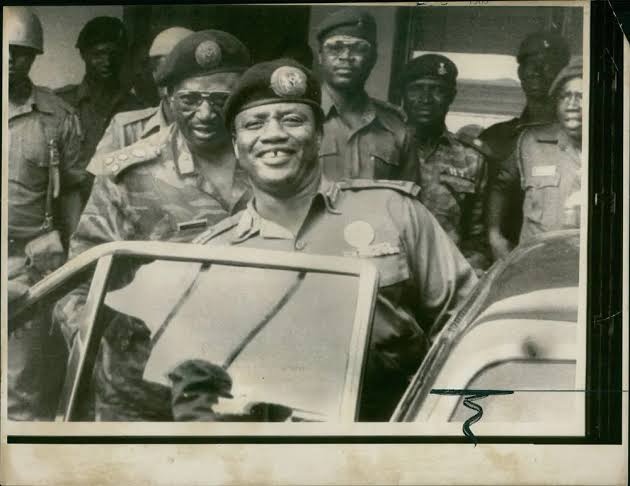
He was born on August 17, 1941, in Minna, in present-day Niger State. [1] Northern Nigeria, dusty roads, conservative, muslim upbringing, structured environment. While his father, Muhammad Babangida, worked in the Native Authority system,[2] his mother, Aisha, grounded the home. Discipline was not optional, it was the major currency in his home.
Source: Gettyimages
Growing up in the late colonial era Nigeria meant you were born into transition. The British were still around, but independence was humming in the distance. Babangida’s early education took place in Bida and later in Kaduna.[3] Even as a boy, accounts suggest he wasn’t loud or flamboyant. He was observant.
The quiet ones are always observing.
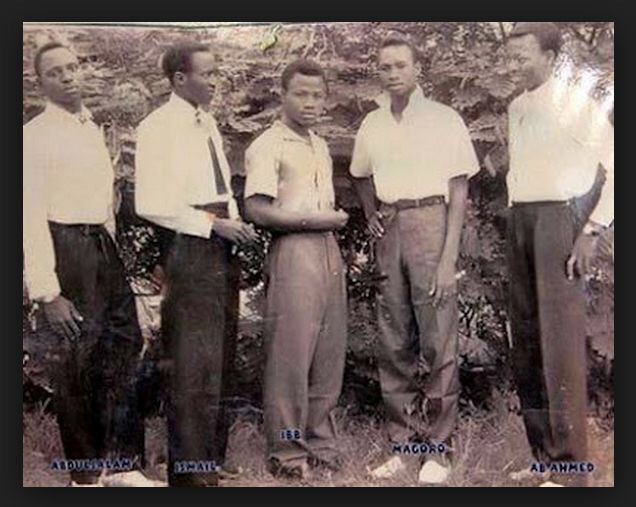
Always calculating. At 21, in 1962, he joined the Nigerian Military Training College (NMTC) in Kaduna.[4] That decision changed not just his life, but Nigeria’s trajectory. The military, at that time, was one of the few national institutions cutting across ethnic and regional lines. It was disciplined, modern, and upwardly mobile. For ambitious young men, it was a launchpad.
And Babangida? He thrived.
Source: Nairaland
Then came the coups in 1966 when Nigeria cracked open. The coup of January had been hijacked by Major General Johnson Aguiyi-Ironsi, the GOC of the Army who the coup plotters had failed to neutralise.[5] In July the same year, he was overthrown in a bloody revenge coup in which Lt. Babangida played a major role as a junior officer.
The counter coup, also known as operation ‘Araba’, was a clear manifestation of suspicion that had engulfed the Army. The Nigerian military was no longer just an institution but a battlefield of ideology and ethnicity.
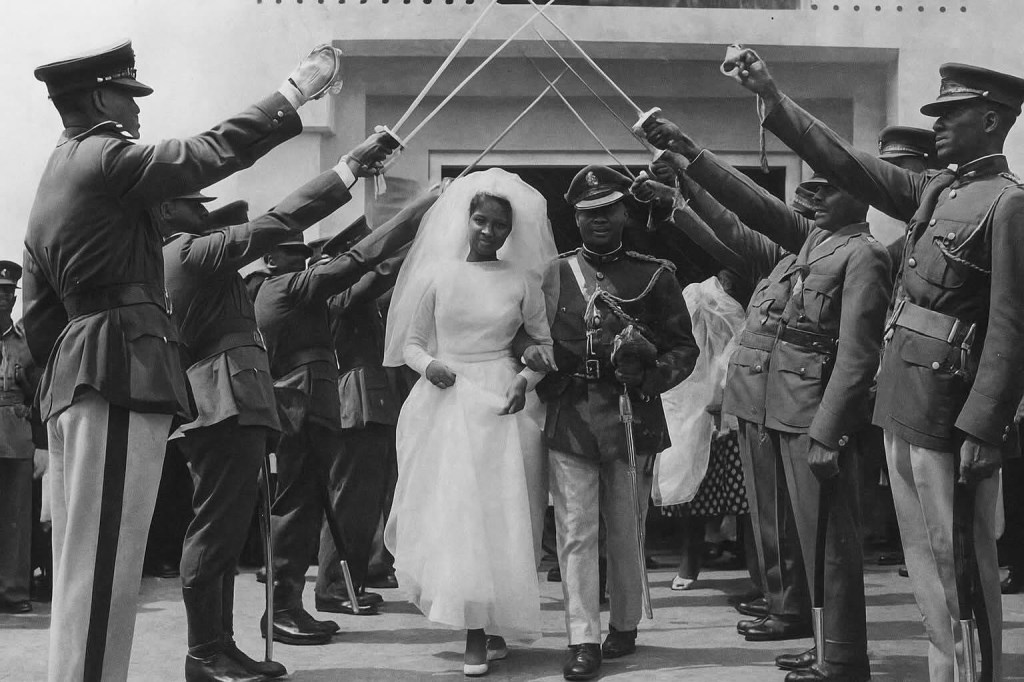
When the Nigerian Civil War erupted in 1967, Babangida fought on the federal side. He was wounded in action.[6] Being shot in war at a young age changes you. It humbles you, it hardens you but it also convinces you that power is about survival and tact. It was during his recovery that he married Maria Okogwu who would later be known as Mariam.
Source: Adeyinka Makinde
During the war and after, he built alliances and strong friendships, most notably with officers like Sani Abacha.[7]
In Nigerian military politics, loyalty is everything. Babangida understood that power in uniform went beyond rank. To be successful, one needed to have strong networks.
As an officer, he had access to various elite training abroad most notably in India and The United Kingdom.[8] These advanced military education sharpened him and exposed him to global systems which influenced his orientation towards soldiering. In essence, he wasn’t just a local soldier, he was globally aware.
By the 1970s and early 1980s, Babangida was climbing steadily through the ranks. Nigeria had entered its cycle of coups and counter-coups, military governments replaced civilian ones, corruption allegations were common. Economic mismanagement had followed the oil boom.
In 1983, Muhammadu Buhari seized power in a coup that overthrew President Shehu Shagari.[9] Babangida supported Buhari initially. He became Chief of Army Staff.[10] But here’s the twist, Babangida believed Buhari’s regime was too rigid, too harsh, and too inflexible.
And Babangida was not rigid, he was fluid and believed in realpolitik. It didn’t help matters that Buhari appointed Gen Tunde Idiagbon (Babangida’s junior) as Chief of Staff, Supreme HQ.
In August 1985, Babangida led a bloodless coup against Buhari. He announced the takeover with smooth confidence. Nigeria had a new leader, just like that.[11]
Babangida is famous for his smile that disarmed people. While other generals looked stern and intimidating, he looked approachable and charming. He would lean in slightly while speaking, listen carefully, then make a decision that nobody predicted. That’s why they called him the Maradona. The Argentine footballer Diego Maradona was known for dribbling past opponents effortlessly.[12] Babangida dribbled politically. One moment he promised a transition to civilian rule, next moment, timelines shifted. Policies reversed, aliances recalibrated. He was strategic ambiguity in human form.
When he took power in 1985, Nigeria’s economy was struggling. Oil prices had dropped, debt was rising and inflation was biting. Babangida introduced the Structural Adjustment Programme (SAP) in 1986 under guidance from the International Monetary Fund and World Bank.[13] SAP meant currency devaluation, removal of subsidies, trade liberalisation and privatisation.
In theory? Reform.
In reality? Pain.
The naira fell and prices rose. Many Nigerians struggled, critics argue that SAP widened inequality. Supporters say he inherited a broken system and had to take tough decisions. Here’s what fascinates me, Babangida didn’t see himself as reckless. He saw himself as modernising. He believed Nigeria needed economic restructuring to survive in a global system.
Whether that belief was idealistic or convenient is still debated.
Babangida promised to return Nigeria to civilian rule. But instead of allowing organic party formation, he created two political parties himself. The Social Democratic Party (SDP) and the National Republican Convention (NRC).[14] He once described them as “a little to the left” and “a little to the right.”
Imagine a military ruler designing democracy like a software update.
He banned politicians, unbanned them, postponed elections and shifted transition dates. It was like watching someone play chess alone and still managing to surprise himself.
But then came June 12, 1993. The presidential election was widely regarded as Nigeria’s freest and fairest. Businessman Moshood Abiola[15] appeared to win. And then Babangida annulled it.[16] That single decision became the defining moment of his legacy.
Why did he annul it? Some argue military pressure, some say fear of instability, ohers say he wanted to maintain control. He claimed there were irregularities and threats to national security. But Nigerians were furious, protests erupted and international pressure mounted. His political genius suddenly looked like political miscalculation.
By August 27 1993, Babangida “stepped aside” and handed over to an interim national government.[17] That phrase became iconic. Not resigned, not overthrown, stepped aside. It was classic IBB language.
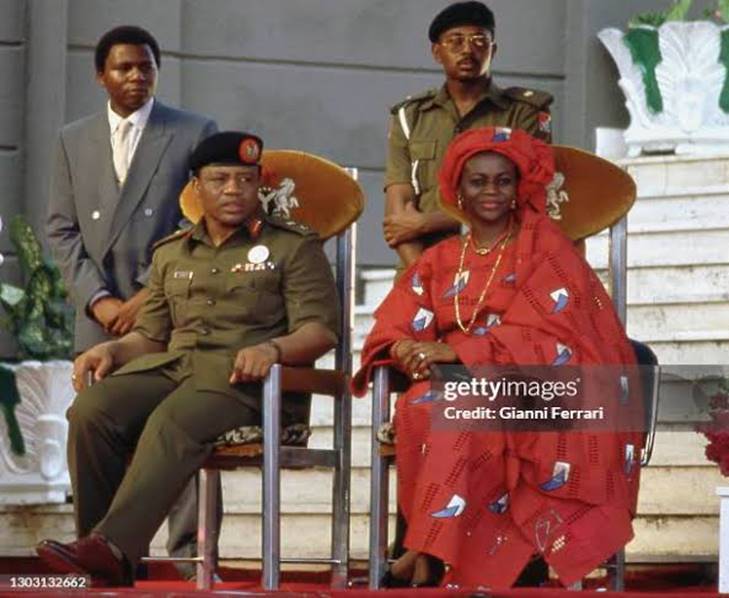
Behind the politics was his marriage to Maryam Babangida. She was elegant, educated and charismatic. She redefined the role of First Lady in Nigeria. Her “Better Life for Rural Women” programme elevated women’s issues nationally.[18] They were seen as a power couple, almost glamorous compared to previous military regimes. They had four children.
Source: Gettyimages
Those who interacted with Babangida socially often describe him as relaxed, humorous, and surprisingly informal. He enjoyed storytelling, he enjoyed being in control of the narrative.
Maybe that’s why he has remained influential long after leaving office.
Unlike some former rulers, Babangida didn’t fade away, he became a political kingmaker. Politicians visited Minna frequently,[19] his hilltop mansion became a pilgrimage site for aspirants. He never fully exited the stage, he just changed seats. Over the years, he expressed regret[20] about June 12, acknowledging it as a difficult decision. He however never apologised for annulling it. In later reflections, he suggested he was constrained by forces within the military.
Whether that is accountability or reframing depends on who you ask.
What Shaped Him? If I had to psychoanalyse him from the outside, I’d say this, growing up in colonial transition taught him that power structures shift. Surviving war taught him that control equals survival. Military training taught him hierarchy and strategy, exposure abroad taught him global realism. Nigeria’s volatility taught him that rigidity breaks regimes. So he chose flexibility, sometimes too much of it.
He believed in controlled democracy, managed transitions, incremental reform and balance and distrusted chaos. But here’s the irony: in trying to control chaos, he often created more of it.
Babangida is not easily categorised. He modernised parts of Nigeria’s banking sector, expanded the press environment in some periods, created new states, empowered technocrats. Yet his regime faced allegations of corruption, press intimidation and political manipulation. And the unresolved trauma of June 12. He is a paradox – reformist and disruptor, strategist and gambler in nature. And maybe that’s why he remains one of Nigeria’s most analysed leaders.
When you think about Babangida, you do not see a cartoon villain or flawless hero. You see a man shaped by instability, convinced that only he understood how to hold the country together. He believed in diplomacy within the military. In balancing factions, in playing the long game. He was less about loud ideology and more about quiet maneuvering. His legacy depends on who’s telling the story.
For some Nigerians, he represents lost democratic opportunity. For others, he represents complex reform during economic crisis. For historians, he represents the peak of military political engineering. But for me? He represents something deeper: the danger of believing you are the only one who knows how the chessboard should look.
Ibrahim Babangida lived power like a strategist, not a preacher. He smiled through storms, he stepped aside instead of falling, he left questions hanging instead of answers. And maybe that’s the most Babangida thing of all.
He didn’t just govern Nigeria.
He dribbled it.
[1] Max Siollun, Oil, Politics and Violence; Nigeria’s Military Coup Culture [1966-1976] [Algora Publishing, 2009].
[2] Karl Maier, This House Has Fallen; Nigeria in Crisis [Penguin, 2000].
[3] John Paden, Ahmadu Bello, Sardauna of Sokoto [Heinemann, 1986]
[4] Nigeria Defense Academy historical records.
[5] Siollun, Oil, Politics and Violence.
[6] Nowa Omoigui, ‘‘The Nigerian Civil War and Military Leadership,’’ archived military studies papers.
[7] Siollun, Soldiers of Fortune; Nigerian Politics from Buhari to Babangida [1983-1993] [Hurst, 2013]
[8] Nigerian military training archives.
[9] Siollun, Soldiers of Fortune.
[10] Ibid.
[11] Ibid.
[12] Contemporary Nigerian Media accounts, 1985-1993.
[13] International Monetary Fund country reports on Nigeria, 1986-1989.
[14] Diamond, Larry, Class, Ethnicity and Democracy in Nigeria [Syracuse University Press, 1988].
[15] Transition Monitoring Group reprts, 1993.
[16] Siollun, Soldiers of Fortune.
[17] Ibid.
[18] Amina Mama, ‘’Feminism or Femocracy’’ Africa Development [1995].
[19] Maier, This House Has Fallen.
[20] Ibrahim Babangida, later public interviews and reflections on June 12.
 Obaba Museum