Tag: origin

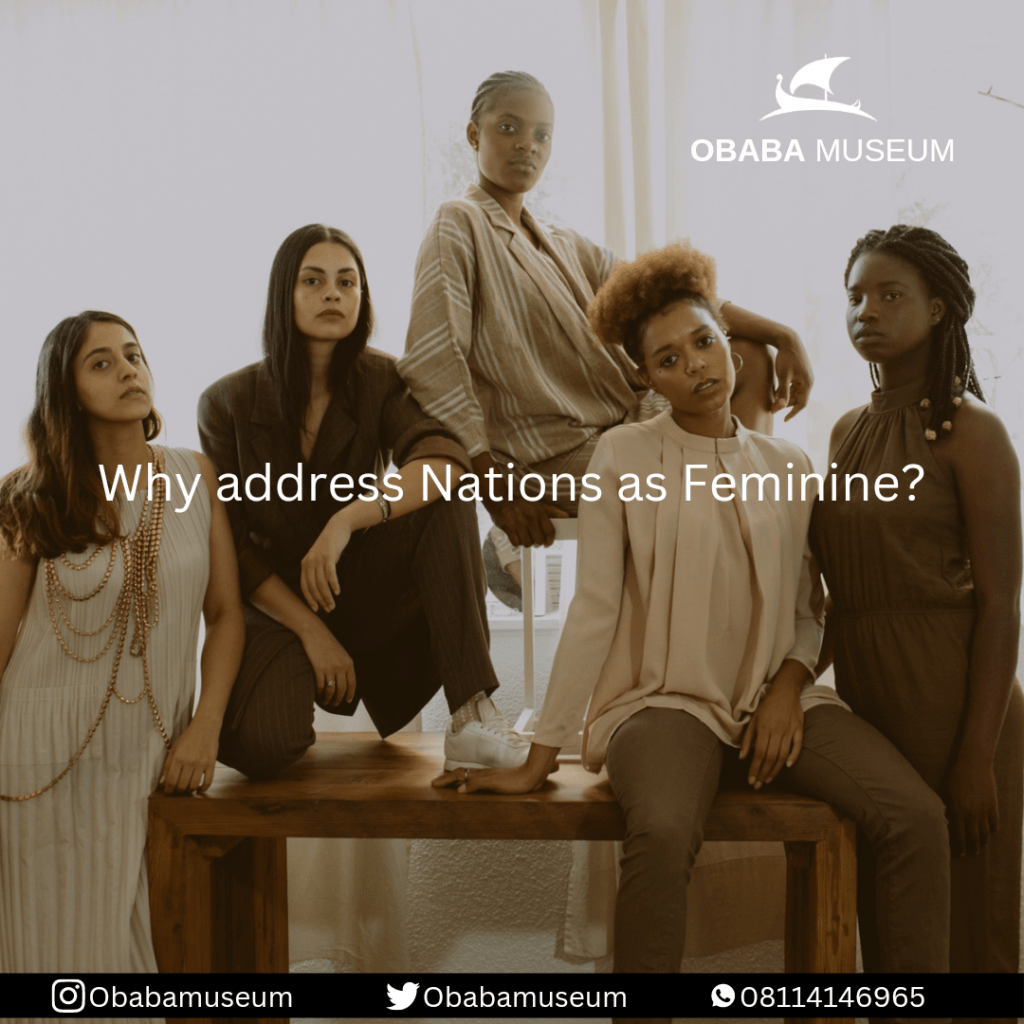
  • Why Address Nations as Feminine?

    Why Address Nations as Feminine?

    In a world, fast-changing; it has become inevitable that humanity redefines rudimentary concepts, such as might have been considered acceptable in earlier centuries, but have now grown obsolete and unacceptable, when juxtaposed with what is obtainable in today’s society.

    As a follow-up to one of the recent publication on this blog, in this piece, I try to challenge the rationale behind the adoption of feminine pronouns as the official appellation for addressing nations. Not just to unnecessarily rouse sleeping dogs, but because this is an aberration that has laid strongly upon my conscience, and that I cannot do away with. 

    As already hinted at in the preceding article, all countries, with an exception of Germany, officially adopt feminine-pronoun appellations in referencing themselves. For instance; the line in the Nigerian pledge “…to defend her unity and uphold her honour and glory…” However, when viewed thoroughly through the feminist lens, the premise for that adoption quickly becomes questionable. 

    The feminist movement has, over the years, made arguments against the portrayal of the female gender as the damsel-in-distress figure—’the weaker vessel’. A concept that had been sold us as truth, through the inundation of the media and other means of socialization. First, it is imperative to state that this writer is strongly opposed to the idea of assessing individual capability on a set of extrinsic properties. Rather, at least in this writer’s opinion, the peculiar strengths of individuals must be taken into account when considering, if consideration is necessary at all.

    In a saner world, one who can lift tons of weight will not inherently be preferred over another who can solve complex problems with the mind. Factly, I consider the overt need to categorize humans along hierarchical lines of ‘strengths’ and ‘weaknesses’ a natural offspring of the patriarchal society we exist in.

    The above remains the critical premise for the crux argument of this article: that to liken a country to a damsel-in-distress needing masculine protection from foreign villain is an unforgivable abberation.

    To quickly contradict myself, the adoption of the appellations themselves is not bad. It is the motive behind the construct that I challenge. For instance, the application ‘motherland’ ascribes flourish and virtue to a nation and for me, is acceptable.

    But in a world, fast changing, we must continue to ask the difficult questions. And challenge every redundant construct that has been hitherto viewed dogmatically. 

    In conclusion, the use of feminine apellations in addressing nations do not need to be entirely revoked, at least in my opinion, only the motive for which they were first adopted needs to be revisited. And humanity at large, entirely re-orientated. 
  • Who Named The Yoruba?

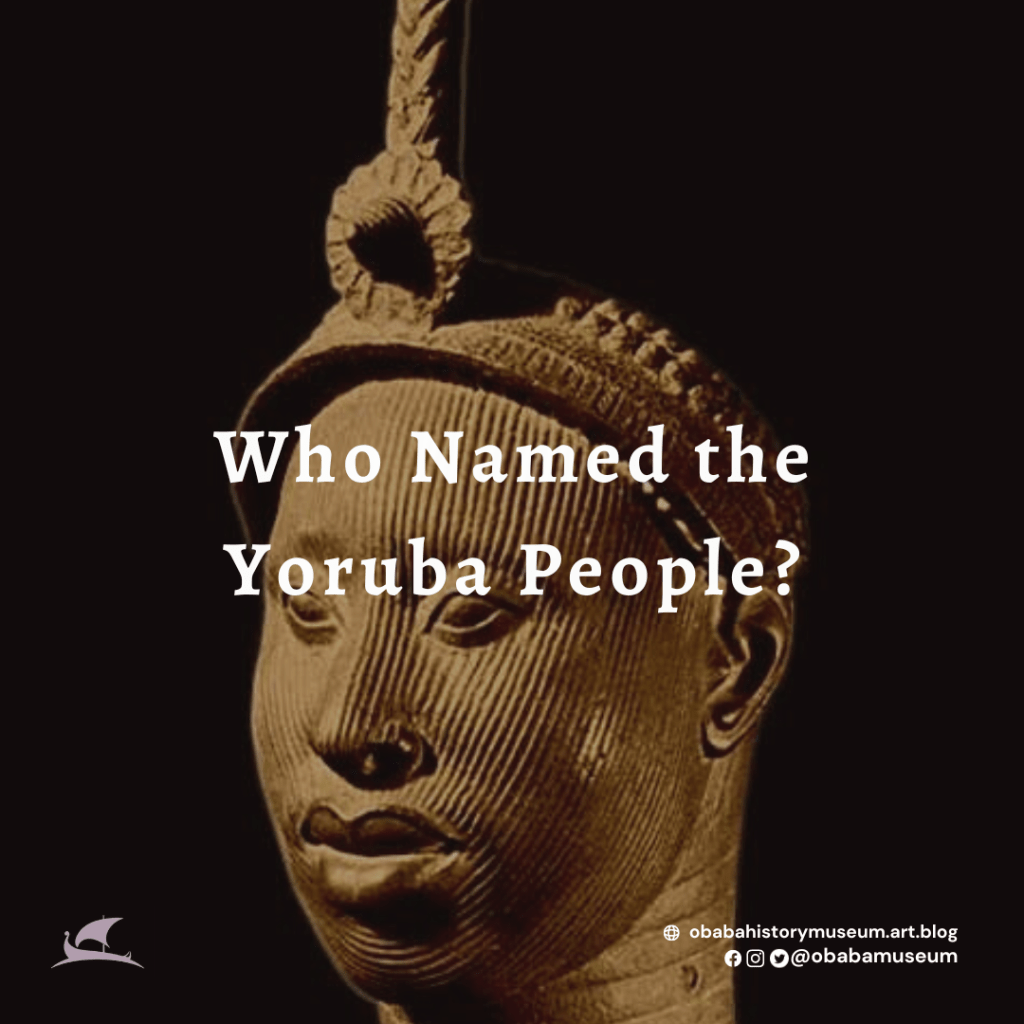
    Who Named The Yoruba?

    Have you wondered why there really isn’t an appropriate interpretation for the word, Yoruba despite the value descendants of Oduduwa place on naming?

    Perhaps, you may have noticed that naming is of great value to the various peoples now collectively regarded as the Yoruba. For example names of individuals are usually based on foretelling or a consequence of the circumstances surrounding their birth, for example parents may name their child Owolabi hoping the child will bring wealth/good fortune to the family, or Adebisi, meaning one who was added to the crown or was born after the parent took titles. You would notice also that the naming of most Yoruba towns were derived from historical events or qualities and attributes, a vivid illustration is Abeokuta-Abe Okuta Olumo which was a place abode under the Olumo rock, Eba-Odan – Ibadan, and Ibi ti Ile ti yo – Oyo and other neighboring towns like Ile ibinu-Benin. However, these factors appear not partake in the word Yoruba. The question therefore is why do the ‘Omo Oodua’ still retain the name. Stay tuned as we trace the origin of this strange appellation now used to characterise the descendants of Oduduwa.

    The Yorubas are one of the three largest ethnic groups of Nigeria, concentrated in the southwestern part of the country. Although a smaller, scattered group live in Benin and northern Togo. They speak a language of the Benue-Congo branch of the Niger-Congo language family.

    In their book, ‘The Yoruba from Prehistory to the Present’, Falola and Usman argue that the word Yoruba was already in use in the interior of the Bight of Benin probably before the 16th century. Ahmed Baba also used this term in reference to the Oyo Empire. You should understand that up until the 1800s, there is little evidence to confirm that the Yoruba regarded themselves as Yoruba, the term was often an external label. They usually referred to themselves based on their subgroups and geo-location, for example, the Egbas, Ife, Okun, etc.

    The name Yoruba was the Hausa name for Oyo people, it was popularized by Hausa usage. As a result of bitter experiences in trade with the Oyo Kingdom where they usually felt cheated and short-changed they developed a stereotypical tag where they referred to the people of Oyo as ‘Yaribanza’ which means cunning, dubious or unreliable. This was later corrupted to Yorubawa or Yoruba. The extension of the term to all speakers of dialects related to the language of the Oyo dates to the second half of the 19th century. It is greatly due to the influence of Bishop Samuel Ajayi Crowther, the first Anglican bishop in Nigeria. Crowther himself was an Oyo Yoruba who compiled the first Yoruba dictionary as well as introducing a standard for Yoruba orthography. The accounts of Crowther coupled with its usage by Colonial officials gave credence to the name.

    The Egbas are know to have resisted that label by the Hausa/Fulani as there are alternative names like ‘Aku’, derived from the first words of Yoruba greetings (such as Ẹ kú àárọ? “good morning”, Ẹ kú alẹ? “good evening”) which has survived in certain parts of their diaspora as a self-descriptive, especially in Sierra Leone and Okun which usually refers to the Yoruba speaking nations within present day Kogi state, Nigeria.

    The native term the Yoruba people call themselves, is “Ọmọ Káàárọ̀-oòjíire,” literally meaning, ‘The People who ask ‘Good morning, did you wake up well?’ Of course the cultures of greeting is one of the striking features of the Yoruba culture, they are known for their many different greetings in many situations. Another term used is, ‘Ọmọ Oòduà,’ meaning ‘Children of Oduduwa,’ referencing the semi-legendary king who is believed to be the founder and ancestor of the modern Yoruba people. The Yorubas usually regard themselves also as ‘Omoluwabi’ which is a philosophical and cultural concept that’s native to them. The concept signifies character, courage, hard work, humility, respect and honour. In clear terms an Omoluwabi is a person of honor and integrity who believes in hard work, respects the rights of others, and gives to the community in deeds and in action. I don’t know o, but if you ask me, I would say that the Omoluwabi is a preferable tag to the Hausa/Fulani imposed name.

    Thanks for reading through, feel free to share and comment.

    References

    Aribidesi Usman and Toyin Falola, ‘The Yoruba from Prehistory to the Present’.

    Noah Yusuf(2020) ‘Yoruba names as a Reflection of People’s Cultural heritage’.

    Wikipedia

Design a site like this with WordPress.com
Get started