Tag: history

  • The Rebel Soldier who Became a National Symbol

    The Rebel Soldier who Became a National Symbol

    On 13 February 1976 (a day to Valentine’s Day 50 years ago), General Murtala Ramat Mohammed was ambushed and killed in Lagos on his way to work by troops loyal to Lieutenant Colonel Buka Suka Dimka. He was on his way to Dodan Barracks with no serious security, asides the service pistol his ADC bore. Along Federal Secretariat Road, his vehicle was blocked. Shots were fired at close range. Within minutes, the Head of State was dead and left on the highway to the full view of bystanders.
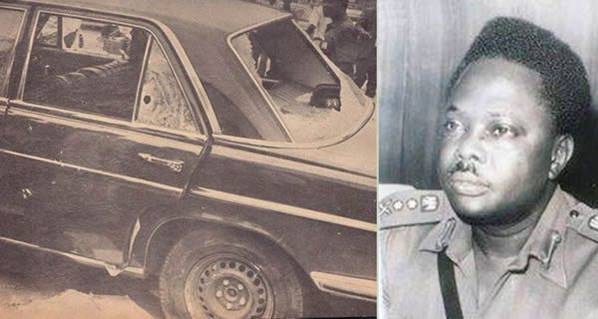
    A picture of General Muritala’s official vehicle moments after he was assassinated C. February 1976.
    Source: Nairaland

    Fifty years later (in 2026), the interpretation of that event remains divided. Some argue that Murtala’s death was almost predictable. That a man who participated in coups, commanded troops in a civil war, and removed a sitting Head of State could not realistically expect a quiet political retirement. Others insist that he had become a necessary reformer and that his assassination interrupted what might have been a structural turning point in Nigeria’s political development.

    There is also a third claim, more speculative but persistent: that Murtala governed with the urgency of someone who knew he might not last. He moved quickly because he understood the volatility of the institution that produced him.

    But before we draw conclusions, we need to ask a more grounded question: How did he get there?

    Before 1976

    Murtala did not emerge suddenly as Head of State the previous year. By the time Gowon was overthrown, he had already been inside the core of Nigerian military politics for nearly a decade. Like Gowon, he belonged to the early generation of post-colonial officers. Born in Kano in 1938, Murtala attended Barewa College in Zaria, a school that produced a generation of northern political and military elites. Like Yakubu Gowon too, he trained at the Royal Military Academy, Sandhurst. On paper, he was a product of the British military tradition of discipline, hierarchy, and loyalty to the chain of command.
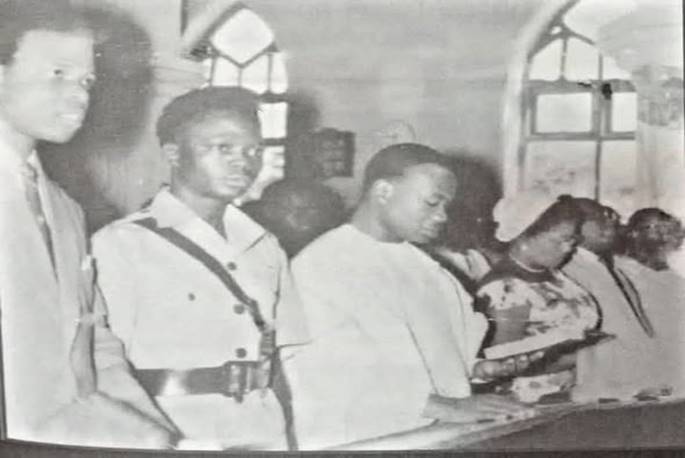
    This rare image captures Lieutenant Murtala Ramat Mohammed in 1962, pictured in military uniform while attending a church service as a young Nigerian Army officer. At the time, he was serving as Aide-de-Camp (ADC) to Dr. Moses Adekoyejo Majekodunmi, the Administrator of the Western Region during Nigeria’s political crisis of the early 1960s.
    Source: Folaranmi Ajayi (Facebook, 2026)

    But there is an important distinction. While Gowon absorbed institutional caution, Murtala absorbed structure, but not restraint. By the mid-1960s, he had developed a reputation for bluntness, impatience, and emotional intensity. Even early colleagues noticed that he only respected discipline when it aligned with his judgment. When it did not, he was prepared to challenge it. The pattern was already forming.

    His First Instance of Open Rebellion

    Murtala’s first clear break with military hierarchy came in July 1966. After the January coup brought General Johnson Aguiyi-Ironsi to power, tensions inside the army intensified. Many northern officers believed the political balance had shifted dangerously, and General Ironsi did little to assuage those fears. His promulgation of the Unification Decree, which replaced the federal system with a unitary structure, deepened that suspicion.

    At this point, Murtala was no longer a passive bystander, he was one of the officers who coordinated the counter-coup from Lagos. He took control of strategic points, including the airport, and maintained communication with other northern officers. In a sense, he was not merely executing orders handed down from above but was part of the circle shaping events as they unfolded. The July counter-coup was a calculated intervention by officers who believed the balance within the federation had been altered beyond comfort.

    It is also important to note that, at that stage, the objective was not simply regime change. Among many northern officers, the idea of Araba (secession of the North) was openly entertained. Murtala was associated with that current of thinking. In other words, his first major political act inside the Nigerian state was tied to a movement that contemplated breaking the state itself. Its an irony today that he is often viewed as a nationalist; people even go further to justify his ‘fellow Nigerians’ phrase as a pointer to his nationalist traits.

    Well, as we would see in the next article, Nigeria ultimately remained united, largely because political negotiation overrode separatist impulses. But July 1966 established something that would follow Murtala throughout his career. When he believed a structure was flawed or dangerous, his instinct was not patience. It was decisive correction, even if that correction risked fragmentation. He did not treat the Nigerian state as untouchable. If he believed it was failing or biased, he was prepared to dismantle or restructure it by force. That was his first open rebellion within the system he had sworn to serve.

    The Civil War: Courage and Disobedience

    When the civil war began in 1967, Murtala was appointed commander of the Nigerian Army’s 2nd Division, responsible for operations in the Midwestern and eastern theatres. His performance during this phase mixed tactical success with persistent friction with the high command. What stands out most in his wartime record was not only bravery, but a pattern of acting independently of orders from Army Headquarters and Supreme Headquarters.
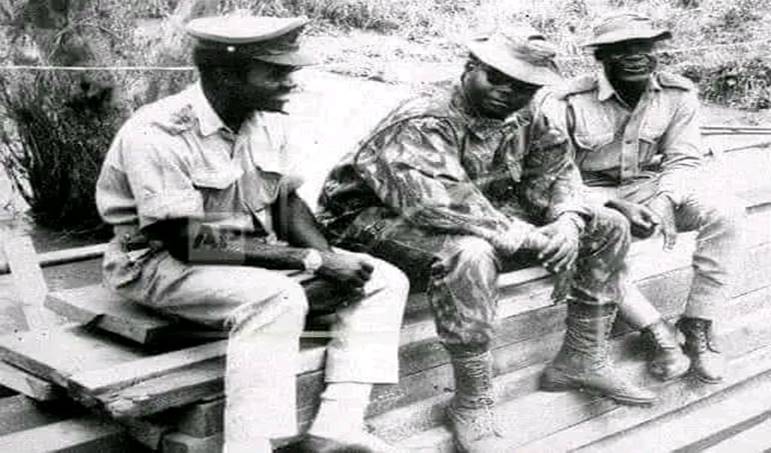
    A picture of General Murtala Muhammad with two other soldiers in Benin after capturing the city during the Biafra War.
    Source: Associated Press

    The most discussed example is the push toward Onitsha.

    After retreating Biafran forces destroyed the key bridge over the River Niger, Army Headquarters in Lagos advised a cautious, unopposed crossing at Idah, followed by an overland advance  (a plan viewed as less risky and more coordinated with neighbouring formations).

    In his usual character, Murtala rejected that option. He favoured a direct river assault from Asaba, believing the momentum was with federal troops. Supreme Headquarters, his brigade commanders, and even the commander of the neighbouring 1st Division, Colonel Mohammed Shuwa, advised against it; despite this, Murtala persisted. He ordered the river crossing despite explicit strategic recommendations to the contrary.

    Twice, the frontal assault was repulsed by the Biafran soldiers with significant casualties and loss of equipment. Even after those setbacks, he tried a third assault before eventually agreeing to Army Headquarters’ original plan and capturing the town. The failure of his earlier attempts cost lives and morale.

    This episode reveals two consistent traits in his wartime command:

    • He valued initiative and decisiveness over procedural coordination.
    • He was willing to act against directives from his superiors if he judged them too cautious.

    Ideally, as some military observers have pointed out, such independence should likely have led to a court-martial in less chaotic conditions. However, in the Nigerian civil war’s fluid environment, it did not.

    These decisions were, however, not isolated, they reflected a larger pattern within the 2nd Division under his command, where he adopted rapid movement, aggressive engagement, and often unilateral decision-making that prioritised tempo over hierarchical compliance. That combination won him recognition for bold leadership and respect from many subordinates. It also created unease among senior officers who saw traditional military discipline eroding under the pressure of his personality and approach.

    The 1975 Coup

    By 1975, Murtala was no longer a divisional commander at war. He was Federal Commissioner for Communications in a government that had been in power for nearly a decade. But the impatience that marked him in 1966 and during the civil war had not softened. The post-war years were marked by oil revenue expansion and reconstruction. They were also marked by delay due to bureaucracy in government procedures. The promised transition to civilian rule, initially projected for 1976, was postponed. Administrative reforms were discussed repeatedly but implemented slowly. Don’t forget that by 1974, there had been two major milestones: The wage and Salary increases headed by Jerome Udoji, and a National Conference on Manpower Utilisation and Development. On one of such occasions where Gowon rejected his memo, he angrily remarked to Shehu Shagari,

    “Don’t mind him!” “We shall soon change him. We put him there and we can remove him anytime!”[1]

    Within sections of the officer corps, especially among those who had fought the war, frustration began to build. To them, the post-war state appeared slow, procedural and overly cautious. Murtala stood at the opposite end of that temperament. He was direct where others were consultative. He preferred resolution to deliberation.

    When the July 29, 1975 coup was executed while Gowon was abroad, Murtala was not an accidental beneficiary. He was the senior officer around whom dissatisfaction had quietly gathered.  Whether or not he drafted the plan himself is less important than the fact that he accepted its outcome without hesitation. Once again, he aligned himself with intervention as a corrective instrument.

    His months in office reflected the same instinct. State governors were removed. Senior officers were compulsorily retired. Thousands of civil servants were dismissed. A new federal capital was announced. Foreign policy shifted decisively. The tempo was unmistakable. Supporters described this as clarity and discipline restored. Critics saw recklessness and institutional shock. But even in government, Murtala behaved as he had in 1966 and during the war: when he believed a structure was defective, he moved to reset it.

    Then came 13 February 1976.
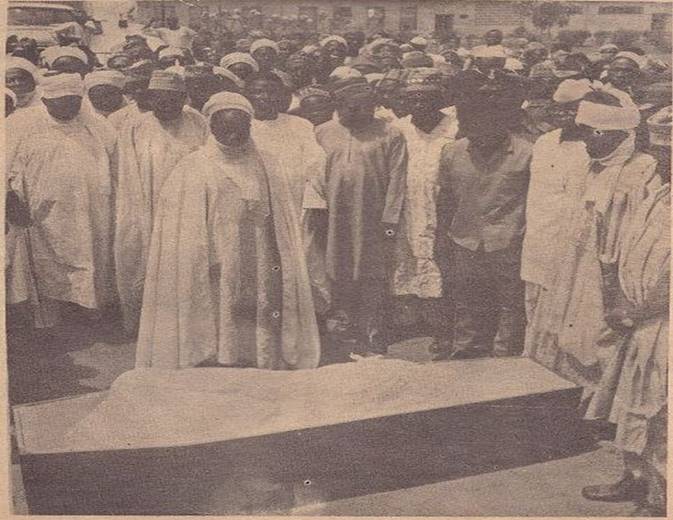
    General Murtala Mohammed’s Burial And Corpse, 1976.
    Source: Nairaland

    The irony is difficult to ignore. A man who had seized the airport in 1966 now has that same airport named after him.

    The first Nigerian Head of State to appear on a naira note is a man whose career repeatedly challenged the very hierarchies he once swore to uphold. Monuments, institutions and public memory have fixed him in national symbolism.

    It is here that Dimka’s failed coup assumes a historical weight beyond its immediate violence. Assassination froze Murtala at a particular moment as an energetic, reformist, and uncompromising leader. Death removed the possibility of decline, error, or prolonged controversy. It converted a divisive figure into a fallen one.

    In life, he was a rebel inside the system. In death, he became a symbol of it.

    That transformation may be the most consequential outcome of 13 February 1976.
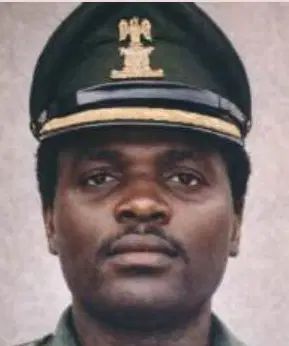
    A portrait of Lt. Col. Buka Suka Dimka. Source:Vanguard News

    [1] Omoigui, N. (n.d.). Military rebellion of July 29, 1975: The coup against Gowon – Part 6. Dawodu. Retrieved February 11, 2026, from https://www.dawodu.com/articles/military-rebellion-of-july-29-1975-the-coup-against-gowon-part-6-635
  • THE PROMISES WE KEEP HEARING 2

    THE PROMISES WE KEEP HEARING 2

    EPISODE TWO: WHEN THE PROMISES BROKE

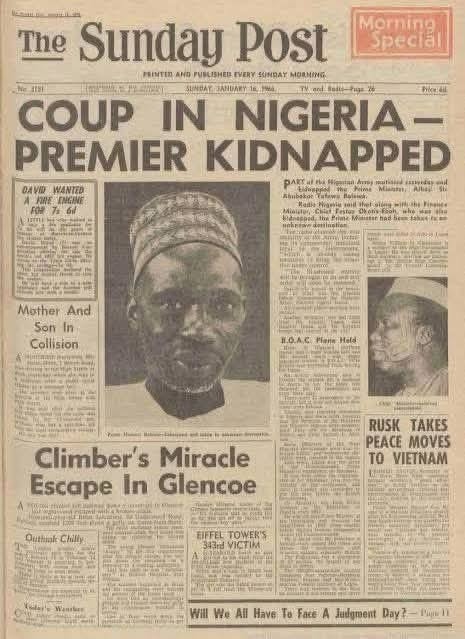
    On the morning of January 15, 1966, Nigerians woke up to a country they no longer recognised. Before dawn, soldiers had moved through Kaduna, Lagos, Ibadan, and Enugu with stealth and precision. By the end of the day, quite a number of politicians were either missing or killed, senior officers in the military were ambushed, and government authority had been effectively shattered. For many citizens, the first confirmation came not from officials in Lagos, but from Radio Kaduna. The voice that came through did not sound like a reassurance but a verdict.

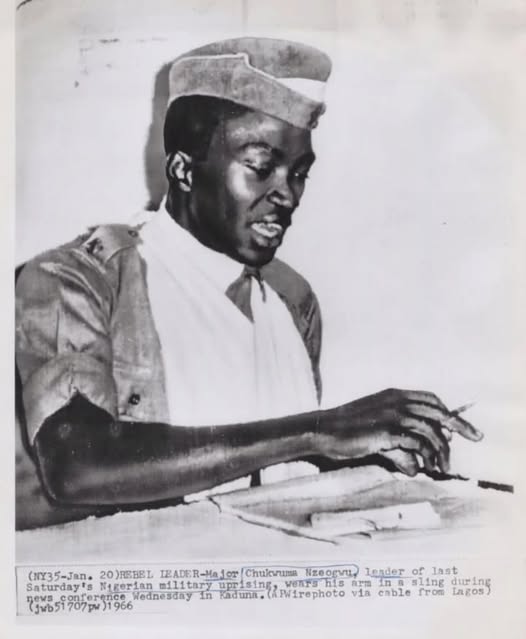
    Major Chukwuma Kaduna Nzeogwu’s broadcast was sharp, moralistic, and unlike anything Nigerians had heard from their leaders. Gone were the polished lines of Independence Day speeches. He spoke of “political profiteers… swindlers… men who seek bribes and demand ten percent.” His speech was not simply a justification for the coup; it was a public indictment of the First Republic. And for many Nigerians, it captured something they already felt but had not articulated: the promises of independence had begun to collapse long before the soldiers arrived.

    Major Chukwuma Nzeogwu, addressing a press conference in Kaduna, Nigeria. His arm was in a sling due to injuries he sustained during the military coup he had led just hours earlier on January 15, 1966

    To understand why the 1966 coup resonated so widely, you have to look at the slow breakdown that preceded it.

    The early optimism of independence did not survive the crises of the early 1960s. By 1962, politics had become a battlefield. The Action Group crisis in the Western Region (a dispute between Awolowo and his deputy, Akintola) grew into a full political fracture. What started as ideological disagreement escalated into violent street clashes, burnings, and targeted attacks. The period later known as Operation Wetie or “Wild Wild West” symbolised how far the democratic project had drifted. State institutions struggled to contain the violence. Public trust evaporated due to perceived biases and partisanship.

    At the national level, tensions grew worse. The 1962 census collapsed into controversy. The 1963 recount did not settle the matter; it further deepened suspicion. The 1964 federal elections were discredited by boycotts and intimidation. And the 1965 Western Regional elections triggered violence so intense that many Nigerians openly questioned whether democracy had a future.

    This was the environment in which political speeches began to lose their power. Leaders still invoked unity, brotherhood, and discipline, but the gap between rhetoric and reality widened daily. Citizens heard the speeches, but they no longer believed them.

    Do you see a similarity today?

    Why Nzeogwu’s Broadcast Hit the Way It Did

    What made his message different was not the language itself but the way he used them. Themes like honesty and discipline had appeared in earlier speeches, but his rendition stood out. Where Azikiwe had used such words to appeal, Nzeogwu used them to condemn. He was not asking for national unity; he was asserting that the political class had betrayed it.

    For many Nigerians, especially in regions where the crises had been most severe, the broadcast felt like a brutal but familiar truth. In the North, early reactions included cautious approval. In the West, exhausted by political violence, some citizens expressed relief that someone had taken control. In the East, responses were more restrained, coloured by concerns about who had been targeted in the coup.

    But across regions, one sentiment was consistent: the politicians no longer controlled the national narrative. Someone else (uniformed, armed, confident) had stepped in to define the country’s direction.

    In actual sense, the coup did not erase political rhetoric, it simply changed its tone. In the days following the intervention, military leaders adopted the same themes that civilians had used the word ‘unity, discipline, national survival’ but the meaning shifted. These were no longer appeals rooted in persuasion but instructions backed by authority. The vocabulary remained familiar, but the centre of power had moved from the parliament to the Supreme Military Council.

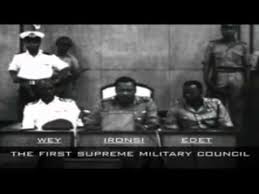
    Aguiyi-Ironsi’s First Press Conference After the January 15, 1966 Coup

    This transformation matters because it marks the first major rupture in Nigeria’s rhetorical tradition. From 1960 to 1966, civilian leaders used language to build consensus, manage crises, and hold together a fragile federation. After the coup, the military used similar words, but as instruments of control.

    This episode reveals the point at which the promises of early independence finally broke under the weight of political crisis. By January 1966, the gap between what leaders said and what citizens experienced had become impossible to bridge. The rhetoric of unity and progress no longer reassured anyone. That vacuum created the space for Nzeogwu’s broadcast, and for the new political language that would dominate the years to come.

    In Episode Three, we will follow this shift into the era of counter-coups and the Civil War: a period when rhetoric about unity, survival, and sacrifice took on deeper, more urgent meanings and when political language began to reflect not just hope, but existential struggle.

    Thanks for reading. Let us know what you think in the comments.

  • The Promises We Keep Hearing 1

    The Promises We Keep Hearing 1

    EPISODE ONE: The First Promises

    In 1960, Nigeria became independent. The euphoria was real, but fragile. Three regions, each with distinct histories and political ambitions, were suddenly asked to govern themselves under a federal system. Unity was therefore not guaranteed; democracy was only an experiment. In this context, every speech from the national stage carried a weight far greater than ceremony. These speeches were instruments of reassurance. They served as appeals to cohesion and subtle warnings.

    By 1962, the first cracks appeared. The Action Group, dominant in the Western Region, fractured. Awolowo and Akintola clashed over leadership, party structure, and policy, turning the Western Region legislature into a battleground. The crisis quickly became national, raising doubts about the viability of democracy itself. Politicians across the country watched as trust between regions eroded, and ordinary citizens began questioning the promises of independence.

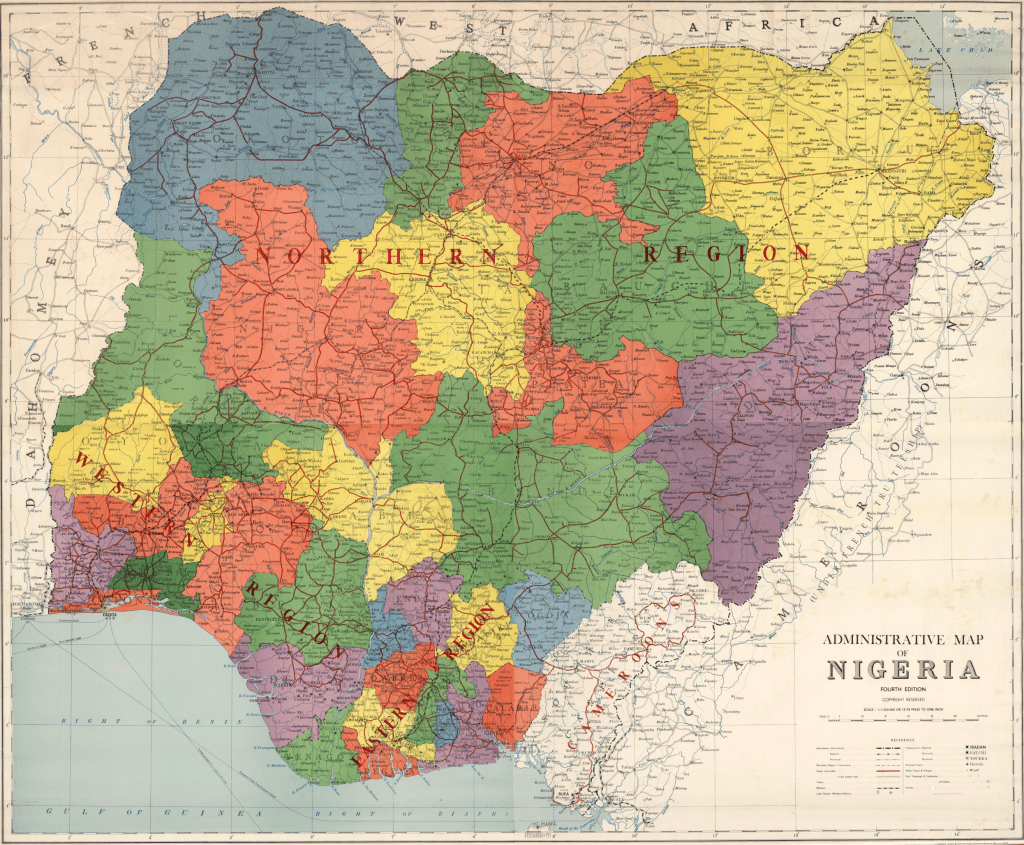
    Detailed map showing the regions and provinces of colonial Nigeria. Produced in 1924 and revised in 1960

    It was against this backdrop that Nnamdi Azikiwe addressed the nation:

    “Let us renew our faith in liberal democracy and strengthen our belief in the greatness of our country.” (1962 Independence Day Speech)

    Contrary to popular beliefs, these words were not just patriotic exhortation on a national day, but a deliberate attempt to restore confidence in a system already under stress. Azikiwe was not only speaking to the citizens, he seemed to also be addressing the emerging power of the military, a silent observer of civilian failures.

    Two years later, the tensions over identity and representation had intensified. The 1963 census had sparked allegations of manipulation, feeding regional suspicion and inflaming ethnic consciousness. Political rhetoric increasingly addressed not policy but cohesion. In his 1964 address, Azikiwe invoked a line from the national anthem:

    “Though tribe and tongue may differ, in brotherhood we stand. Let us give meaning to these words by living and working together.”

    These words were not symbolic; they were a response to a real threat – a nation on the verge of fragmenting along ethnic lines. Interestingly, decades later, the administration of President Bola Ahmed Tinubu reintroduced this old anthem officially. Senate President Godswill Akpabio argued at the time:

    “If we had kept to that anthem, we probably would not have banditry today in Nigeria because if you take your neighbour as your brother, you will not want to kill him.”

    But that is a digression for another day. Returning to the early 1960s: the federal elections of 1964 and the ensuing violence in the Western Region, later dubbed the “Wild Wild West” or “Wet tie” crisis, intensified the stakes. Political rhetoric became both shield and strategy. Leaders promised peace, discipline, and unity while the country witnessed arson, intimidation, and targeted attacks. The language of promise was a mechanism of control: to assure, to persuade, and to postpone the inevitable confrontation.

    By 1965, the military was observing these developments with increasing concern. Civilian authority appeared ineffective, and the prospect of intervention grew. The promises made by politicians, while aspirational, also underscored the fragility of the republic. Gowon’s 1966 Independence Day address illustrates the continuity of the message, even as the voice shifted from civilian to military:

    “We must rediscover honesty and sincerity. Let us dedicate ourselves to discipline, loyalty and service.”
    “Our nation must remain united. It is only in unity that our progress can be guaranteed.”

    The words remained familiar, unity, progress, discipline, but their delivery signaled a change in authority. Whereas early promises sought to inspire, military rhetoric sought to command. Yet the underlying narrative of hope persisted, as though the nation’s imagination required a constant reminder that a better Nigeria was always within reach.

    Looking back, the first promises of independent Nigeria reveal two enduring truths. The first is that rhetoric is inseparable from the context in which it is delivered. Every speech, every line of persuasion was a response to political crises, social anxieties, and regional tensions.
    Second, the themes of unity, progress, and renewal established in the 1960s have endured. They continue to resonate because they address the same hopes, fears, and expectations of Nigerians today.

    Episode One closes here, not with resolution but with foreshadowing. The promises of 1960–1966 laid the groundwork for the challenges that would erupt in 1966, as the nation confronted civil war, further coups and the first tests of the rhetoric’s durability. Understanding these first promises is essential to tracing how political language shapes not only expectations but the trajectory of the nation itself.

  • The Promises We Keep Hearing

    The Promises We Keep Hearing

    Every election season in Nigeria feels like a revival. You hear new slogans, see new faces but the same promises of hope. In 2014 up till 2015, a new political coalition promised “Change”, then by 2019 they moved to the “Next Level.” Today, we listen patiently to the promise of “Renewed Hope.” These promises may sound fresh but are quite familiar; they are all echoes of promises we’ve heard before.

    In recent months, while reading through old Nigerian newspapers, one thing became clear: these promises are not new. From independence till now, every government has spoken the same language of transformation. They often promote the belief that a new dawn is just one administration away. These repeated declarations are not just political statements; they have become part of our national rhythm.

    This recurring pattern of rhetoric is what inspired this series — The Promises We Keep Hearing. It’s an attempt to look back at how political speech has shaped Nigeria’s identity and imagination. By tracing the evolution of the words of our leaders, we observe their tone and ideals. We also note their contradictions. This analysis helps us understand how language itself became one of the most powerful tools of governance in Nigeria.

    During the colonial era, Nationalist leaders delivered anti-colonial speeches. Today, most politicians make populist appeals to mobilise people, legitimise actions and, manipulate public opinion.

    The early nationalist movements of the 20th century show how language carried the moral weight of freedom. Early nationalist leaders understood the power of well-crafted speeches. Macaulay, often regarded as the father of Nigerian Nationalism, was renown for his fiery essays in The Lagos Daily News. Azikiwe’s speeches were often effective because they married intellect and hope, painting Nigeria as a proud, united nation (you really need to listen to his speeches).

    Awolowo’s tone, on the other hand, was often pragmatic and policy-driven, reflecting the discipline of a planner (See ‘Awo’, his memoir for more of this). Ahmadu Bello’s speeches often appealed to cultural preservation and dignity, linking tradition with progress. No wonder he was highly regarded by majority of the Northern Nigerian populace.

    The 1960s were full of optimism, but also rivalry. Independence brought hope, however political language quickly became a contest of identities and power. Our politics became regionally based. By 1966, the military replaced politicians who had fought themselves with words and the same institutions that wuld supplant them.

    Their eloquence gave way for the language of command. Leaders like Aguiyi-Ironsi, Gowon, and Murtala Mohammed spoke not to persuade, but to instruct. Even so, words such as unity, discipline, and accountability became rallying cries for a nation finding its footing.

    With the return to democracy in 1999 came a new vocabulary: unity, reform, rebirth. Obasanjo spoke with authority, Yar’Adua with humility, Jonathan with empathy. Today, slogans dominate social media: Change. Next Level. Renewed Hope. But the power of words hasn’t faded. Leaders still know that how they speak matters.

    Nigeria’s political rhetoric is also a story of how we imagine ourselves. The words of leaders shape what we believe is possible. This series starts by tracing those words – their origins, their intent, and their impact. Understanding the promises we keep hearing might just help us understand the country we’re becoming.

  • ‘Ìyà àgbà ló jemí’

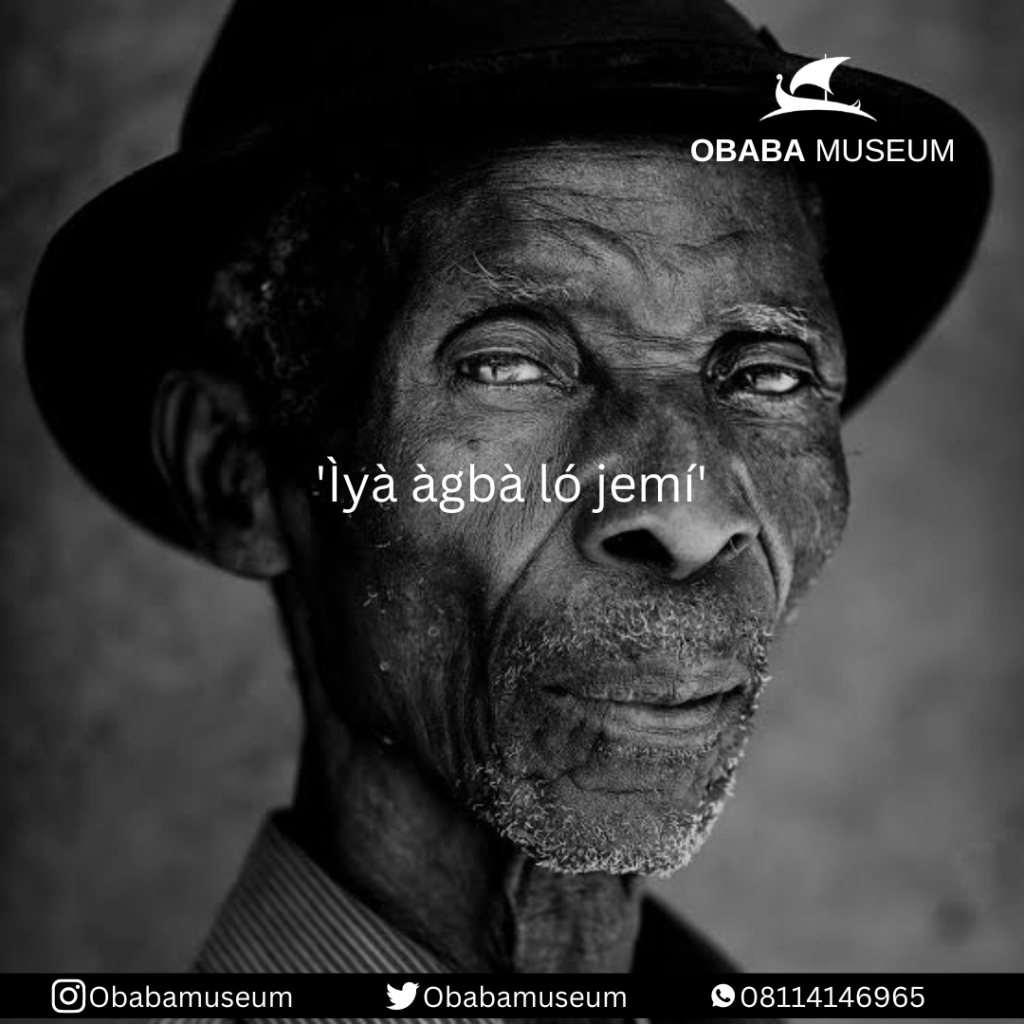
    ‘Ìyà àgbà ló jemí’

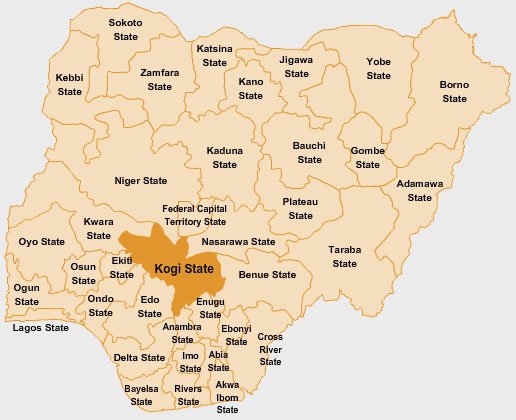
    For most people familiar with the Yoruba nation the popular Ijesha, Ijebu and of course the Eegun dialects are not strange, however most of you reading this would be surprised to hear there is also the okun. Yes, ‘Okun’ people geographically would be regarded as close cousins of the Ekiti people. They are the Yoruba speaking tribes in Kogi state and have quite an interesting culture, language and lifestyle. Follow the conversation closely.

    Okun people make up over 20% of the entire population of Kogi state and are spread across six local government areas in Kogi State, they are; Kabba-Bunu, Yagba-West, Yagba-East, Mopa-Muro, Ìjùmú and Lokoja local government Areas.
    They speak various Yoruba dialects such as Owé, Ìyàgbà, Ìjùmú, Bùnú and Oworo, but their language is generally called Okun partly because it’s the common word for greeting.
    The beauty of this is that a non Okun person might not be able to figure out the slight differences in the dialects because every speaker flaunts his dialect at will, with full assurance that the other Okun person will understand what is being spoken about. This is often true, except for slight variations in the accent the spoken dialects are basically the same.
    More so, almost all of them speak the common Yoruba fluently even without any prior exposure outside Kogi – interesting, Right?
    Their dialects and culture is largely influenced by various reasons such as:

    Diversity of the State

    Kogi state could be regarded as a culturally diverse region with a huge number of ethnic groups like the Ebira, Igala, Idoma, Bassa (small fraction of Nupe mainly in Lokoja and Bassa Local Government Area), the Ogugu subgroup of the Igala, Gwari, Kakanda, Oworo people (A Yoruba Group), Ogori, Bassa komo, and many more.


    In addition to it’s ethnic diversity, it’s next door neighbors are many and diverse. In Nigeria, Kogi has the highest number of neighbours, a total of ten states share boundary with Kogi such as; Ondo, Ekiti, Kwara, Niger, Benue, Nassarawa, Anambra, Enugu, Edo and the Federal capital territory.

    History

    History has also played its part in shaping the Okun identity. The Nupe raids of the 19th century and their interaction with the Hausas due to geographical zoning have left an indelible mark on the Okun people and their culture.
    According to oral source, Okun people migrated from Ile-Ife, the cradle of the Yoruba race when Yorubas were spreading to occupy more lands. Before spreading out, each and everyone was instructed to report to Ile Ife for a yearly meeting.
    The man, that led a group of young people to a location (now called YAGBA) in Kogi state did not return over a long period of time. When he eventually returned and explained that he lost larger part of his acquired land to some other migrants and slave raiders.
    He was blamed for the loss and in defense he said, ”ÌYÀ ÀGBÀ LÓ JEMÍ” meaning that the invasion and annexation of a large portion of his acquired land was because he did not have elderly people around him to give counsel. Since then, they started teasing him at Ile Ife, calling him Iya agba. They associated this name with him whenever they wanted to send messages across to him after he had returned to his occupied area, now called Yagba.


    Over the years, the Okun people have faced numerous challenges, ranging from geo political zoning, marginalisation and what could be regarded as the identity crisis.

    Their problem started during the colonial era when they were politically grouped into the Northern protectorate by Sir Frederick Lugard, the British High Commissioner at that time. The abolition of the provincial and regional administrative units in 1967 led to their merging with Ilorin to form old Kwara state. Then, Igala was merged with old Benue State. However, on the 27th of August 1991, Okun people were removed again and merged with Ebira, Igala from Benue state and some other tribes to form Kogi state. Despite their protest against merging them with completely different tribes, they were forced into this union. Their efforts to break away and form Okun State, which could facilitate close affinity with their Kiths and Kins in the South West, has not yet materialised.


    Okun people bear Typical Yoruba names just like other communities in South Western Nigeria. In fact, virtually all of their settlements are named in basic Yoruba language examples are: Ayegunle, Ayetoro, Kajola, Egbeda, Egbeda Ega, Okedayo, Oke-aba (Kabba), Odo Ere, Odo Eri, Ife-olukotun, Iyamoye, Agbaja, Igbo Nla, Obajana and Ikoyi.
    Even, groups that make up Bunupeople of Okun have Yoruba names like; Okemeta, Okemesan, Akumerindinlogun and Kiri.


    Some notable Okun indigenes are:
    Chief Kola Jamodu, Eyitayo Lambo, Pastor Sam Adeyemi, Smart Adeyemi, James Faleke, Dino Melaye, Shola Amoebi, Tunde Ednut, Jaywon, Nike Davies Okundaye, Sam Alle, Bayo Ojo, Joseph Ojo Omonehin, Dare Art Alade, Sunday Bada, Funke Akindele, and Victor Obaba.

    Thanks for reading through, I would like to hear your thoughts and opinion about this article. Please share them in the comments.

    The first edition of our magazine, The Explorer would be published this December, If you would like to, or know anyone who has a business and would like to advertise, we have some few spaces reserved. Contact us: 08114146965
  • The Chronicles of Human Language

    The Chronicles of Human Language

    Today, we have about 7,151 living languages in the world, but not without proper consideration that this number is in flux. Due to the dynamicity of the world, over 40% of languages are now endangered. Regardless of the many languages, Humans have grown ample respect for English language, a language which had  taken its place as one of the world’s predominant form of communication with its influences extending over as much as 2 billion of the global population. Despite the diversity of human minds, due stereotypical usage of these languages and other factors, there are common reoccurring questions to be answered. Questions like, how the first word of our ancestors sounds like?  What are the oldest languages in the world? How old is English language?


    Languages have always been enumerated highly, because of its vital role in advancement and human evolution. Imagine a world without any means of communication, but thanks to annals, historians, linguists and archaeologists, disseminating the dern of language has been made easy and fun. Going by archaeological proofs, the oldest dead language in the world is the Sumerian language. Dating back to at least 3500 BC, the oldest proof of written Sumerian was found in today’s Iraq, on an artifact known as the Kish Tablet. Thus, given this evidence, Sumerian may be considered as one of the earliest language in the world.

    Sumerian was gradually replaced by Akkadian as a spoken language around 2000 BC, but it continued to be used as a literary, ceremonial, scientific and sacred language until the 1st century AD. Unknown to the modern world until the 19th century when Assyriologists began deciphering its cuneiform inscriptions, written Sumerian can be divided into several time periods: Archaic Sumerian (31st–26th century BC), Old or Classical Sumerian (26th–23rd century BC), Neo-Sumerian (23rd–21st century BC), Late Sumerian (20th–18th century BC) and Post-Sumerian (after 1700 BC).
    It should be noted that Sumeria belongs to  group of  dead languages i.e extinct languages, “one that is no longer the native language of any community”, even if it is still in use, like Latin.

    Other very dead languages include but not limited to;
    • HURRIAN  – oldest proof of written Hurrian dates back to the 21st century BC;
    • PALAIC – attested in cuneiform tablets in Bronze Age Hattusa – circa the 16th century BC;
    • HIEROGLYPHICS – its earliest known complete written sentence has been dated to about 2690 BC;
    • AKKADIAN – first attested texts from around the mid-3rd-millennium BC;
    • ELAMITE – the earliest Elamite writings use a pictographic Hurrian  – oldest proof of written Hurrian dates back to the 21st century BC;
    • HITTITE – the oldest known text in the Hittite language was written by Anitta, a king that reigned in the 17th century BC;
    • MYCENAEAN GREEK – the most ancient attested form of the Greek language with the earliest writings dating back to 1450 BC.


    Furthermore, aside Sumerian and many other dead languages, Humans should be exposed to the fact that some languages  not withstanding how old they have gotten, having been born, grown and mutated by time, they still find life on the lips of people and hence exist till today. Likes of them are short-listed below;
    Sanskrit (3500 years old)
    Greek (3400 years old)
    Coptic Egyptian (2200 years old)
    Hebrew (3000 years old)
    Chinese (3200 years old)
    Aramaic (3100 years old)
    Arabic (2800 years old)
    Farsi (2500 years old)
    Irish Gaelic (1500 years old)

    The list isn’t exhaustive as we know that not all spoken languages ever made it to writing. Next week, we would be looking at the history of the English language.

  • The People of Okuku

    The People of Okuku

    Few days ago, I met a lady who seemed friendly and smiley. I asked for her name which sold her out as Yoruba. However, her specific city of origin was somewhat unique. It was something I had never heard before. She said she was from Okuku in present day Osun, Nigeria. I told her I would definitely do a little finding on this settlement as there was really not much she knew about it. Perhaps we could both travel down there for a field research.

    Immediately I got home, I searched the term ‘Okuku’ online and found a lot of other meanings, one of which was the Edo bridal hairstyle. Fortunately I finally found an article on a brief history of the settlement and how the name came about. Grab a seat and enjoy the gist.

    Like most Yoruba settlement, Okuku town traces descent from Ile-ife, Oladile, the founder of Okuku was said to be a descendant of Oduduwa. It is said that he left Ile-Ife at the same time with Alara, Ajero and Orangun to settle and take possession of virgin lands.
    After series of conquests, they all settled leaving Oladile who remained a ‘lone wolf’.

    Alara settled in Aromoko-Ekiti, Ajero settled in Ijero-Ekiti, and Orangun settled in Ila. Oladile was instructed by the Ifa oracle not to settle until he came across an exceptionally thick clump of palm trees. Eventually he found a completely uninhabited spot in a thick palm forest, near River Otin. He named the place “Iko-Ikin (Iko – a thick clump, Ikin – palm nuts), over time the word eventually metamorphosed to” Kookin”.
    In no time, Kookin grew to be a large and prosperous town because of new immigrants who trooped in from Further North. Legend has its that it grew to be an Iron Works Centre courtesy of its access to iron from the mines at Isundunrin near Ejigbo (in current day Osun, Nigeria).


    Two tragedies informed the name Okuku as it became known as today: around 1790, Kookin fought and lost a battle called ‘Ijesha-Arara’ (Dwarfs Ijesha) with the warriors of Ijesha. There were few people who survived the war. As if that wasn’t enough, their disaster was compounded by water poisoning consequently upon drinking from Omi Amuku (Amuku River).

    Oba Jala Okin led the survivors to a few kilometres towards Northern side of the ruins of Kookin to found another settlement which came to be called ‘Okuku’, derived from Oku to ku ku (Transliterated to mean remains of the dead).
    The peace of the new-found Okuku was disturbed once again by the Ilorin-Ibadan wars. It was not until after the war that Okuku once more enjoyed peace following Captain Bower’s Imposition of Peace in 1893.
    The Olokuku of Okuku Chieftaincy Declaration October, 1956, gave recognition to four ruling houses:
    1 – Edun
    2 – Oyewusi
    3 – Oyeleke
    4 – Oyekanbi
    Now, Okuku is the headquarters of Odo-Otin local government in Osun State, Nigeria. It is the nearest major town on the boundary between Osun and Kwara states. Among its immediate neighbours are Ikirun, Inisa, Ila-Odo (nearest to Kwara state) , Iba, Ijabe, Igbaye, Ekusa, Oyan and Erin-Ile (Kwara state)

    Thanks for reading through. I’m sure you learnt something new today. If you would like to read more articles like this, subscribe to get notified whenever we publish. Don’t forget to leave a comment, let’s know what you think.

  • Who Named The Yoruba?

    Who Named The Yoruba?

    Have you wondered why there really isn’t an appropriate interpretation for the word, Yoruba despite the value descendants of Oduduwa place on naming?

    Perhaps, you may have noticed that naming is of great value to the various peoples now collectively regarded as the Yoruba. For example names of individuals are usually based on foretelling or a consequence of the circumstances surrounding their birth, for example parents may name their child Owolabi hoping the child will bring wealth/good fortune to the family, or Adebisi, meaning one who was added to the crown or was born after the parent took titles. You would notice also that the naming of most Yoruba towns were derived from historical events or qualities and attributes, a vivid illustration is Abeokuta-Abe Okuta Olumo which was a place abode under the Olumo rock, Eba-Odan – Ibadan, and Ibi ti Ile ti yo – Oyo and other neighboring towns like Ile ibinu-Benin. However, these factors appear not partake in the word Yoruba. The question therefore is why do the ‘Omo Oodua’ still retain the name. Stay tuned as we trace the origin of this strange appellation now used to characterise the descendants of Oduduwa.

    The Yorubas are one of the three largest ethnic groups of Nigeria, concentrated in the southwestern part of the country. Although a smaller, scattered group live in Benin and northern Togo. They speak a language of the Benue-Congo branch of the Niger-Congo language family.

    In their book, ‘The Yoruba from Prehistory to the Present’, Falola and Usman argue that the word Yoruba was already in use in the interior of the Bight of Benin probably before the 16th century. Ahmed Baba also used this term in reference to the Oyo Empire. You should understand that up until the 1800s, there is little evidence to confirm that the Yoruba regarded themselves as Yoruba, the term was often an external label. They usually referred to themselves based on their subgroups and geo-location, for example, the Egbas, Ife, Okun, etc.

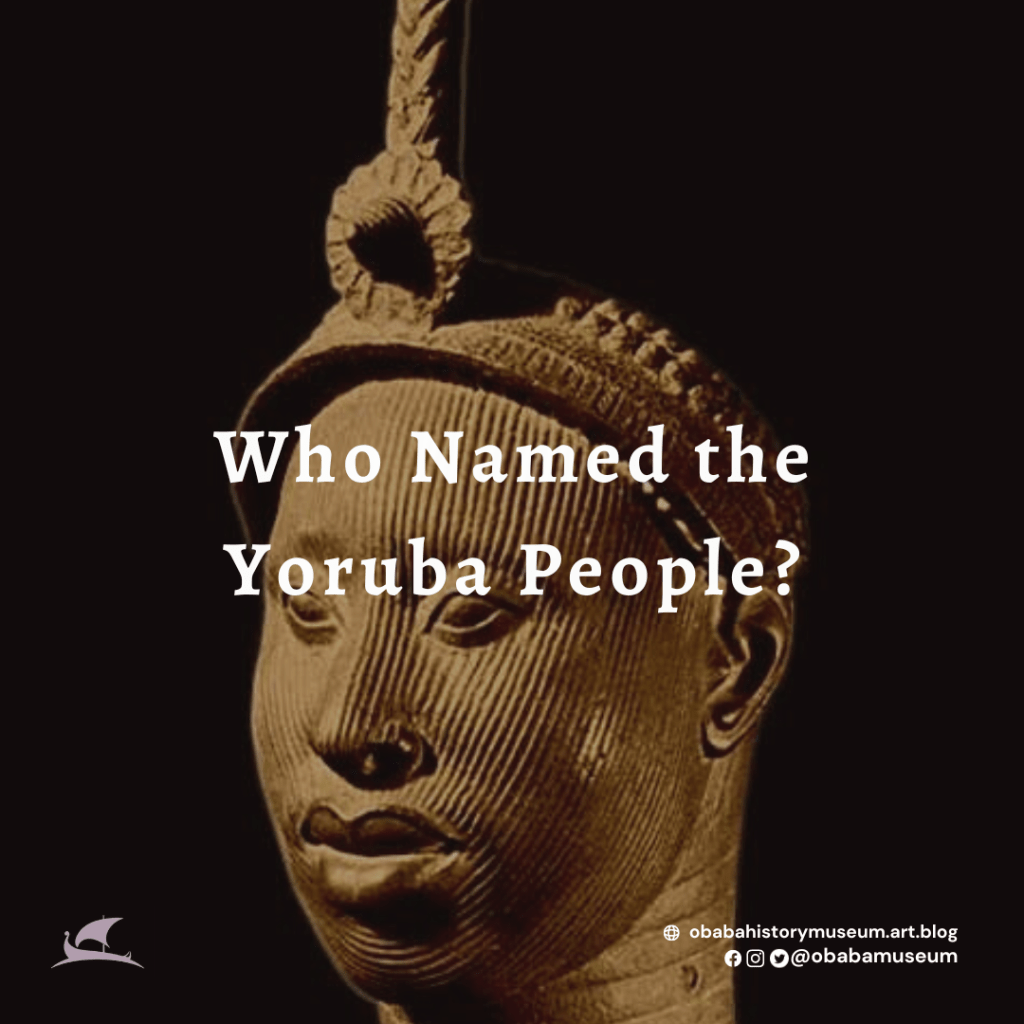
    The name Yoruba was the Hausa name for Oyo people, it was popularized by Hausa usage. As a result of bitter experiences in trade with the Oyo Kingdom where they usually felt cheated and short-changed they developed a stereotypical tag where they referred to the people of Oyo as ‘Yaribanza’ which means cunning, dubious or unreliable. This was later corrupted to Yorubawa or Yoruba. The extension of the term to all speakers of dialects related to the language of the Oyo dates to the second half of the 19th century. It is greatly due to the influence of Bishop Samuel Ajayi Crowther, the first Anglican bishop in Nigeria. Crowther himself was an Oyo Yoruba who compiled the first Yoruba dictionary as well as introducing a standard for Yoruba orthography. The accounts of Crowther coupled with its usage by Colonial officials gave credence to the name.

    The Egbas are know to have resisted that label by the Hausa/Fulani as there are alternative names like ‘Aku’, derived from the first words of Yoruba greetings (such as Ẹ kú àárọ? “good morning”, Ẹ kú alẹ? “good evening”) which has survived in certain parts of their diaspora as a self-descriptive, especially in Sierra Leone and Okun which usually refers to the Yoruba speaking nations within present day Kogi state, Nigeria.

    The native term the Yoruba people call themselves, is “Ọmọ Káàárọ̀-oòjíire,” literally meaning, ‘The People who ask ‘Good morning, did you wake up well?’ Of course the cultures of greeting is one of the striking features of the Yoruba culture, they are known for their many different greetings in many situations. Another term used is, ‘Ọmọ Oòduà,’ meaning ‘Children of Oduduwa,’ referencing the semi-legendary king who is believed to be the founder and ancestor of the modern Yoruba people. The Yorubas usually regard themselves also as ‘Omoluwabi’ which is a philosophical and cultural concept that’s native to them. The concept signifies character, courage, hard work, humility, respect and honour. In clear terms an Omoluwabi is a person of honor and integrity who believes in hard work, respects the rights of others, and gives to the community in deeds and in action. I don’t know o, but if you ask me, I would say that the Omoluwabi is a preferable tag to the Hausa/Fulani imposed name.

    Thanks for reading through, feel free to share and comment.

    References

    Aribidesi Usman and Toyin Falola, ‘The Yoruba from Prehistory to the Present’.

    Noah Yusuf(2020) ‘Yoruba names as a Reflection of People’s Cultural heritage’.

    Wikipedia

Design a site like this with WordPress.com
Get started