Although the proverbial half bread is better than nothing, one must not be disillusioned to the fact that the enthusiasm shown by Nigerian youth in mobilising for registration for permanent voter’s card (PVC) does not necessarily mean that the much acclaimed ballot-revolution is imminent. In the aftermath of the EndSars movement that took place in October 2020, the Nigerian youth have shown an increasing inclination towards politics and governance—something that was hitherto alien to them. This, one must concede, influenced the PVC registrations a great deal as youth-driven NGOs sprang up in different parts of the country, with the purpose of mobilising Nigerians, en-masse, for registration. This in itself is very commendable and is a further testament to the benefits of youth’s involvement in politics. However, this is not yet Uhuru.
Travelling few months down memory lane, precisely to the primaries conducted in preparation for the 2023 general elections, one easily remembers the discrepancies that plagued that very exercise. We witnessed the blatant financial inducement of the celebrity status delegates and the indiscriminate manipulation and bypass of electoral laws and processes to favour particular individuals. Now, considering that the crop of gladiators going at the hierarchies of political offices in the 2023 general elections was projected from such a process riddled with such overt flaws, one cannot help but look to the future with little hope.
Against this backdrop, Nigerian youths—and Nigerians in general—might fall victim of a phenomenon called “voting without choosing” where citizens exercise their democratic franchise but still end up shortchanged as a result of the largely similar array of persons they are allowed to choose from. This is particularly because the indirect primary system that many political parties adopted saw delegations—without the interest of Nigerians at heart—cast their vote for the highest bidders.
Having established the problem, one is left with the task of proffering solutions. First, we must realise the certainty that Nigeria’s problems will not automatically fizzle out after the 2023 elections, regardless of which candidate emerges. Therefore, whatever devotion expressed in the build-up to the election must remain intact after because being partisan does not and should not end at the polls. Electorates must prepare to be conscious of the activities of any government it elects into power so it can hold that government responsible when it falters. They should continually listen in on ongoing conversations about government polices and take opinions on them. Taking a step further will be to organise into political parties and also aspire for offices.
Nigeria’s problem has largely been poor leadership as well as an apathetic citizenry. It has, therefore, been encouraging to see Nigerians wake up to their civil duties in recent times. The core message of this article, however, is that the youth must brace themselves for further involvement in politics and governance because only such participation can ensure good leadership in the country.
Author: AsíwájúofUI
-
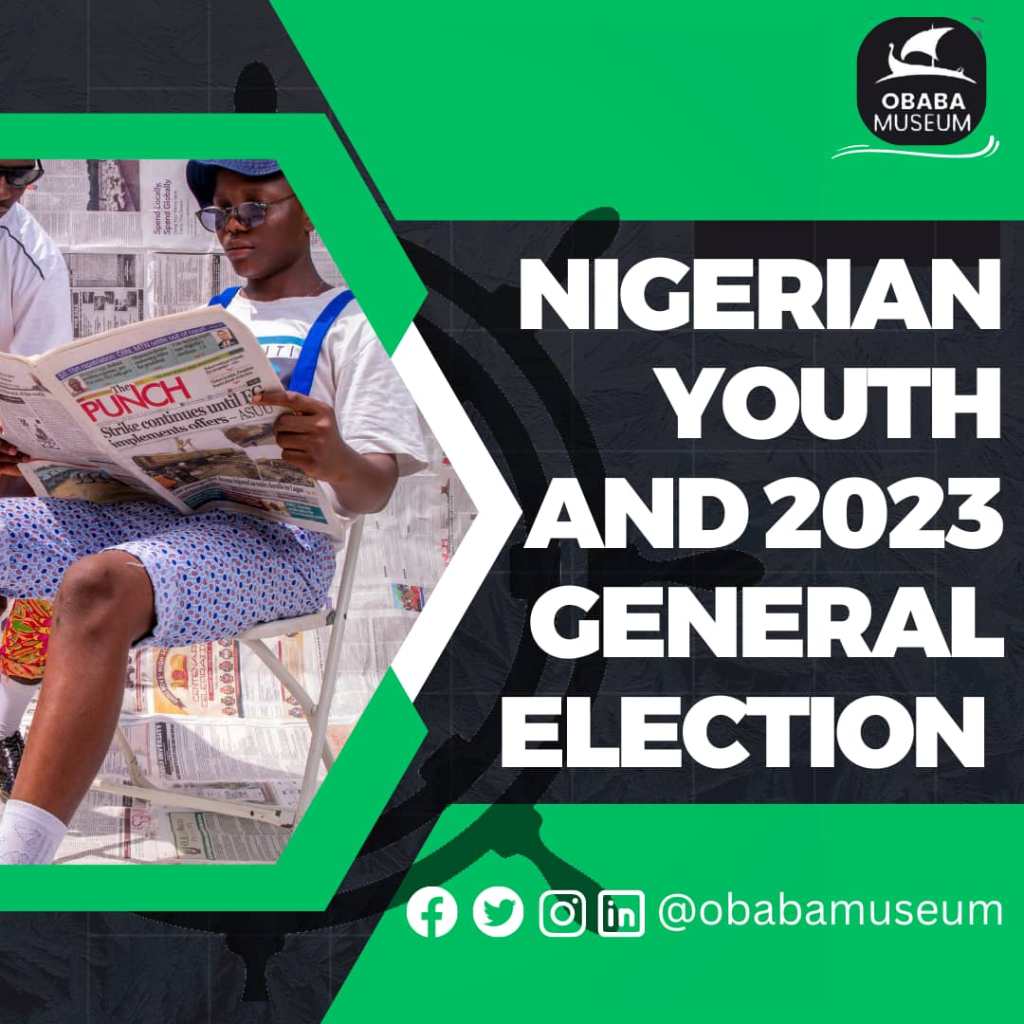
Nigerian Youth and the 2023 General Elections
-
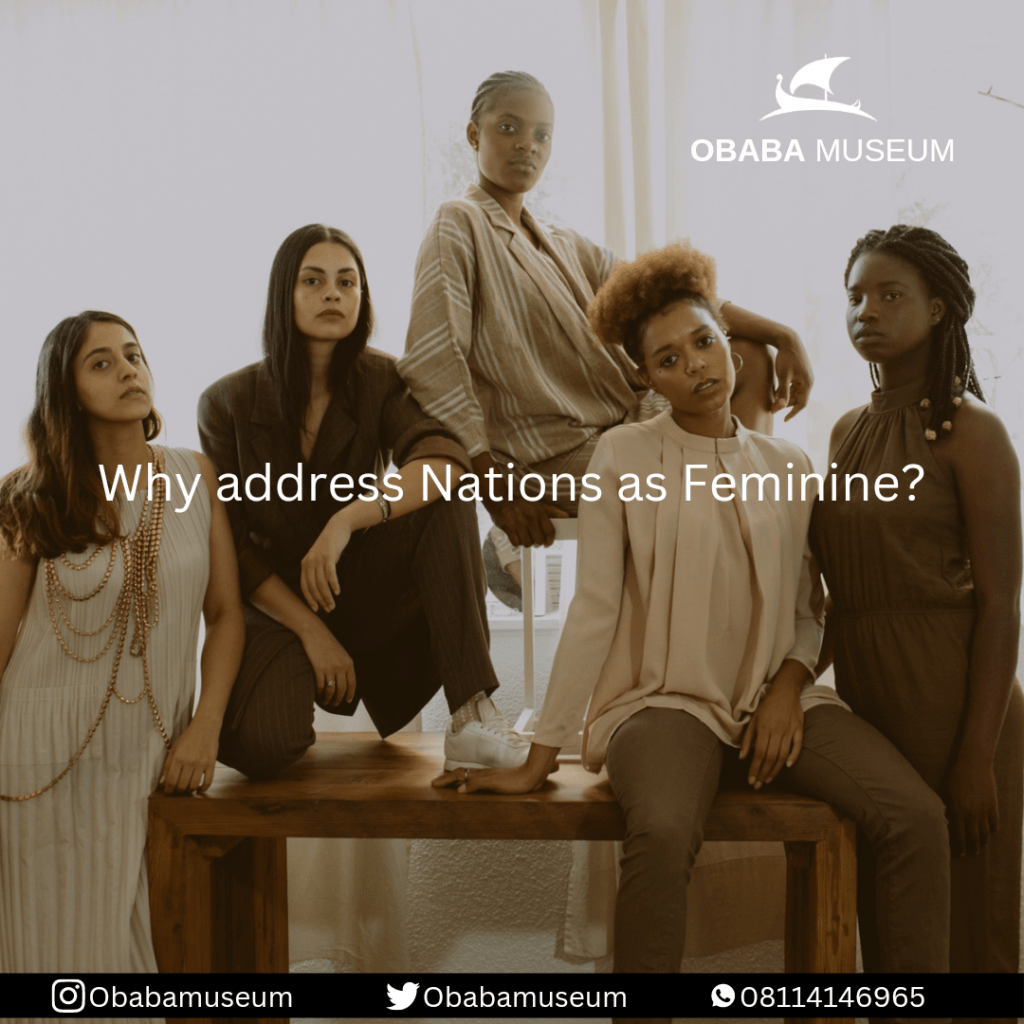
Why Address Nations as Feminine?
In a world, fast-changing; it has become inevitable that humanity redefines rudimentary concepts, such as might have been considered acceptable in earlier centuries, but have now grown obsolete and unacceptable, when juxtaposed with what is obtainable in today’s society.
As a follow-up to one of the recent publication on this blog, in this piece, I try to challenge the rationale behind the adoption of feminine pronouns as the official appellation for addressing nations. Not just to unnecessarily rouse sleeping dogs, but because this is an aberration that has laid strongly upon my conscience, and that I cannot do away with.
As already hinted at in the preceding article, all countries, with an exception of Germany, officially adopt feminine-pronoun appellations in referencing themselves. For instance; the line in the Nigerian pledge “…to defend her unity and uphold her honour and glory…” However, when viewed thoroughly through the feminist lens, the premise for that adoption quickly becomes questionable.
The feminist movement has, over the years, made arguments against the portrayal of the female gender as the damsel-in-distress figure—’the weaker vessel’. A concept that had been sold us as truth, through the inundation of the media and other means of socialization. First, it is imperative to state that this writer is strongly opposed to the idea of assessing individual capability on a set of extrinsic properties. Rather, at least in this writer’s opinion, the peculiar strengths of individuals must be taken into account when considering, if consideration is necessary at all.
In a saner world, one who can lift tons of weight will not inherently be preferred over another who can solve complex problems with the mind. Factly, I consider the overt need to categorize humans along hierarchical lines of ‘strengths’ and ‘weaknesses’ a natural offspring of the patriarchal society we exist in.
The above remains the critical premise for the crux argument of this article: that to liken a country to a damsel-in-distress needing masculine protection from foreign villain is an unforgivable abberation.
To quickly contradict myself, the adoption of the appellations themselves is not bad. It is the motive behind the construct that I challenge. For instance, the application ‘motherland’ ascribes flourish and virtue to a nation and for me, is acceptable.
But in a world, fast changing, we must continue to ask the difficult questions. And challenge every redundant construct that has been hitherto viewed dogmatically.
In conclusion, the use of feminine apellations in addressing nations do not need to be entirely revoked, at least in my opinion, only the motive for which they were first adopted needs to be revisited. And humanity at large, entirely re-orientated.
-

Pyrokinesis
in memory of those killed at the lekki massacre.
Tonight, I light up my heart like a candle-wick,
in remembrance of everyone we’ve lost.
I’m guilty of self-immolation. Every inch of my anatomy burning—
And all the tears shed won’t quench this inferno.
I am a memorial for every sowed seedling,
Sister and brother planted into the earth.
with death’s cold tongue.
This is how we remember the dead,
we chrome everything black and light,
a candle hoping the flickering flame guides their passage
into everlasting fire.

-
Things fall apart; the center cannot hold.
The singular literary work that popularized the poetic line used as the title of this piece—written by the late Chinua Achebe—addressed the putrefaction that beset the pre-colonial Igbo traditions and heritage upon the introduction of western culture.
Quite contradictory is the role reversal that, in my opinion, occurred regarding education in Nigeria.
It continues to trouble me that the colonials, who enslaved the African continent for selfish greed, still gave a liberating education to the continent, and in a disconcerting contrast, our self-governing Kakistocrats have crippled education on all levels.
In retrospect, the brilliant author of the literary work referenced in the first paragraph was a product of the white-man education in Africa, further buttressing—when placed side-by-side with the average standard of education at each level—that devastating decay—induced by the neglect of education by the crop of leadership in Nigeria—has eaten deep into the same sector.
In truth, the dilapidation has been rapid and consistent since education became relegated in the country. This, in my opinion, solely hinges on the absence of visionary leadership in the state. This is my view. Let’s hear yours!
-

Power Drinkards
sober-reflecting on the days when they were still sober.
reminiscing the times before
their tongues
ever tasted power. Before
their lips kissed
the rim of the calabash.
behold our Messiah who turns
power to wine—
strong frothing wine. &
drink till it blurs their
vision. &
deafens their ears. &
corrupts their hearts.
coursing through
their esophagus like the
venom of a diamondback rattle snake.
Disclaimer: Power-drinkards are liable to run mad.
Greed;drowningdrinking them
& driving them insane
like it isn't a crime to
drink & drive. power
corrupts but absolute power
corrupts absolutely.
Power drunk
they gyrate indefatigably to
the lamentations of their
people.
They say "serve us another
round, for we will never
tire.
We will drink until our very
deaths."
Power drunk
they gyrate indefatigably to
the lamentations of their
people.
One day,
your calabash will run dry.
And your keg will break.
where then will you turn to
to quench your insatiable
thirst?
which herb will cure you of
your madness? Who will wean
you of your deadly addiction?
sober-reflecting on the days
when these men were sober.
reminiscing on
the days before power drank
them… -

A Play In The Jungle
Who ever knew that the Lion was not-too-old to run?
Or who knows why when the cub entered the bout
He was called a sheep—a black sheep?
But either ways, the cat family must lay claim to the throne

Now, even the wolf wants to lead the flock
Because this is the jungle; where anything goes

I can't remember being taught the drama technique
That sidelines the main characters in a play
Having them sit as the audience
Watching as jesters play
Power games with their fate.
In this play where every actor is a clown.

It's funny how only the climax determines the drama's genre
And how I can already predict
That this farce will end in a devastating tragedy
In this play where no one follows the script
Every character struggling to steal the spotlight


It's probably no coincidence that
Cheetah and Cheater are homonyms
Because either can win this race in the jungle

Every virulent animal has stepped up to the line
They are on their marks
The stadium goes quiet
As we await the bang like our lives depend on it.
 Obaba Museum