It is shortly after 08:00 hours in Kampala, two hours ahead of Lagos.
The OAU session for the day has already begun. The hall is settled. Amadou-Mahtar M’Bow, then Director-General of UNESCO, is addressing the conference. Idi Amin is chairing the session. He has just delivered his keynote address when news reaches him that something had happened in Nigeria. The information is sketchy but credible. It has been reported by Reuters.
Yakubu Gowon, who had probably heard rumours of the news arrives late. As he takes his place, Amin signals to him. Gowon is called to the high table. Amin shows him a folded piece of paper. The message is brief. A coup has been announced in Nigeria. Gowon reads it without visible reaction. He returns to his seat. For a period, he says nothing. Then he beckons to Usman Faruk, the Military Governor of the North Western State, who is part of the Nigerian delegation. When Faruk leans in, Gowon speaks quietly, in Hausa:
Abin da mu ke jin tsoro, ya faru a gida. (What we feared has happened at home).

Source: Historic Images
The session continues.
By the time the note reached Gowon, the coup was already several hours old. It had been meticulously executed with surgical precision. Lagos had already heard the first radio broadcast, which bore no language of treason, nor talk of ideology.
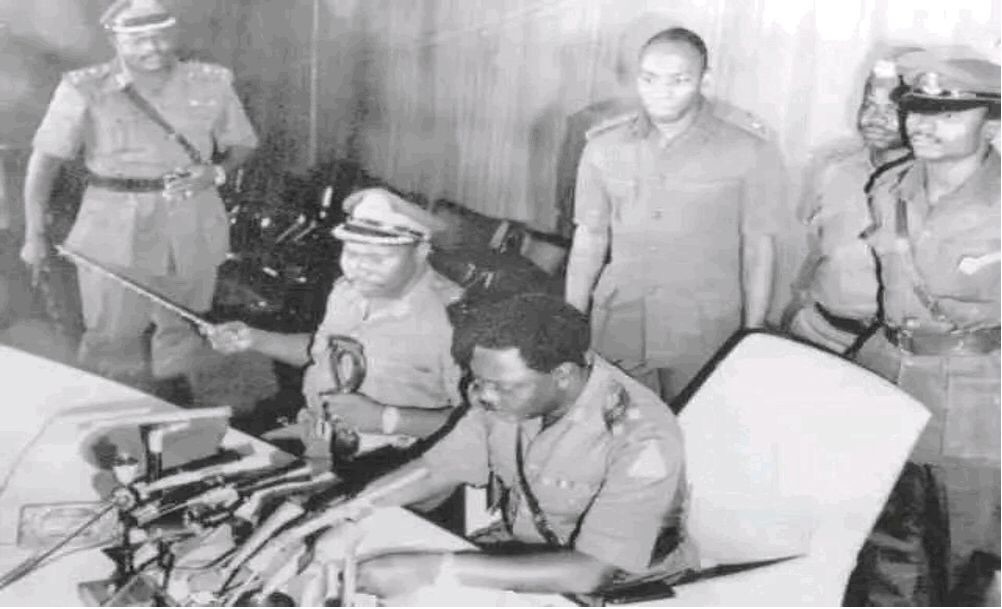
Speaking as Nigeria’s new Head of State, Murtala sat behind the microphone with a firm, commanding presence. At his right was Brigadier Olusegun Obasanjo, the newly appointed Chief of Staff, Supreme Headquarters. On the far left stood Brigadier Iliya Bisalla, Commissioner for Defence, while just behind them were Lt-Colonel Tunde Idiagbon and Lieutenant Akintunde Akinsehinwa, Murtala’s loyal aide-de-camp. Source: TVCNews.ng
“Fellow Nigerians. “Events of the past few years have indicated that despite our great human and material resources, the Government has not been able to fulfil the legitimate expectations of our people. Nigeria has been left to drift. This situation, if not arrested, would inevitably have resulted in chaos and even bloodshed. “In the endeavour to build a strong, united and virile nation, Nigerians have shed much blood. The thought of further bloodshed, for whatever reasons must, I am sure, be revolting to our people. The Armed Forces, having examined the situation, came to the conclusion that certain changes were inevitable…
The accusation was framed as an administrative failure – the usual corruption, indecision, and the stalled transition to civilian rule. This wasn’t a rebellion in the dramatic sense but a precise surgical strike. The subtle genius of all this was the way silence itself became a weapon against Gowon, just like it had been used against the whole country during the counter-coup of July 1966. Remember that for three days (July 29-31, 1966), the whereabouts of General Ironsi was unknown. Brigadier Ogundipe had sent Lt. Col Gowon to negotiate with the coup plotters, only for him to come back as Head of State. Well, you’re already piecing the picture, right?
This time, every single person who might have defended Gowon, every loyalist, had either been neutralised, co-opted, or simply frozen by caution. It wasn’t out of confusion or fear, but simply a reasonable political calculation. One thing was clear, Gowon had already run out of goodwill from his major constituency (the Army). Reading Murtala Muhammed’s speech from Kampala, he would have known immediately that the country he thought he still controlled was gone.
That calm, firm tone in the broadcast was a demonstration of decisiveness by a rebel who had facilitated the rise of Gowon in the first place. And when you step back and think about Gowon himself, it tells you a lot. Here was a man who had survived a civil war, navigated the fractious politics of a newly independent Nigeria, and held the country together through almost impossible circumstances.
Ironically, he was not confronted by street chaos or mobs, but by the quiet efficiency of men he had once commanded. At this moment, he realised, almost philosophically, that power can slip away in silence. Betrayal isn’t always loud. Sometimes, it’s just the quiet click of a plan executed without error.
While addressing a press conference in Kampala, he quoted Shakespeare’s As You Like It to reflect on his exit from power, saying,
“All the world is a stage and all the men and women merely players. They have their exits and their entrances”.
It was clear that he had learned a great lesson. While quoting Shakespeare, he must have realised that loyalty and charisma have limits, even history has its limits. The military, that very institution that had made him Head of State, had grown pragmatic, restless, and disillusioned. Gowon had held power but in that OAU hall in Kampala, he saw clearly how fragile that power really was.
But when did his trouble really start?
To answer that properly, we need to go back to how Gowon entered the military and how he came to power in the first place.
Yakubu Gowon joined the Nigerian Army in 1954. He was part of the generation of officers who entered the army just before independence. At that time, the military was one of the few national institutions that offered upward mobility across regional lines. It was structured, disciplined, and still heavily influenced by British training. He trained at Sandhurst and later attended staff courses in the UK. That training shaped his outlook. Gowon was not ideological, he was institutional. He believed in hierarchy, order, and procedure. He was not known as a radical officer. If anything, he was seen as steady and professional.

In February 1956, the Queen visited Nigeria. On her return to Britain, a guard honour comprised of West African officer cadets studying at the Prestigious Royal Military Academy, Sandhurst, were assembled to recieve the Queen and her family (husband prince Philip and their two kids, Prince Charles and Princess Ann)
Source: Nairaland
By January 1966, when the first military coup in Nigeria happened, he had just returned from a course in the UK. The coup, led by Major Ifeajuna and Nzeogwu, had seen to the death of many senior political leaders and several northern officers. In the midst of this chaos, Major General Ironsi took power. The country became tense, especially in the North, where the coup was viewed through an ethnic lens.
Maj. Gen. Ironsi, the new Head of State, appointed Gowon as the first Chief of Army Staff, one of the youngest officers to hold the position. This was significant because it showed he was trusted, but it also showed something else: he was acceptable across factions in a military that was already developing internal suspicions.

Source: Ethnic African Stories
The counter-coup in July 1966, however, changed everything again. Ironsi was killed. The military hierarchy was shattered. Many of the most senior officers were either dead or politically compromised. What remained was a fractured officer corps looking for someone who could hold the centre. Gowon was not the most senior or the most forceful. But he was the most acceptable.
Brigadier Babafemi Ogundipe, who was next in line after Ironsi, attempted to assume command. On paper, succession should have been straightforward; however, the reality was murky. The northern officers who had executed the counter-coup were not prepared to take orders from him. Rank, in that moment, became just an accessory. Authority had shifted to those who controlled the guns.
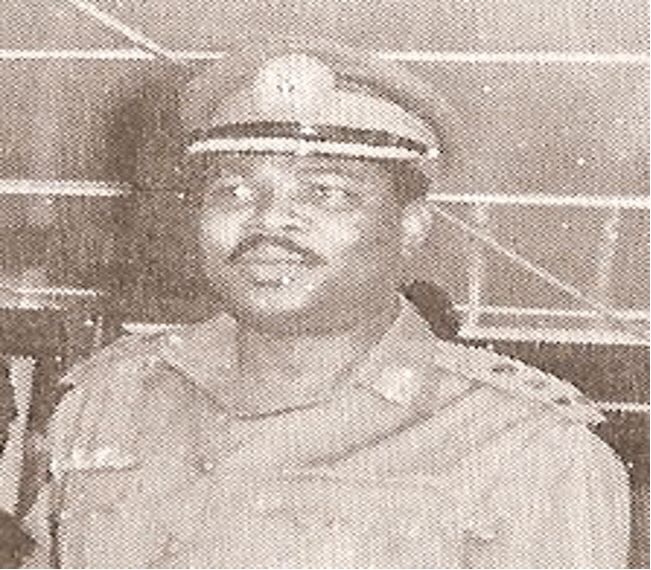
Ogundipe’s position became untenable almost immediately. He needed someone the mutineers would accept. Gowon fit that requirement. He was northern, but had not been associated with the January coup. He was also senior enough to be credible, yet not so senior as to threaten the officers who had just taken decisive action. Moreover, he was professional and, importantly, seen as cautious.
Source: Wikipedia
So, Brigadier Ogundipe sent Lt. Col. Gowon to speak to the coup plotters. That decision proved decisive.
On 1 August 1966, to the bewilderment of Ogundipe, Lieutenant Colonel Yakubu Gowon was announced as Head of State. That was the real beginning of his long-term dilemma. His elevation was not the result of a structured constitutional transfer, but a settlement (a compromise inside a divided military). He emerged as a leader because he was the point at which competing interests temporarily converged. That gave him the office, it did not automatically give him deep-rooted loyalty. From the first day, his authority rested on a balance. In fact, when General Muritala’s memo was rejected by Gowon in 1972, he was quoted by Shehu Shagari, the then Finance Minister to have said:
“Don’t mind him!” “We shall soon change him. We put him there and we can remove him anytime!”[1]

Source: The Cable
In essence, Gowon’s authority, from the very beginning, was conditional. He was Head of State, yes. But he was also the product of a negotiation inside a wounded institution. The July 1966 counter-coup had not restored order in a clean, constitutional sense. It had merely shifted the balance of force. Those who carried out the mutiny did not want to govern directly. They wanted someone who could stabilise the situation without threatening them. Gowon became that bridge.
But, you know, bridges are meant to connect interests. They are rarely sovereign in their own right. That early dependence shaped his style in office. He governed carefully and avoided humiliating powerful officers. He always consulted widely, which made him move slowly where others might have moved decisively. In 1966, that caution was an asset. Nigeria was on edge. The regions were suspicious of one another. The army itself was fractured along ethnic and generational lines. A forceful or ideological leader might have accelerated disintegration.
Then came Aburi in January 1967. The meeting between Gowon and Ojukwu in Ghana has been interpreted in many ways, but one thing is clear: it exposed the tension between military collegiality and political sovereignty. At Aburi, the atmosphere was informal, almost fraternal. Agreements were reached verbally. But once back in Lagos, federal civil servants and advisers warned that implementing Aburi as understood by Ojukwu would hollow out the centre. Gowon initially hesitated but eventually modified the interpretation through Decree No. 8. That hesitation mattered. To Ojukwu, it confirmed the distrust that had built up from the assassination of General Ironsi.
By May 1967, Gowon made the boldest move of his career. Sensing Ojukwu’s move to secede, he broke Nigeria into twelve states. On the surface, it was a wartime calculation. It weakened the Eastern Region’s bargaining power and undercut Ojukwu’s leverage. But structurally, it did something deeper to the nation. It altered the federal architecture in ways Nigeria is still negotiating today. State creation became both a tool of integration and a permanent feature of political competition.
Then the war began.
From 1967 to 1970, the conflict bought Gowon something invaluable: time. Wartime narrows public focus. During wartime, survival takes precedence over reform as the need for stabilisation often overshadows scrutiny. In that environment, leadership is judged by endurance and cohesion, not administrative efficiency. During those years, Gowon was not managing oil wealth or civilian impatience. He was prosecuting a war to keep the country intact. That objective simplified politics. Loyalty was closely tied to national survival. Dissent could be framed as sabotage.
Victory in 1970 elevated him further. The war consolidated his authority and expanded his legitimacy. Ironically, oil revenues increased almost immediately, Nigeria’s international profile rose due to its economic and military strength.
However, once peace returned, expectations resurfaced. The same structure that had centralised authority during conflict now had to justify itself in peacetime. And peacetime is less forgiving. It demands timelines, reforms, and visible direction.
So, in many ways, the war strengthened Gowon. But it also postponed the day of reckoning. When that reckoning came in the early 1970s, through various debates about corruption, governance, and especially the transition to civilian rule, it was sharper because it had been deferred.
It was within this context his overthrow happened.
[1] Omoigui, N. (n.d.). Military rebellion of July 29, 1975: The coup against Gowon – Part 6. Dawodu. Retrieved February 11, 2026, from https://www.dawodu.com/articles/military-rebellion-of-july-29-1975-the-coup-against-gowon-part-6-635
 Obaba Museum
Leave a comment