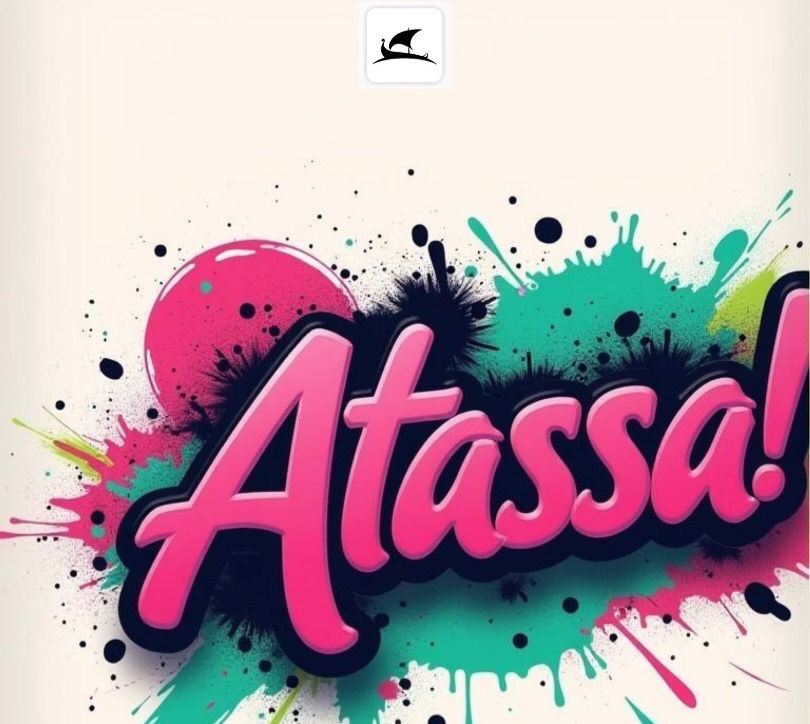
If you have been scrolling through TikTok lately, you’ve probably heard it. Sometimes it is shouted with dramatic flair, sometimes it is whispered like a secret, sometimes it drops right at the climax of a joke. Nobody explains it. Nobody even pauses to ask what it means. But somehow, everyone gets it. I guess that is what makes for a good inside joke.
Like so many internet catchphrases before it, Atassa has become a sound for all occasions. It slips into reaction videos, skits, and music edits. You can think of it as a kind of verbal seasoning sprinkled wherever you need extra spice. But here is the thing, if I ask you where it started, you fit no sabi o.
And that is because Atassa is not alone. It joins a long tradition of viral words that the internet grabbed, reshaped, and turned into inside jokes. Think back to Twitter’s “Bomboclat” wave or the bizarre Sco Pa Tu Mana era. Did I see you nod? If you did, you be ancestor o. I am just kidding sha.
But jokes apart, how do random words go from obscure origins to global entertainment? And what happens when their meanings get lost along the way? That is a question worth pondering. Perhaps you could share your thoughts.
On TikTok, Atassa now works almost like a sound effect.
Someone stumbles in a skit. Atassa!
A punchline lands. Atassa!
A dramatic reveal hits. Atassa!
The good thing is that it is flexible, ambiguous, and rhythmic enough to fit any vibe.
But where does it actually come from? That is where things get interesting.
Some say it came from a dream. A creator from Sàbè in Benin claimed he woke up shouting Atassa and turned it into content. Others link it to the Fon language, where it can mean something as ordinary as basin. A few argue it is just a random chant.
Origin story aside, once TikTok got its hands on it, the meaning did not matter anymore. Atassa has now become more of a feeling than a definition.
Remember the Bomboclat Trend
If Atassa is today’s viral darling, Bomboclat was yesterday’s Twitter obsession. Around 2019, timelines were suddenly flooded with it. The format was simple. Post a picture or clip with the caption “Bomboclat” and wait. Within minutes, replies rolled in with witty captions, sarcastic remarks, or hilarious re-interpretations of the image.
The first viral use, according to reports, was a September 2019 tweet with two pictures from the cartoon CatDog. From there, it became Twitter’s shorthand for ‘caption this’
But here is the twist. Bomboclat is not just a fun syllable. In Jamaican Patois, it is a loaded expletive with cultural depth. Some sources even trace it back to the literal meaning of ‘toilet paper’ or ‘menstrual cloth’. In essence it is used as a sharp insult and a release of frustration. On Twitter, though, it was stripped of all that and turned into a harmless meme.
The critique here is obvious. When language travels online, especially across borders, it often gets flattened. What Jamaicans wield with emotional force became just another tool in Twitter’s joke arsenal.
Don’t forget the ‘Sco Pa Tu Mana’ Era?
There was also Sco Pa Tu Mana, the nonsense word that ruled Twitter in 2019 before it got overthrown by ‘Bomboclat’. It came from a Ghanaian track by Kawoula Biov featuring Patapaa who was known for his chaotic, offbeat style (remember One Corner? Yeah na him sing am). On this particular track, he slipped Sco Pa Tu Mana into his verse not as a meaningful word but as filler.
The internet, of course, could not resist. Soon, Twitter users worldwide were posting random phrases with the hashtag #Scopatumana. It became a kind of linguistic dare. A prompt for opinions, like saying ‘what do you think about this? Or ‘share your thoughts’. A photo of a food, a celebrity or even a random object could be captioned Sco Pa Tu Mana, and the replies would pile in.
What made it work was not meaning but rhythm and vibe. Like Atassa, it was catchy. And just like Bomboclat, it thrived on call and response. It did not need a dictionary definition to spark joy.
Now, if you put Atassa, Bomboclat, and Sco Pa Tu Mana side by side, you would notice a common pattern. They are all short, punchy, and flexible. They are the perfect ingredients for memes and endless remixing. They also thrive on call and response culture. One person posts it and others quickly respond, pile on, or reframe it in their own style. Most importantly, they flatten cultural depth. Bomboclat became detached from its Jamaican roots and turned into a global joke. Sco Pa Tu Mana, lifted from a Ghanaian rap verse, left its local setting and evolved into meme-speak. And Atassa, whether dream-born or rooted in Beninese language, is no longer about its origin. E don turn content.
That is the paradox of internet language. On one hand, words can unite us across borders. On the other hand, they raise uncomfortable questions. Are we celebrating cultural expressions or stripping them of meaning? And once the internet takes a word, who really owns it?
Atassa might have been born in a dream, a Benin household, or a football stadium. Bomboclat might have been a Jamaican curse. Sco Pa Tu Mana might have been nonsense. But once they hit the internet, they became something else entirely (memes that meant everything and nothing at the same time).
And that is the beauty and the tragedy of internet language. A word can carry centuries of cultural weight or absolutely no meaning at all. Either way, the internet will remix it until it is unrecognizable.
So the next time you hear someone yell Atassa on TikTok, remember this. You are not just laughing at a sound. You are watching language itself go through the blender of the internet, and somehow it still comes out catchy.
 Obaba Museum
Leave a comment