It’s Thursday, the 15th of January 1970, Philip Effiong, the acting Head of State of Biafra announces the unconditional surrender of Biafra, following Ojukwu’s ‘foreign peace trip’.
We’re told that Colonel Olusegun Obasanjo, GOC 3 Marine Commando Division, had earlier on received the instruments of surrender from General Effiong the previous day at Amichi village in Anambra – a previous stronghold of Ojukwu.
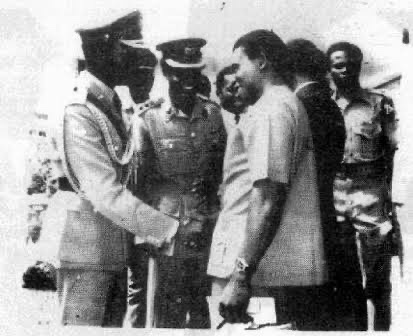
At Dodan Barracks, the Nigerian head of State Major-General Yakubu Gowon shake hands with arrested senior Biafran officers that were presented to him by Colonel Olusegun Obasanjo. Obasanjo said the Biafran officers were reporting for “reassignment and redeployment”. Gowon greeted the leader of Biafra’s delegation Phillip Effiong with the words “how are you my friend?”
Effiong then proceeds to deliver the surrender speech:
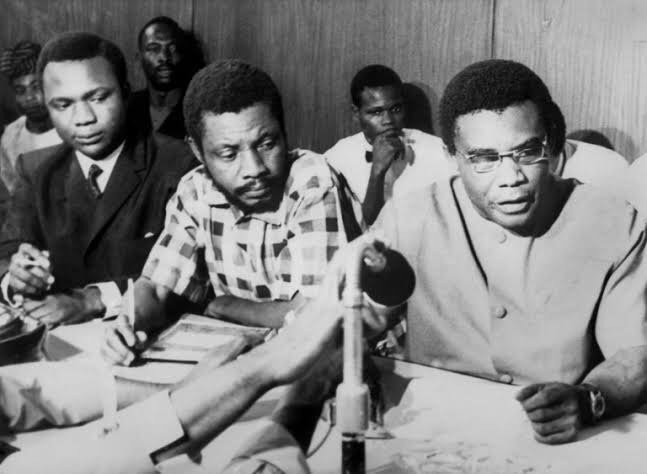
I, Philip Effiong, do hereby declare: I give you not only my own personal assurances but also those of my fellow officers and colleagues and of the entire former Biafran people of our fullest cooperation and very sincere best wishes for the future.
It is my sincere hope the lessons of the bitter struggle have been well learned by everybody and I would like therefore to take this opportunity to say that I, Maj. Gen. Philip Effiong, officer administering the government of the Republic of Biafra, now wish to make the following declaration:
That we are firm, we are loyal Nigerian citizens and accept the authority of the federal military Government of Nigeria.
That we accept the existing administrative and political structure of the Federation of Nigeria.
That any future constitutional arrangement will be worked out by representatives of the people of Nigeria. That the Republic of Biafra hereby ceases to exist.
Following this, Gowon delivers his ‘Speech to the Nation’ signalling the end of the Nigerian Civil War. He states that the ‘so-called rising sun of Biafra is set forever’ and that it would be ‘a great disservice for anyone to continue to use the word ‘Biafra’ to refer to any part of the East Central State of Nigeria’. He then calls on Nigerians to ‘build a new nation’.
In the aftermath of the war, Nigeria faced the challenging task of healing wounds and reintegrating the former secessionist region of Biafra into the larger nation.
The Federal Military Government declares that the Armed Forces Remembrance Day which was previously marked on the 11th day of November would now be marked on January 15 every year in honour of the many lives lost in the bitter civil war and coup of 1966.
Every January 15, we remember our fallen heroes and the sacrifices of all serving members of the Armed Forces. The heart of the commemoration lies in the laying of wreaths, a sombre ritual conducted at the National Arcade in Abuja and war memorials nationwide. Dignitaries, officials, and military personnel gather, honouring the fallen by placing wreaths at cenotaphs. Statewide observances, religious services, and military parades amplify the day’s gravity.
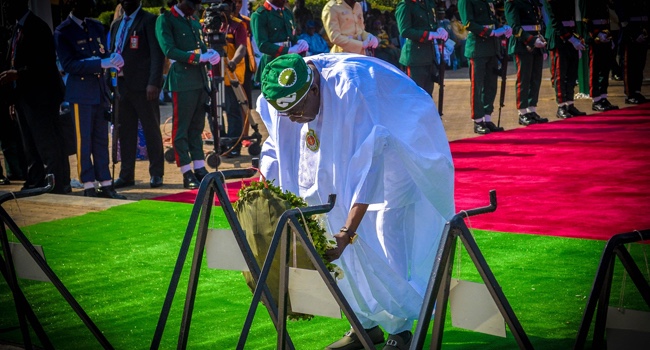
The President of Nigeria typically addresses the nation on Armed Forces Remembrance Day, reflecting on the significance of the occasion, expressing gratitude to the armed forces, and reaffirming the commitment to national unity and security. The Nigerian Legion plays a pivotal role in the planning of the ceremony which often begins two months before the event.
Every soldier prays for peace because, they bear the brunt of violence.
God bless the Armed Forces of Nigeria!
 Obaba Museum
Leave a comment