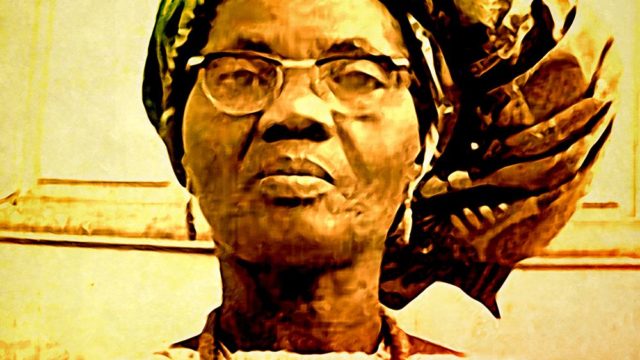
Funmilayo Ransome-Kuti was a prominent activist and women’s rights advocate during Nigeria’s colonial era. She fought passionately against colonial oppression and played a crucial role in Nigeria’s struggle for independence. Ransome-Kuti was also a vocal champion of women’s rights and social justice. She founded the Abeokuta Women’s Union, which empowered women to participate in politics and demand better living conditions.
Funmilayo Ransome-Kuti was born on October 25, 1900, in Abeokuta, in what was then the British protectorate of Nigeria. Her father, Daniel Olumeyuwa Thomas, was a Yoruba farmer and an Anglican minister, while her mother, Lucretia Phyllis Omoyeni Adeosolu, was a skilled trader. These early influences shaped Funmilayo’s strong sense of social justice and concern for the welfare of her people.
At the age of 11, Funmilayo was sent to the Abeokuta Grammar School, where she received a Western education that would later become instrumental in her activism. In 1919, she married Reverend Israel Oludotun Ransome-Kuti, who shared her passion for social change and supported her throughout her endeavors. Her activism began in the 1930s, during the height of British colonial rule in Nigeria. She became a vocal advocate for women’s rights and fought against various discriminatory practices and laws targeting Nigerian women. She founded the Abeokuta Ladies Club, which provided a platform for women to discuss issues affecting their lives and unite in the struggle for equality.
She was also a founding member of the Nigerian Women’s Union (NWU) in 1949, which later evolved into the Federation of Nigerian Women’s Societies (FNWS). Through these organizations, Funmilayo campaigned against taxation policies that unfairly burdened women and fought for increased political representation for women at both the local and national levels.
As Funmilayo’s influence grew, she expanded her activism beyond women’s rights. She became a prominent figure in the Nigerian independence movement, joining forces with other nationalists to advocate for self-rule and liberation from British colonial rule. One of her most notable moments came in 1947 during the Alake crisis. The Alake of Egbaland, Sir Ladapo Ademola II, was an influential traditional ruler who was perceived as collaborating with the British colonial authorities. In response to his actions, Funmilayo led a protest of Egba women to the Alake’s palace, demanding his abdication. This unprecedented action led to the Alake stepping down from his throne, symbolizing the power and determination of the Nigerian people in their fight for self-determination.
Funmilayo Ransome-Kuti’s legacy extends far beyond her activism during the Alake crisis. She was a tireless fighter for human rights, democracy, and social justice, and her contributions significantly influenced Nigeria’s political landscape. Her relentless advocacy played a crucial role in the development of Nigeria’s nationalist movement and laid the groundwork for the eventual independence of the country in 1960.
Unfortunately, her activism also made her a target of the colonial authorities and later, the Nigerian government. She was arrested and imprisoned several times for her activism and was even thrown out of a window during one particularly brutal crackdown on her son, Fela Anikulapo Kuti.
Funmilayo Ransome-Kuti’s journey from an educated Nigerian woman to a prominent political activist and feminist icon is a testament to the power of determination and courage in the face of adversity. Her life’s work significantly advanced the cause of women’s rights in Nigeria and laid the foundation for a more inclusive and equitable society.
Her unwavering dedication to social justice and the fight for independence earned her the revered title, “The Woman Who Dethroned the Alake.” Today, Funmilayo’s legacy continues to inspire activists and leaders, both in Nigeria and beyond, to strive for a better world where equality and justice prevail for all.
Her courage and determination continue to inspire women in Nigeria to raise their voices and fight for their rights.
 Obaba Museum
Leave a comment