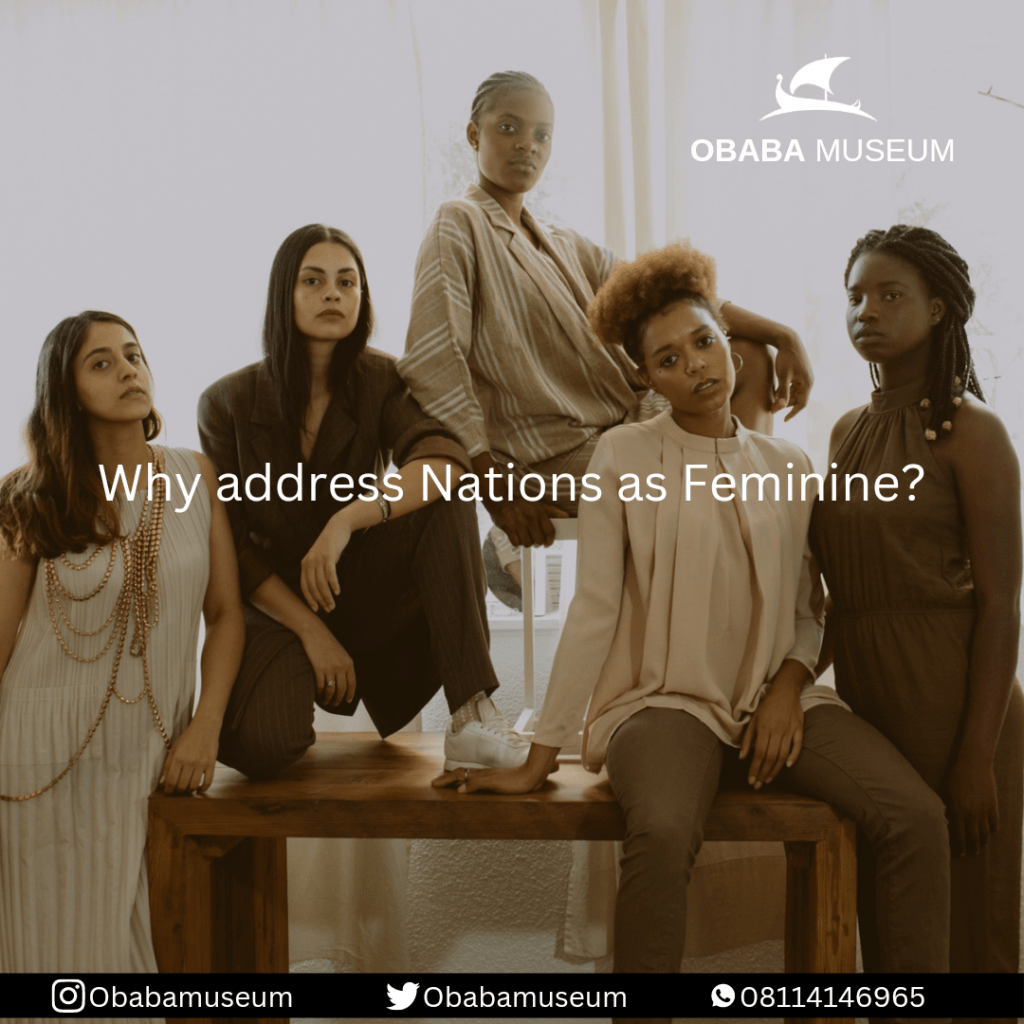
In a world, fast-changing; it has become inevitable that humanity redefines rudimentary concepts, such as might have been considered acceptable in earlier centuries, but have now grown obsolete and unacceptable, when juxtaposed with what is obtainable in today’s society.
As a follow-up to one of the recent publication on this blog, in this piece, I try to challenge the rationale behind the adoption of feminine pronouns as the official appellation for addressing nations. Not just to unnecessarily rouse sleeping dogs, but because this is an aberration that has laid strongly upon my conscience, and that I cannot do away with.
As already hinted at in the preceding article, all countries, with an exception of Germany, officially adopt feminine-pronoun appellations in referencing themselves. For instance; the line in the Nigerian pledge “…to defend her unity and uphold her honour and glory…” However, when viewed thoroughly through the feminist lens, the premise for that adoption quickly becomes questionable.
The feminist movement has, over the years, made arguments against the portrayal of the female gender as the damsel-in-distress figure—’the weaker vessel’. A concept that had been sold us as truth, through the inundation of the media and other means of socialization. First, it is imperative to state that this writer is strongly opposed to the idea of assessing individual capability on a set of extrinsic properties. Rather, at least in this writer’s opinion, the peculiar strengths of individuals must be taken into account when considering, if consideration is necessary at all.
In a saner world, one who can lift tons of weight will not inherently be preferred over another who can solve complex problems with the mind. Factly, I consider the overt need to categorize humans along hierarchical lines of ‘strengths’ and ‘weaknesses’ a natural offspring of the patriarchal society we exist in.
The above remains the critical premise for the crux argument of this article: that to liken a country to a damsel-in-distress needing masculine protection from foreign villain is an unforgivable abberation.
To quickly contradict myself, the adoption of the appellations themselves is not bad. It is the motive behind the construct that I challenge. For instance, the application ‘motherland’ ascribes flourish and virtue to a nation and for me, is acceptable.
But in a world, fast changing, we must continue to ask the difficult questions. And challenge every redundant construct that has been hitherto viewed dogmatically.
In conclusion, the use of feminine apellations in addressing nations do not need to be entirely revoked, at least in my opinion, only the motive for which they were first adopted needs to be revisited. And humanity at large, entirely re-orientated.
 Obaba Museum
Leave a comment