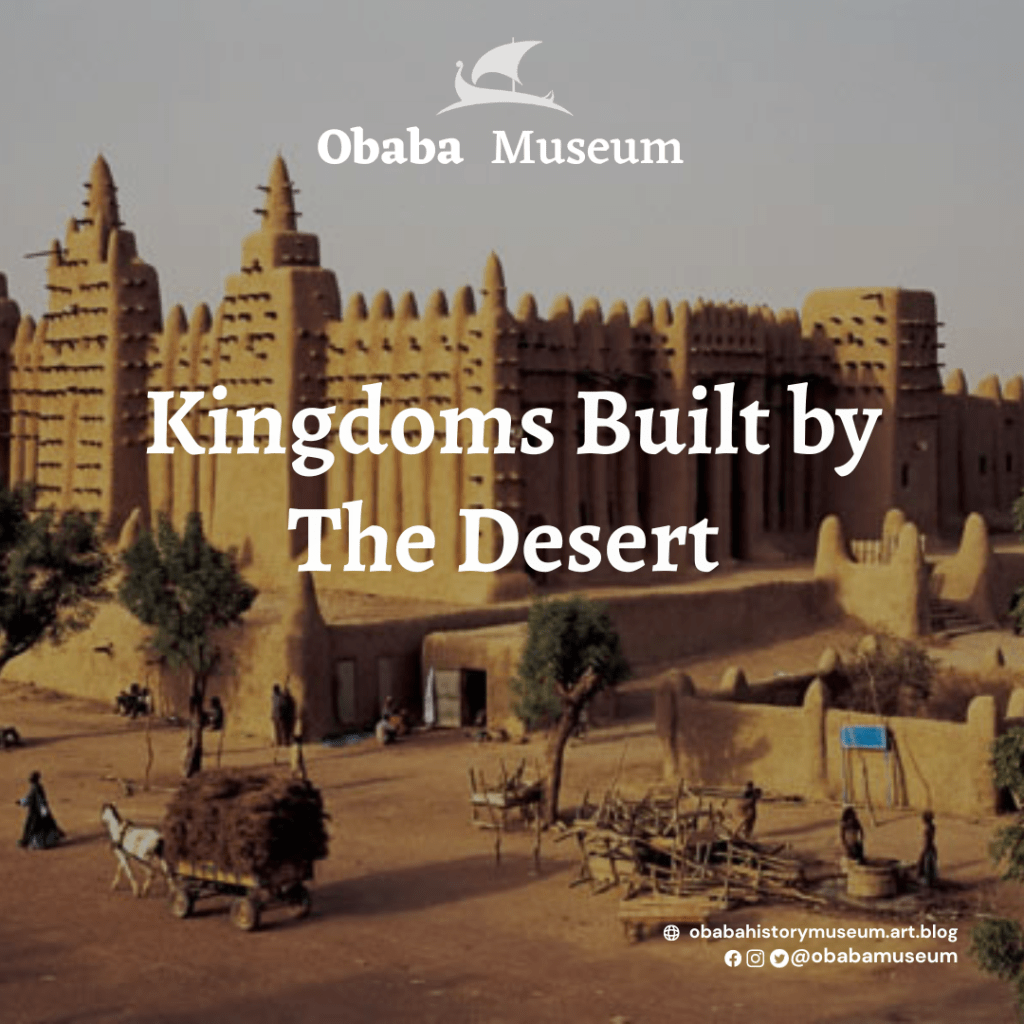
For a good number of years, trade moved back and forth across the Sahara with goods exchanging hands in West Africa, however West Africans did not really benefit from the Saharan trade because the routes were often controlled by Berbers from North Africa.
One of the major articles of trade was Gold, arguably the most expensive and wanted commodity in human history. Of course it was an abundant natural resource in the possession of West Africans which eventually made the control of the trade routes go into the hands of West Africans. The ability to control the trade routes to their advantage brought about the birthing or rise of three great empires; Ghana, Mali and Songhai.
GHANA KINGDOM
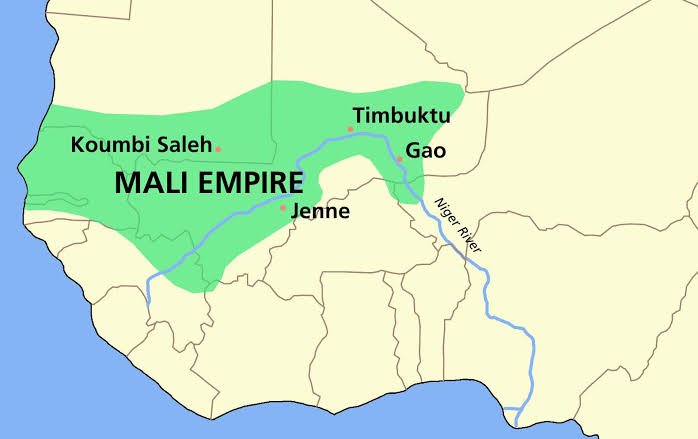
The Ghana Empire was also known as Wagadou or Awka existed from 300 to 1100 AD. The word Ghana means King of gold. The Ghana empire was founded by the Soninke people and was based in the capital city of Koumbi Saleh.
Ghana was rich in gold and salt- two valuable articles of trade. People wanted gold for its beauty and salt to preserve their food and of course make their food tasty. As trade in gold and salt increased, Ghana’s rulers gained power, they built up armies equipped with iron weapons that were superior to other nearby cities. As time passed by, Ghana took control of trade merchants. Merchants from the north and south would meet in Ghana to exchange goods. Gradually, Ghana took firm control of West Africa’s trade routes, almost all trades between Northern and Southern Africa passed through Ghana.
Eventually, the rulers of Ghana started forcing traders to pay taxes. Every trader who entered Ghana had to pay a special tax on the goods he carried and another on the goods he took with him when leaving. They gained an incredible amount of wealth from the trade and used the wealth to build an army and an empire.
As the kingdoms of Ghana extended into the Sahara, increased contact with Arab traders from the east brought the Islamic religion to Ghana. In the 1060s, a Muslim group called the Almoravids attacked Ghana in an effort to force its leaders to convert to Islam. They weakened Ghana’s empire by cutting off many trade routes. Without its trade, Ghana was nothing and the empire eventually fell. The influence of Islam however remained strong. Despite its collapse, the empire’s influence can be felt in the establishment of numerous urban centers throughout its former territory and beyond. In 1957, the British colony of Gold Coast under the leadership of Kwame Nkrumah named itself Ghana in honour and remembrance of the historic empire although, they never shared the same geographical boundary or location.
MALI KINGDOM
Mali was along the upper Niger River. This area’s fertile soil helped Mali grow and control the trade on the river. The empire grew rich and powerful through the control of the trade.
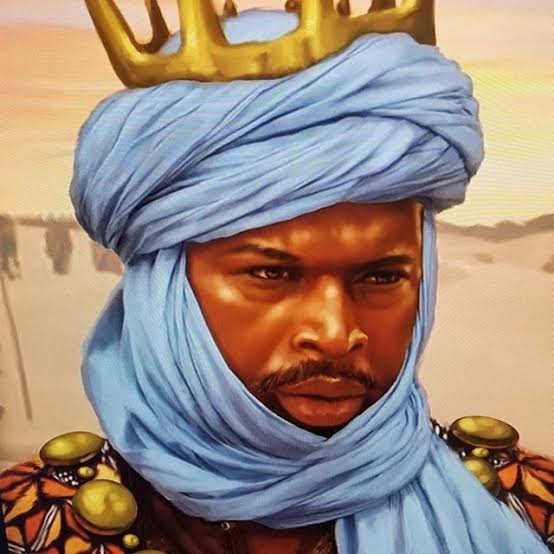
Mali’s rise to power began under a ruler named Sundiata. He won back his country’s independence and conquered nearby kingdoms, one of which was Ghana. However, Mali’s most famous ruler was Mansa Musa (Musa Keita). Under his leadership, Mali reached the height of its wealth, power, and fame.
Mansa Musa ruled Mali from 1312 to 1337. During that time, Mali added many trade centres including Timbuktu, Djenne, and Gao, to its empire. Traders came to Timbuktu from the north and the south to trade salt, gold, shells, and many other goods. Religion was very important to Mansa Musa. In 1324 he left Mali on a Hajj, or pilgrimage to Mecca. Making this journey at least once in their lifetime is the spiritual duty of all Muslims. As he journeyed to Mecca, Mansa Musa introduced his empire to the world. The stories of Mali’s wealth and religion spread far and wide. Because of Mansa Musa’s influence, Islam spread through a large part of West Africa.
Mansa Musa wanted all Muslims to be able to read the Qur’an. Therefore, he stressed the importance of learning to read and write the Arabic language and he sent scholars to study in Morocco. These scholars later set up schools in Mali for studying the Qur’an. To encourage the spread of Islam in West Africa, Mansa Musa brought back artists and architects from other Muslim countries to build mosques throughout lands.
The architectural advances in cities like Timbuktu as well as an organized government, an emphasis on education, and expansion of trade all combined to make Mansa Musa Mali’s most successful ruler. Unfortunately, Mansa Musa died and poor leadership weakened the empire. By 1500 nearly all of the lands the kingdom once ruled were lost. Only a small area of Mali remained.
SONGHAI KINGDOM
In the 1300s, Mansa Musa had conquered a rival kingdom of people called Songhai who also lived along the Niger River. As the Mali Empire weakened, the Songhai grew in strength. They took advantage of Mali’s decline and regained their independence conquering most of Mali.
One of Songhai’s greatest rulers was Muhammad Ture, who chose the title Askia the Great. Like Mansa Musa, Askia the Great was a devout Muslim who supported education and learning. Under his rule, the cities of Gao and Timbuktu flourished. They contained great mosques, universities, schools, and libraries. People came from all parts of West Africa to study mathematics, science, medicine, grammar, and law.
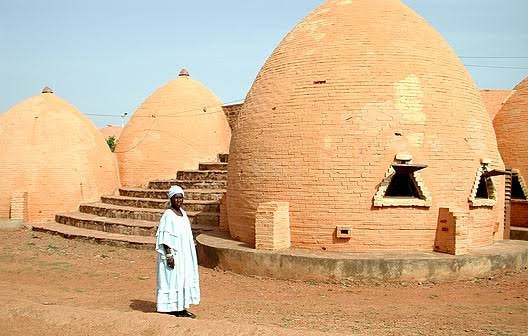
Askia understood that an empire needed effective government so he created a professional army, and to enhance the empire, he set up five provinces, each led by a governor who was loyal to him. He also created specialized departments to oversee various tasks, much like modern day government offices do.
Soon after Askia the Great lost power, the empire of Songhai declined. Songhai was invaded by the Moroccans, the kingdom’s northern neighbors. The Moroccans wanted to control the Saharan salt mines. They had superior military power and were able to take over Timbuktu and Gao. Changes in trade patterns completed Songhai’s fall.
Of course many other empires also rose up due to their ability to control the Trans Saharan trade routes, however we listed the
 Obaba Museum
Leave a comment