In the last episode, we talked about the two great figures featured on the Twenty Naira note, today you’ll see much more and even the original Pictures used on the Naira notes. Let’s begin!
The Ten Naira note alongside the Five Naira and one Naira, was reintroduced on July 1979 with new portraits. On October 1, 1978 General Murtala Mohammed, Alvan Ikoku, Sir Tafawa Balewa and Sir Herbert Macaulay were declared national heroes during the regime of General Olusegun Obasanjo. The February of the previous year (1977), a new twenty Naira note with the portrait of General Murtala, had been introduced as part of the activities marking the one year anniversary of his assassination. By the 2nd of July 1979 the portraits of Alvan Ikoku, Sir Tafawa Balewa and Herbert Macaulay were featured on the Ten, Five and One Naira notes respectively.
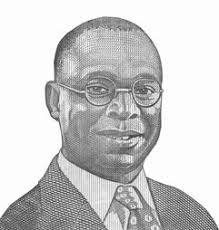
Alvan Ikoku (1900-1971) is still someone many Nigerian masses see daily, because at least, in most areas of the country, you should still be able to purchase a sachet water (pure water) for Ten Naira but do you really know his significance in Nigerian history?
Dr. Ikoku was an activist, nationalist, politician and statesman. One great thing about Dr. Ikoku is his reputation for pioneering education in Nigeria, in fact, it is safe to say that his greatest contribution was in the area of education. He established one of Nigeria’s very first private secondary schools, Aggrey Memorial College in Nigeria in Arochukwu, Abia State in 1931. At Aggrey, he introduced carpentry as a subject, where he called it ‘the Education of the Hand.’ The most interesting aspect of this is that the students were able to make their desks, lockers, chairs, bookshelves and tables all by themselves. Almost all his children studied at Aggrey college too.
The school was at the forefront of technical and entrepreneurial education, as well as the teaching of indigenous languages. He did not just run the school but also taught some of the subjects.
After the 1946 constitutional changes, which allowed more Nigerians to be in the legislative chambers, Ikoku was one of the persons nominated into the Eastern Nigeria House of Assembly. In 1947 he became part of the Legislative Council in Lagos as one of three representatives of the Eastern Region.
He contributed to making the colonial government implement the decisions of Nigeria Union of Teachers (NUT) and also pushed for some of its educational ordinances to be amended in the 1950s. He later became the president of the union in 1955. In 1962, he advocated for the Education Bill of Rights for primary school education to be free for six years across the country and also for indigenous languages to be taught in schools. The bill in the first republic did not scale through, but in 1976 the Federal Military Government adopted it as a policy for the country.
He served on various educational bodies in the country, including the West African Educational Council (WAEC) and Council of the University of Ibadan, among others. Dr. Ikoku died on November 18, 1971, seven years later, he was declared a national hero and featured on the ten Naira note a year later.
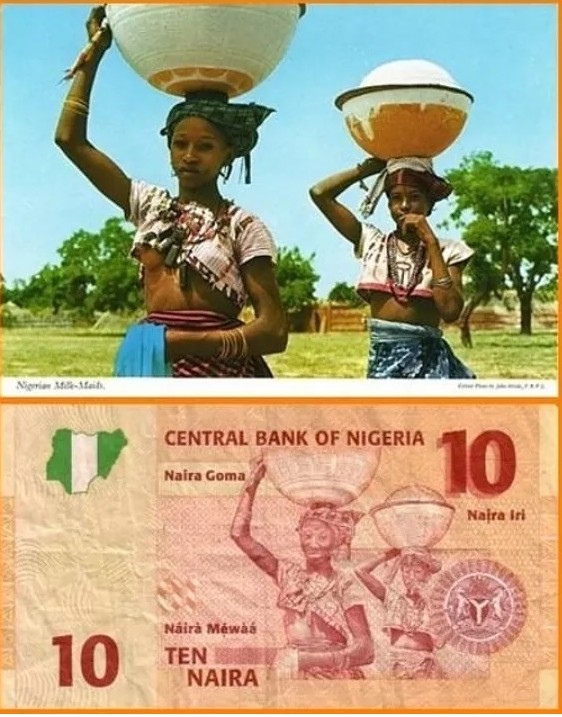
At the back of the ten Naira notes are pictures of two Fulani milkmaids carrying calabashes filled with Fura da nono. It has been discovered that this picture was captured by John Wilfrid Hinde an English photographer, whose idealistic and nostalgic style influenced the art of postcard photography. Hinde took the picture of the Fulani milk maids between 1960 and 1970. Fura da nunu/nono is a special treat.
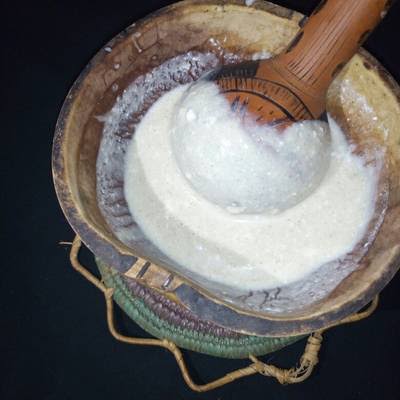
Fura da nono is very popular in the Northern states where it can be taken any time of the day. Nono is the Hausa word for cow’s milk while Fura is millet flour usually moulded into balls; the two are usually sold together by the Fulani maids. However many people prefer to use plain yogurt to mix with the fura and drink. Well most of my friends add a lot of sugar to their millet cereal lol, I forgot to tell you millet cereal is the closest English translation I know for fura da nono.
The Five Naira note features, on its front view, Sir Abubakar Tafawa Balewa (1912-1966), Nigeria’s first and only Prime Minister. He is most popularly known as a Nigerian politician, and the only prime minister of Nigeria but do you know that he originally trained and served as a teacher? Nicknamed the Golden Voice of Africa because of his oratory skills, he arguably could be described as one of Nigeria’s greatest speakers (you need to check out some of his videos to confirm).
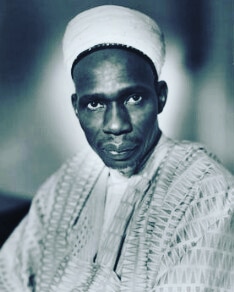
Tafawa Balewa had very humble origins. He was born on October 1, 1912 in the village of Tafawa Balewa, in modern-day Bauchi State. His father, Yakubu Dan Zala, was a slave who rose in service of the Madaki of Bauchi and became a district head. He took the name of his birthplace together with his name Abubakar. Tafawa Balewa derives its name from two corrupted Fulani words: ‘tafari’ meaning ‘rock’ and ‘baleri’ meaning ‘black’. He was his father’s only child and contrary to the belief of most Nigerians he had no Hausa origin, his father was in fact of Bageri ethnicity, and his mother Fatima Inna was Fulani.
He attended Koranic school and learnt the first chapter of the Qur’an by heart at a very young age. For his Western education he attended Bauchi Provincial School. According to his teacher and classmates he was shy, quiet and not really an outstanding student. He later enrolled at Katsina Teacher Training College (1928-1933) and graduated with a third class certificate, performing best in English. He became a teacher and having passed the Senior Teacher’s Certificate examination he would go on to become headmaster of the Bauchi Middle School. Alongside a handful of northern teachers he obtained scholarship to study at the University of London’s Institute of Education from 1945 to 1946, where he received a teacher’s certificate in history. Upon returning to Nigeria, he became an Inspector of Schools for the colonial administration before entering politics.
In 1946 the Bauchi Native Authority had selected Tafawa Balewa as their representative to the Northern House of Assembly and the House of Assembly in turn selected him to become a member of the Nigerian Legislative Council. In the North’s first elections in 1951, Tafawa Balewa won seats in the Northern House of Assembly and in the House of Representatives in Lagos, where he became a minister in the Central Council. By 1952 he became Minister of Works and in 1954 was made Minister of Transport and the Senior Minister and leader of the NPC in the House of Representatives. In 1957 he became the first prime minister of Nigeria, a position he held until his death in 1966.
Balewa was initially suspicious of Nigerian unification and feared that the Northern Region would be dominated by the better educated and dynamic South. He was quoted to say
‘the southern tribes who are now pouring into the north in ever increasing numbers…do not mix with the northern people in social matters and we…look upon them as invaders. Since 1914 the British government has been trying to make Nigeria into one country, but the Nigerian people themselves are historically different in their backgrounds, in their religious beliefs and customs, and do not show themselves any sign of willingness to unite. So what it comes to is that Nigerian unity is only a British intention in the country.’
He would later change his ideology to adopt a more federal outlook following a visit to America in 1955. He later remarked
‘in less than 200 years, this great country (America) was welded together by people of so many different backgrounds. They built a mighty nation and had forgotten where they came from and who their ancestors were. They had pride in only one thing —their American citizenship… I am a changed man from today. Until now I never really believed Nigeria could be one united country. But if the Americans could do it, so can we.’
Many Nigerians believe he wasn’t too effective as a leader due to the subservience to his party leader, the Premier of Northern Nigeria, Sir Ahmadu Bello. Hence he was viewed by the indigenes of Southern Nigeria as an agent for the extension of Northern politics/interest, this turned out to be one of the factors leading to his abduction and assasination by some disgruntled sect of the army.
As Prime Minister of Nigeria, Tafawa Balewa, from 1960, doubled as the country’s foreign affairs minister till 1961, when his government created an official Foreign Affairs and Commonwealth Relations ministerial position in favour of Jaja Wachuku who became, the first substantive Nigerian Minister of Foreign Affairs and Commonwealth Relations (later External Affairs) between 1961-1965.
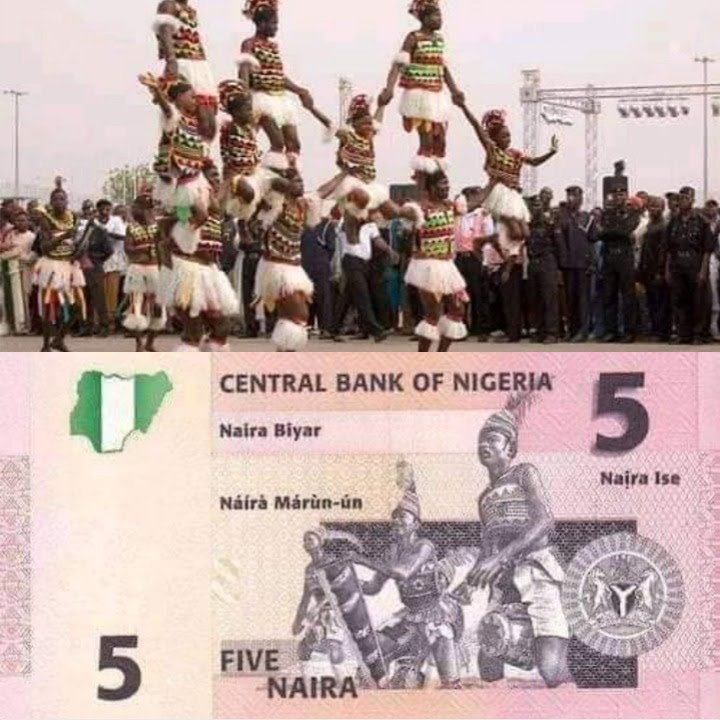
The Nkpokiti Dance Troupe is featured at the back of the Five Naira note, it was established in 1959 by Chief Festus Okoli. History has it that when all the states in Nigeria converged in Lagos in the year 1970, at Lagos to celebrate the end of the war, the Nkpokiti group, made use of that opportunity and took their dance to another level. They won three thousand pounds which was the grand prize together with a gold gong. The group performs mind blowing acrobatics and balance techniques which has made it feature in many national and international magazines.


Herbert Macaulay (1864-1945) was a Nigerian political leader, he was also a civil engineer, journalist and accomplished violinist. He is usually regarded as the father of nationalism in colonial Nigeria due to his stance against racism and colonial rule in Nigeria. Born in Lagos, he clearly belonged to a distinguished missionary family with roots in the abolition movement and Sierra Leone colony his father was the Reverend Thomas Babington Macaulay, prominent Lagos missionary and educator, and his maternal grandfather, Samuel Ajayi Crowther, first African bishop of the Niger Territory. He joined the civil service in September 1881 as a clerical assistant but obtained a scholarship to study at England in July 1890 where he trained to become a civil engineer (the first Nigerian in this profession) and a land surveyor.
After completing his tertiary education, he returned to Nigeria where he was made the surveyor of Crown lands in Lagos. However, he soon became dissatisfied with this employment because of the two-tier system that existed in the government service at the time. The two-tier system was one whereby British civil servants enjoyed better conditions and higher salaries than their African counterparts. This led him to venture into private practice in 1898, the same year, he got romantically involved with Caroline Pratt, the daughter of an African Police Superintendent and they later married but she died the following year in August 1899 with the marriage producing no offspring. He went on to marry Maria Pase although there are several records that show he had other mistresses who had children for him.
Though he was barred from elective public office, Macaulay made his mark in politics through journalism, political organisation and various advisory capacities. He groomed and maintained an interest in the history and concerns of black people throughout the world.
In 1921, Macaulay passionately led protests in Lagos over water rates, land issues, and mishandling of the railway finances. In 1922, he helped a Lagos chief in his legal battle with the colonial government who had forcefully taken some of his lands for government purposes. The highest court in England heard the case and returned the land to the chief. This victory inspired Macaulay to establish in 1923 Nigeria’s first political party, the Nigerian National Democratic Party whose members were the first to sit in the Legislative Council.
In 1927, he teamed up with his friend, Dr John Akilade Caulcrick to buy the Lagos Daily News, the first daily newspaper founded in 1925. He used the platform of the paper for his battles against the government and his African political opponents. His features and editorials were often critical of the colonial government in relation to racial segregation, taxation and politics. Macaulay set a high tempo for nationalist movement in Colonial Nigeria and provided a framework on which subsequent nationalists would build on.
Next week we’ll be concluding this series by taking a look at the personalities on the 100, 200 and 500 Naira notes with particular emphasis on their influence on politics in colonial and independent Nigeria. Thanks for reading through today.
Kindly let us know what you think in the comment section.
 Obaba Museum
Leave a comment