Last week we began a series on the various personalities featured on the Naira notes with particular emphasis on the twenty Naira note. I know I also promised to explain why the twenty Naira note is the only note with the green colour today, I’ll definitely keep to that promise, the only issue is that this week’s series is more of a trip down history lane😳 I would be taking part 2 of that series next week. I wouldn’t want to bore you with too much background history but this week I want to briefly show you how the Nigerian currency looked even before the introduction of the first set of Naira notes. Sit tight, relax and enjoy the gist or do I say display 🤔 because you’d be seeing a lot of throwback pictures o😂.
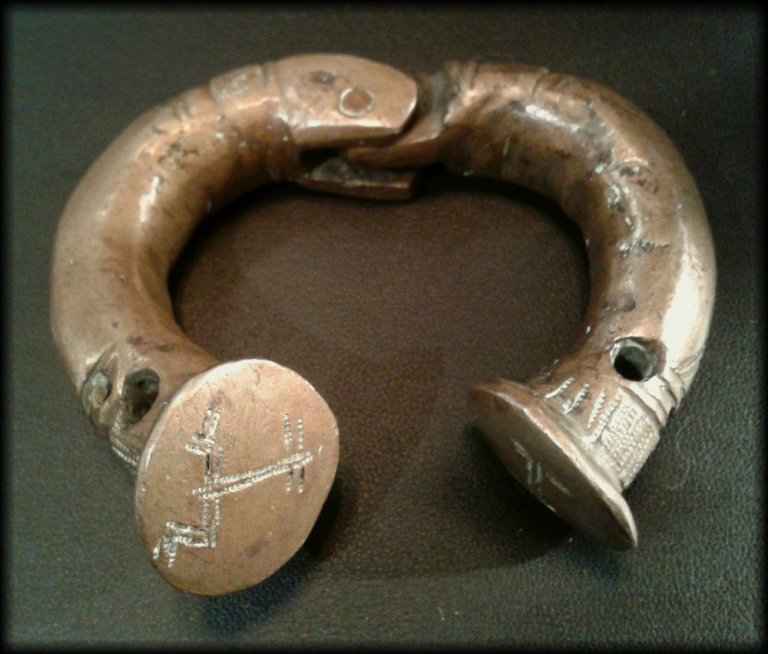
On October 1912, twelve years after the British assumed formal responsibility for administering the region known today as Nigeria, the West African Currency Board (WACB) was established (an equivalent of the Central Bank). The Colonialists needed a standard currency to aid economic exploitation as various currencies had existed in the various colonies they now administered. Examples of such currencies included Manilla of various shapes, cowrie shells, gold bars, and so on. Another major reason for the establishment of the WACB was that by 1910 the amount of silver coinage in circulation in the West African Colonies Nigeria, Gold Coast (Ghana), Sierra Leone and Gambia was almost equivalent to that in circulation in the United Kingdom and given the fact that cash transactions had began to replace barter and other forms of currency more money was needed in circulation. The Board was responsible for the control and supply of currency in the Gold Coast (Ghana), Nigeria, Sierra Leone and Gambia.
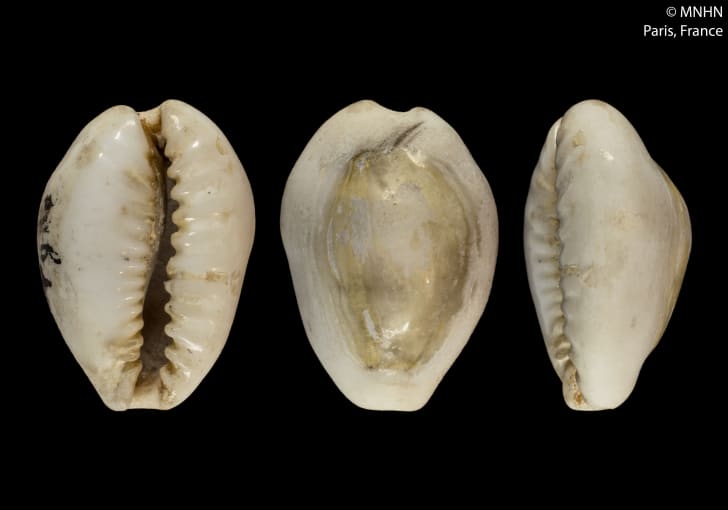
Credits: MUSÉUM NATIONAL D’HISTOIRE NATURELLE
The first cash notes issued by the Currency Board were 2, 10 and 20 shillings. A centre at Lagos was used for the circulation of currencies in the various colonies till each colony attained self government and independent status. In Nigeria, the Currency board was responsible for the circulation and control of currency till July 1959 when the Central Bank of Nigeria (CBN) was established.
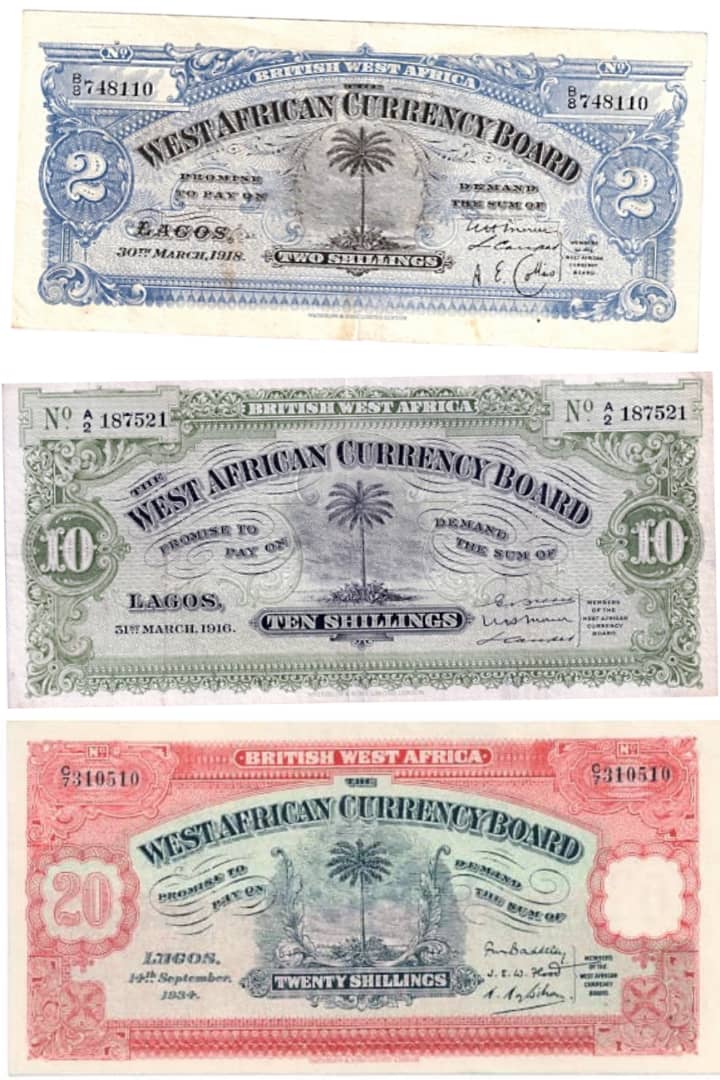
First issue of the 2, 10 and 20 shillings
Many currency notes have been issued by the CBN since 1959 till date, in fact studying the history of currency development may confuse you a bit if you do not get your sources right. The first currency notes issued by the CBN in 1959 were in the denominations of Five pounds, One pound, Ten Shillings and Five shillings, coins in the denominations of Two shillings, three Pence, One Penny and One half Penny were also issued the same year. Well looking critically at these new currency notes, the only visible change was the name of the issuing body; instead of the WACB you now had the the CBN and the Federation of Nigeria imprinted to indicate the independent status of Nigeria
In 1965, the currency notes were changed to reflect the country’s republican status. So instead of ‘Federation of Nigeria’, you now had ‘Federal Republic of Nigeria’ imprinted on each notes. The denominations of Five pounds, One pound, Ten Shillings and Five shillings were reissued in different colours from those of 1959. The coins in use were still the same ones issued in 1959. The notes all had the same pictures in the front but differed in the illustrations at the back.
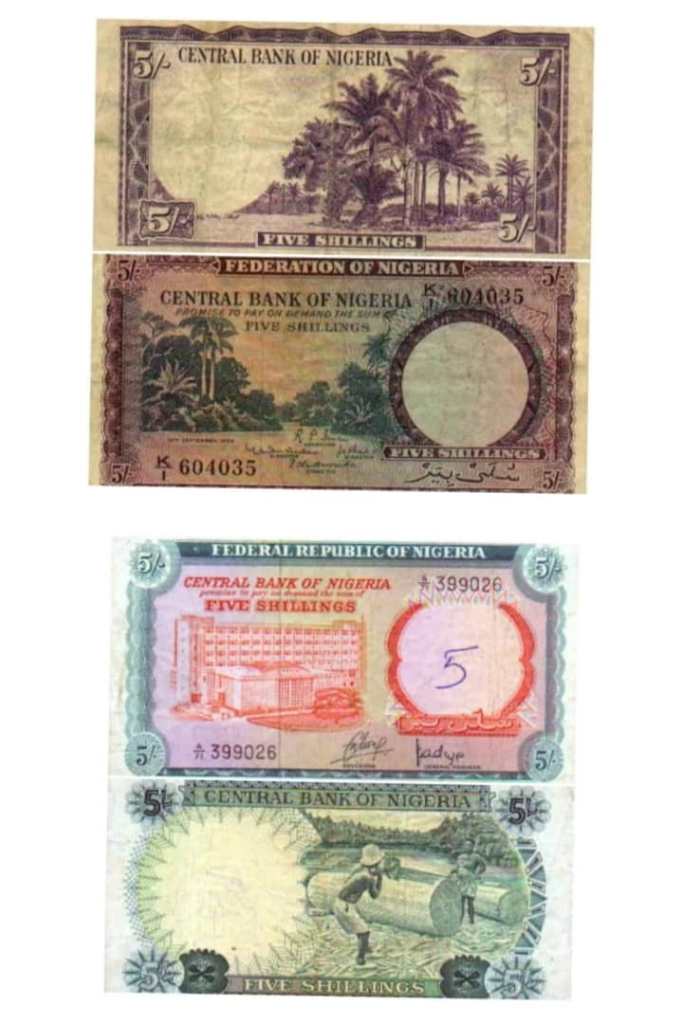
In 1968, Nigeria was fighting a civil war, hence as a war strategy, new currency notes were issued as an economic strategy to control the use of the country’s currency by the Biafrans during that period. The currency notes were in denominations of Five (5) Pounds, One (1) Pound, Ten (10/-) Shillings and Five (5/-) Shillings while the coins issued in 1959 remained the same. Nigeria made a great leap in changing to its own decimal currency on January 1, 1973, both notes and coins experienced this change. It was named Naira by Chief Obafemi Awolowo. This could be regarded as the real history of modern currency in Nigeria. Naira and kobo was rolled into the Nigerian economy with bank notes and coins. In 1973, we had ½, 1, 5, 10 and 25 kobo issued in coins, and 50kobo ₦1, ₦5 and ₦10 issued in bank notes. Yes you heard me right, 50kobo and 1 Naira were first issued in notes; the 50kobo notes were withdrawn from the market in 1978 and reintroduced as nickel plated coins in 1989.
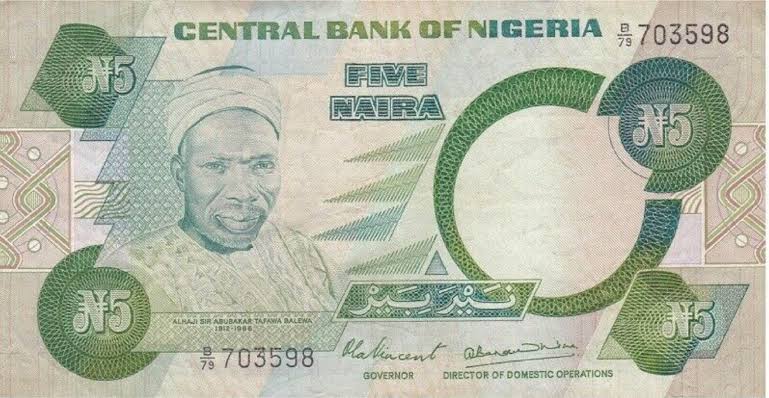
Okay, here’s the reason why the twenty Naira note is the only Naira note with the national colour, green. By July 1979 when the One, Five and Ten Naira notes were reintroduced in addition to the Twenty Naira previously introduced in 1977, the Five and Twenty Naira notes bore the colour Green, perhaps due to the fact that both notes bore the portraits of former Heads of Government (PM Tafawa Balewa and Gen. Murtala Mohammed) It was during the Buhari-Idiagbon regime in 1984 that the colours of the Currency notes were changed in an attempt to control money laundering. It was alleged by the government then that many politicians had been involved in hoarding raw cash embezzled during the previous administration. The changes of just the colours of each currency notes rendered such monies (yes I deliberately used this word ‘monies’) useless.
I know this week’s episode wasn’t really what you were expecting but next week, I shall conclude the episode we started last week thanks for reading through, let me know what you think in the comment section and put down your suggestion for my next post.


 Obaba Museum
Leave a comment