Hello 👋 thanks for always reading through and also contributing. This week we’ll be starting a series on the iconic images featured on the Naira notes and the story behind them. Before we proceed I just wanted to ask you, whose picture appears on the five Naira note? You probably haven’t seen it in the past five months😭😂 due to the constant inflation in the local economy. Unlike before where you could get a good bunch of candy🍬 with 5 Naira or even a loaf of bread for N20, today the relevance of icons imprinted on our currency is gradually coming to question. Let’s not even talk about the coins because that’s a story for another day.

We’ve decided to start with the twenty Naira note today due to the fact that it’s the oldest paper money still in circulation today or to be safe, as at the time of writing this 😉. You may wonder why is the twenty Naira note the only green Naira note today? Just relax and follow through.
On 11th February 1977, a new banknote with the value of twenty naira (₦20) was issued. It was the highest denomination introduced at the time as a result of the growth of the economy; and partly due to inflation. The banknote was the first in Nigeria to bear the portrait of a prominent Nigerian citizen, the late Head of State, General Murtala Ramat Muhammed (November 8, 1938 – February 13 1976) who was the torch bearer of the Nigerian Revolution in July, 1975. The note was issued on the 1st anniversary of his assassination as a fitting tribute to a patriotic son of Nigeria. On October 1, 1978 he was declared a national hero alongside Alvan Ikoku, Sir Tafawa Balewa and Sir Herbert Macaulay who respectively adorned the Ten Naira, Five Naira and One Naira notes issued on the 2nd of July 1979. Late Gen. Murtala Mohammed was one of the most charismatic figures in Post Civil War Nigeria, he was promoted to the rank of brigadier general in 1971, aged 33, becoming one of the youngest generals in Nigeria. In the coup d’état that brought him to power on July 29th 1975, he introduced the phrases ‘Fellow Nigerians’ and ‘with immediate effect’ to the national lexicon. Subsequent military coup speeches would be patterned with these flowery lexicons. In a short time, Murtala Muhammed’s policies won him broad popular support, and his decisiveness gave him the status of a folk hero. He was in fact the most widely celebrated Military Head of State among the common man in Nigeria.
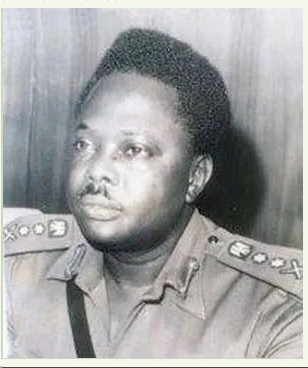
His father, Mallam Dako Mohammed, was an indigene of Igbe Village, in Auchi current day Edo State, but Murtala himself was born in Kano to a mother from the Kano royal family. The general loved his mother so much that on assumption of office as Head of State in 1975, he dropped his middle name, Rufai and chose Ramat, in her honour. He also married Hafsatu Ajoke, a Yoruba lady in 1963.
Nigeria under Murtala presided over a period of rampant economic prosperity. At the same time, his regime transitioned from being authoritarian into consensus decision-making with Murtala the leader of a military triumvirate, alongside Generals Olusegun Obasanjo (the Chief of staff Supreme Headquarters) and Theophilus Danjuma (Chief of Army Staff). The dictatorship softened and Murtala unveiled plans for the demilitarization of politics. In 1976 barely seven months into his rule Murtala without having time to see his plans implemented was assassinated in a failed coup d’ètat attempt, and was succeeded by Olusegun Obasanjo, who, in fulfilment of the solemn promise made by his predecessor, led the Nigerian transition to democracy with the Second Nigerian Republic on October 1979.
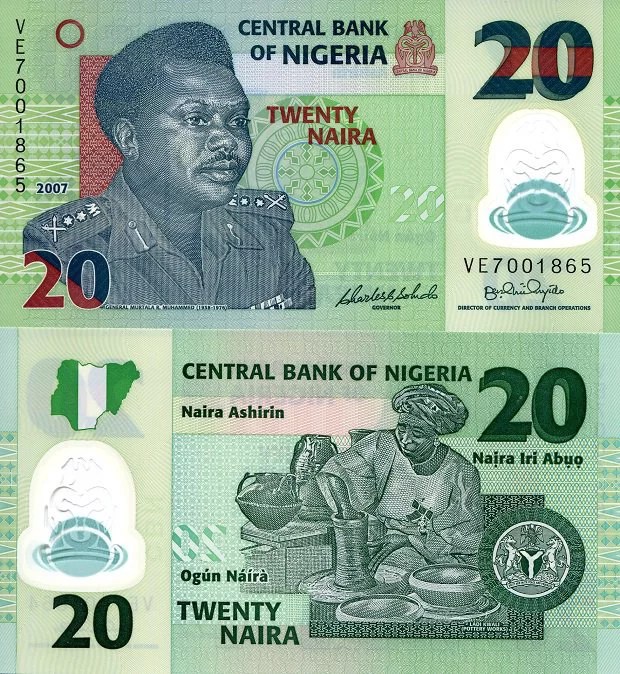
On February 28, 2007, new versions of the 20 Naira note was released in polymer, this new note, in addition to the portrait of Gen. Murtala, featured at the back the picture of Hajiya (Dr) Ladi Kwali, a talented potter from the village of Kwali in the Gwari area of what is now called the Federal Capital Territory, FCT. She was born in 1925 and though she never had a formal education, she was one of the most influential women of art. Growing up in a community where pottery was indigenous to the women folk, she first trained with her aunt in her village located in what is now the Kwali Area Council of the Nigerian Federal Capital Territory. Her talent was recognised early by the Emir of Abuja (now Suleja), Alhaji Suleiman Barau, who collected her pots for display in his palace where they caught the attention of the potter Michael Cardew during his 1950 tour in Colonial Nigerian.
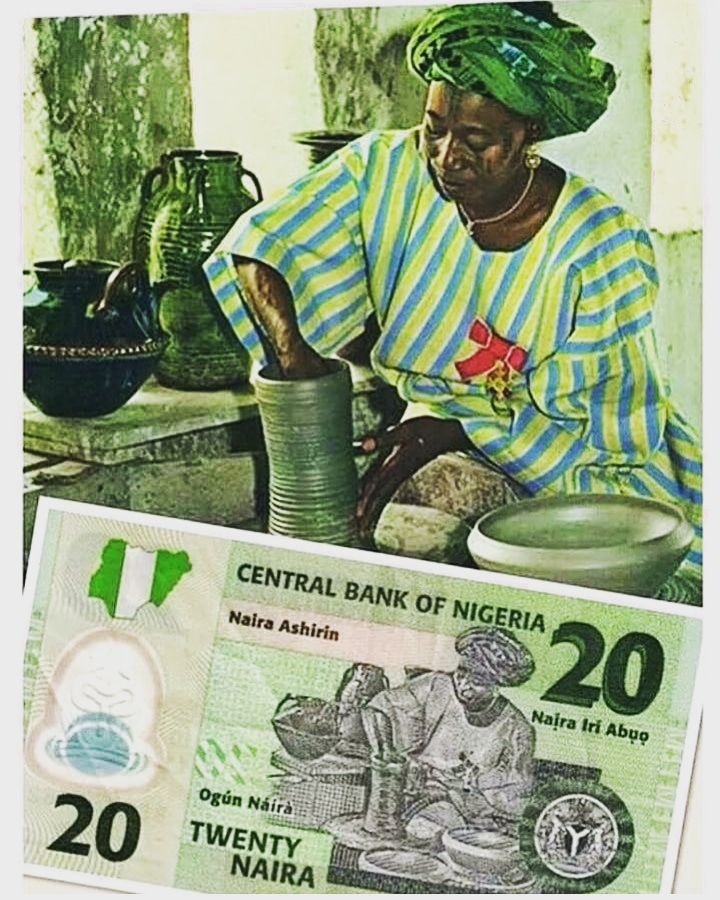
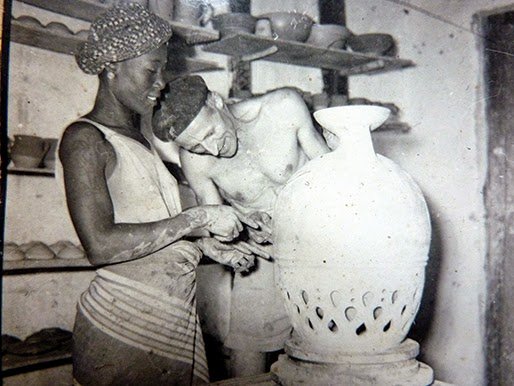
After M. Cardew founded the Pottery Training Centre (PTC) in Abuja in 1952, L. Kwali became its first female trainee in December 1954. She completed her training in January 1959 and was employed at the centre.
Although M. Cardew taught her wheel-throwing, L. Kwali used the centre’s stoneware clay to create pots using the traditional free-hand modelling technique in which she was adept, Cardew also learnt some of this traditional techniques from her. The rendition of schematised figures of scorpions, fishes, birds, snakes, chameleons, crocodiles and lizards on her pottery was a signature of Ladi Kwali.
Ladi Kwali was conferred numerous awards and tires during her lifetime. She was a Member of the Most Excellent Order of the British Empire, she was also received the National Honour of Officer of the Order of Niger in 1981. Although she could neither read nor write, she was awarded a doctorate degree by Ahmadu Bello University in 1977. Her story is one which shows true greatness in an African woman.


 Obaba Museum
Leave a comment